


Nepal records 11 new Covid-19 cases on Saturday
Nepal reported 11 new Covid-19 cases on Saturday.
According to the Ministry of Health and Population, 2, 083 swab samples were tested in the RT-PCR method, of which 10 returned positive. Likewise, 1, 277 people underwent antigen tests, of which one was tested positive.
The Ministry said that no one died of virus in the last 24 hours. The Ministry said that 90 infected people recovered from the disease.
As of today, there are 942 active cases in the country.

Nepal, India sign four agreements during PM Deuba’s India visit
Nepal and India signed four agreements during Prime Minister Sher Bahadur Deuba's three-day visit to India on Saturday.
The two countries signed agreements on International Solar Alliance, technical assistance related to railways, supply of petroleum products and technical expertise between Nepal Oil Corporation and Indian Oil Corporation.
Earlier, Prime Minister Deuba and his Indian counterpart held a one-on-one meeting at Hyderabad House.
The agreements were signed after the meeting between the delegation of two countries.
As per the technical assistance agreement related to railway, India will help in producing railway manpower.

PM Deuba, Indian PM Modi inaugurate Janakpur-Jayanagar rail service
Prime Minister Sher Bahadur Deuba and his Indian counterpart Narendra Modi inaugurated the Janakpur-Jayanagar rail service on Saturday.
The prime minister of the two countries jointly inaugurated the rail service by showing a green flag during a program organized at Hyderabad House, New Delhi this afternoon.
With the inauguration, the train will carry passengers regularly from Jayanagar to Kurtha from Sunday.
The train, which will run up to 35 km from Jayanagar of India to Kurtha of Janakpurdham, will be operated twice a day.

Ayodhi Prasad Yadav: Spending ceiling on poll campaigning should be removed
Political parties are gearing up for the May 13 local elections and busy selecting candidates for 753 local units across the country. Meanwhile, the Election Commission is also preparing. As the election date gets close, the past functioning of the local bodies is being evaluated and campaign spending is again under discussion. Kamal Dev Bhattarai talked to Ayodhi Prasad Yadav, the former chief election commissioner who successfully conducted the all three ties of elections in 2017.
What is your impression of the upcoming local elections?
This is a periodic election being held in line with the constitutional provisions. Even though there are contradictory provisions in the constitution and electoral laws, the Election Commission in the end decided to hold the polls before the expiry of the local governments’ term.
Holding elections in a timely manner would help institutionalize the new federal structure. People’s trust in federalism and republicanism will increase. The upcoming elections will further strengthen this political system.
How do you evaluate the first five years of local governments?
I recently visited some areas of Madhes and talked to common people. Frankly, they were not pleased with the performance of local representatives. Instead of focusing on public services, local representatives seem more interested in securing facilities and luxury for themselves.
In terms of resources, the local units are better equipped now than in the past. But this isn’t reflected in service delivery. There are many anomalies and problems in our society. The local governments haven’t been able to address them in a timely manner.
Most of them haven’t been able to meet the expectations of their local electorates. Some local bodies, however, were unable to work for a full five-year term, as the elections were held in multiple phases.
How can we improve the performance of local bodies?
Local governments have been heavily politicized, which has affected their work. To address this problem, we have to elect non-political representatives. Doing so will encourage independent candidates to enter politics. We can adopt a full proportional representation (PR) system in local governments. In many countries, local bodies have non-political representatives.
Political representation in local governments has led to poor public services and added economic burden. If a full PR system is adopted, we can address such problems. The first-past-the-post (FPTP) electoral system at the local level is creating a lot of problems.
What is the possibility of vote-rigging in local elections?
During the 2017 elections held under my leadership there were no reports of vote-rigging or fraud. There were some obstructions created by the Netra Bikram Chand-led group, and some political parties were also in protest. But we nonetheless managed to hold the elections in a fair manner.
But now, there is cut-throat competition. Candidate-selection process has become tough. This is because elected representatives get good facilities. More youths are active in politics as they want to get some positions in local bodies. So there is a high possibility of violence at some polling centers. Candidates have already started to influence voters and polling stations.
Elections have become expensive. How do we minimize electoral costs?
Candidates are spending a lot of money on campaigns. To address this issue, we have to remove the current FPTP system. If we adopt a PR system, it will help curtail election costs. The Election Commission has a ceiling for campaign expenditure. This means the state itself is encouraging parties and their candidates to spend money on election campaigns. Better remove the spending ceiling, which is unnecessary for a campaign that doesn’t last more than two weeks.
To bring change, we should create public awareness. I just returned from my village. There, the political parties and prospective candidates have already started organizing parties to woo voters. They are also distributing “fuel money” to the youths.
Another way of reducing election expenditure is by removing the provision of salary for local representatives.

Bangladesh sentences four to death for killing blogger in 2015
A court in Bangladesh has sentenced four people to death for killing a blogger and science writer critical of hardline religious thought seven years ago, Aljazeera reported.
Ananta Bijoy Das, known for his critical writings on religions, was attacked by masked men with machetes near his home in the northeastern city of Sylhet on May 12, 2015.
His murder happened only three months after US-based Bangladeshi blogger Avijit Roy was killed in a similar fashion by machete-wielding assailants in the capital Dhaka. Roy had founded a website called Mukto-Mona (Free Thinkers) for which Das also used to write.
Between 2013 and 2016, Bangladesh saw a series of deadly attacks on bloggers, secular activists and religious minorities, claimed by armed groups linked to ISIL (ISIS) or al-Qaeda.
While delivering the verdict on Wednesday, Judge Nurul Amin Biplob of the Sylhet Anti-Terrorism Tribunal told a packed courtroom that “if these accused are not given exemplary punishment, people of other terrorist, extremist ideologies will be encouraged to commit such killings”.
The four men given the death penalty for Das’s murder are Abul Hossain, 25; Abul Khayer Rashid Ahmed, 24; Faysal Ahmed, 27; and Mamunur Rashid, 25.
A fifth accused, Safiur Rahman Farabi, was acquitted for lack of evidence against him. However, Farabi is already serving a life sentence for Roy’s murder, according to Aljazeera.
Farabi and Rashid Ahmed were present in court on Wednesday when the verdict was announced, the remaining three convicts are absconding.
‘Fear and apprehension’
While delivering the verdict, Judge Biplob said Das was brutally murdered in broad daylight for practising his fundamental right to free speech.
“The main purpose (of the killing) was to spread fear and apprehension among writers who wrote or spoke about liberalism, progressivism, science and prejudice prevalent in the society through the brutality and horror of the killing,” he said.
Mominur Rahman Titu, special counsel for the state in the Sylhet anti-terrorism tribunal, said: “Justice has been ensured through this verdict. We are satisfied.”
However, another lawyer Misbah Uddin Siraj, who appeared on behalf of the prosecution, said he was “not entirely satisfied” with the verdict as Farabi was acquitted in the case, Aljazeera reported.
“We were able to prove Farabi’s guilt in court. However, I do not understand the reason for his release. We will appeal to the high court in this regard,” Siraj told Al Jazeera.
The defendants’ lawyer Abdul Ahad called the verdict “a serious violation of justice” and said he will appeal in a higher court.
“Abul Khayer was not involved in the killings,” he said. “At that time, he did not use Facebook or blog. He did not even know Ananta Bijoy.”
Das’s brother-in-law Samar Vijay Shri Shekhar was present in the court when the verdict was announced and called for speedy implementation of the verdict.
“Once the verdict is implemented, the family will get some relief. Besides, three convicts are fugitives. They should be arrested soon,” he told Al Jazeera.
Das, a banker by profession and the general secretary of the Council for Science and Rationalism of Bangladesh, used to edit a magazine called Jukti (Logic), besides being associated with Roy’s Mukto-Mona blog where he mostly wrote on evolutionary theories in science.
After Roy’s murder in 2015, Das feared he could also be killed by the same assailants and tried to flee the country. But he failed, according to Aljazeera.
In April of that year, he was invited to attend a press freedom event organised by the Swedish PEN organisation, but he could not get a visa for Sweden.
“Murders of Avijit or Ananta put a dent in the face of our nation. It was a slap in the face of secularism,” Bangladesh rights activist Nur Khan Liton told Al Jazeera.
“Yes, verdicts in both the cases have been delivered. But Bangladesh still fails to create a space where people can freely express their opinion without fear,” he said.
Sweden-based exiled Bangladeshi journalist Tasneem Khalil condemned the capital punishment given to Das’s killers. “It can never be a tool for ensuring justice. This horrible medieval practice has no place in a modern, civilised society,” he told Al Jazeera.
However, Khalil added that by “slaughtering” Das and other Bangladeshi rationalists, the killers “successfully ensured that religious issues are now a taboo topic in the country”.
“Very few, if any, dare to speak up on religion these days, lest they too are killed while the government watches from the sideline.”
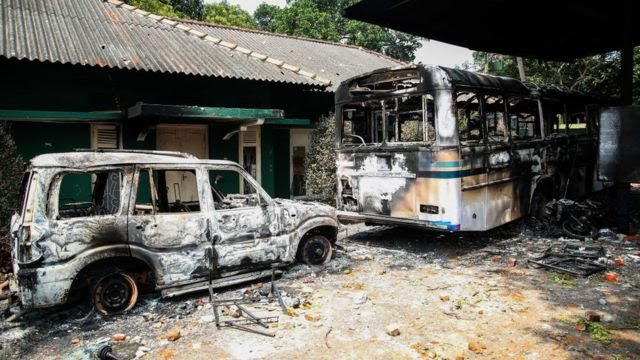
Sri Lanka imposes state of emergency amid protests
A nationwide state of emergency has been declared in Sri Lanka, a day after protests outside the president's house turned violent, BBC reported.
Protesters stormed barricades and have been accused of setting vehicles ablaze near President Gotabaya Rajapaksa's private residence on Thursday.
The military has since been deployed and now has the power to arrest suspects without warrants.
Sri Lanka is in the midst of a major economic crisis.
It is caused in part by a lack of foreign currency, which is used to pay for fuel imports.
Faced with power cuts lasting half a day or more, and a lack of fuel and essential food and medicines, public anger has reached a new high in the island nation of 22 million, according to BBC.
The protest outside President Rajapaska's house on Thursday began peacefully, but participants said things turned violent after police fired tear gas, water cannons and also beat people present.
Protesters retaliated against the police by pelting them with stones.
At least two dozen police personnel were reportedly injured during the clashes, according to an official cited by Reuters news agency.
On Friday, 53 demonstrators were arrested, and local media reported that five news photographers were detained and tortured at a police station. The government said it would investigate the latter claim.
Despite the crackdown, protests continued, and spread to other parts of the country.
Demonstrators in the capital carried placards calling for the president's resignation, BBC reported.

Will Smith resigns from Oscars Academy over slap
US actor Will Smith has resigned from the Oscars Academy after slapping comedian Chris Rock on stage during last Sunday's ceremony, BBC reported.
"My actions at the 94th Academy Awards presentation were shocking, painful, and inexcusable," his statement said.
The Academy said it accepted the resignation and would "continue to move forward" with disciplinary proceedings.
Smith slapped Rock over a joke about his wife's shaved head, a result of the hair-loss condition alopecia.
Less than an hour later, he was awarded the best actor award for his role in "King Richard", where he played the father of tennis stars Venus and Serena Williams.
"The list of those I have hurt is long and includes Chris, his family, many of my dear friends and loved ones, all those in attendance, and global audiences at home," Smith said on Friday.
"I betrayed the trust of the Academy. I deprived other nominees and winners of their opportunity to celebrate and be celebrated for their extraordinary work. I am heartbroken."
The actor said he wanted to "put the focus back on those who deserve attention for their achievements", according to BBC.
He concluded that "change takes time and I am committed to doing the work to ensure that I never again allow violence to overtake reason".
The Academy's president David Rubin said it had accepted Smith's resignation, but would continue its disciplinary proceedings.
Rock addressed the episode during a stand-up show in Boston on Wednesday, saying he was "still kind of processing what happened".
The comedian, 57, who is currently starring in his "Ego Death" tour of the US, was greeted with a standing ovation by fans.
Rock had earlier decided not to press criminal charges against Smith, reports say.
Smith's wife, actress Jada Pinkett-Smith, broke her silence in a brief Instagram post on Wednesday, writing: "This is a season for healing and I'm here for it."
Resigning from the Academy is a big deal. Membership of this illustrious, invitation-only body is seen as a mark of achievement in itself, BBC reported.
Only a handful of people have ever been expelled: they include Harvey Weinstein, Bill Cosby and Roman Polanski - although it wasn't clear that the same fate awaited Will Smith. He would have found out in a few weeks.
But the actor decided to seal his own fate, and forfeit his esteemed role as an Oscar voter - by quitting now. His mea culpa is strongly worded, but not the end of the story.
The Academy says its disciplinary proceedings will continue, which leaves open the possibility that he could be stripped of the Oscar he won on Sunday - although that seems unlikely - or he could be denied future appearance at Academy Awards ceremonies.
But Hollywood is a forgiving place, and Smith a hitherto well-liked character. Perhaps his next starring role will be opposite Oprah Winfrey, to explain all, according to BBC.

Russia aims Ukraine disinformation at Spanish speakers
Though Russia is the country that invaded its neighbor Ukraine, the Kremlin’s version relentlessly warns social media users across Latin America that the US is the bigger problem, Associated Press reported.
“Never forget who is the real threat to the world,” reads a headline, translated here from Spanish. The article, originally posted in late February on Twitter by RT en Español, is intended for an audience half a world away from the fighting in Kyiv and Mariupol.
As that war rages, Russia is launching falsehoods into the feeds of Spanish-speaking social media users in nations that already have long records of distrusting the US. The aim is to gain support in those countries for the Kremlin’s war and stoke opposition against America’s response.
Though many of the claims have been discredited, they’re spreading widely in Latin America and helping to make Kremlin-controlled outlets some of the top Spanish-language sources for information about the war. Russian outlet RT en Español is now the third most shared site on Twitter for Spanish-language information about Russia’s invasion, according to the Associated Press.
“RT’s success should be concerning to anyone worried about the success of democracy,” said Samuel Woolley, a University of Texas professor who researches disinformation. “RT is geared toward authoritarian control and, depending on the context, nationalism and xenophobia. What we risk is Russia gaining control of an increasingly large market share of eyeballs.”
US-based tech companies have tried to rein in Russian outlets’ ability to spread propaganda following the invasion, by banning apps linked to the outlets, demoting the content and labeling state-run media outlets. The European Union has banned RT and Russian state-owned Sputnik, Associated Press reported.
Yet the content thrives on Spanish-language websites, message boards and social media pages. While Russia also creates propaganda in languages including English, Arabic, French and German, it’s found particular success with Spanish-speaking users, according to recent research by Esteban Ponce de Leon, a Bogota, Colombia-based analyst with the Atlantic Council’s Digital Forensic Research Lab, a Washington think tank that receives funding from the US and other governments.
Russia’s discredited claims about Ukraine and the US include allegations that the invasion was necessary to confront neo-Nazis, or that the US has secretly backed biological warfare research in Ukraine. In fact, the US has long publicly provided funding for biological labs in Ukraine that research pathogens with the hope of curbing dangerous disease outbreaks, according to the Associated Press.
That type of disinformation can easily flow from Latin America into other countries — including the US— that have large Spanish-speaking communities. Sometimes it’s passed between relatives who might be sharing the claims across continents with one another. It’s another potential entry point for Russia, and a reminder of the sophistication of the Russians’ efforts.
’There’s different avenues where RT is actively engaging communities across Latin America and the United States,” said Jacobo Licona, a researcher at the Democratic firm, Equis Labs. “That’s part of the reason RT has been so effective, they’ve been building this network or community ahead of time.”
As one of the world’s most-spoken languages, Spanish is of obvious interest to any government or organization intent on shaping global public opinion. But Russia’s focus on the Spanish language goes further, reflecting the historic and strategic importance of Central and South America during the Cold War, said analyst Ponce de Leon of the Atlantic Council.
For decades, the Soviet Union sought to exploit historic tensions between the US and Latin America by supporting communist factions and larger allies including Cuba. Russia has sought to portray the US as a colonizing empire, even as the Kremlin has worked to strengthen its own ties to the hemisphere, Associated Press reported.
RT’s Spanish language service began in 2009, four years after its English language version. It has rapidly gained ground, and is now far more popular than its English counterpart. RT en Español has more than 16 million followers on its Facebook page, nearly triple the number of its English site.
High profile names in Latin America have in some cases given RT a hand. Ex-Ecuadorian President Rafael Correa began hosting a weekly political talk show for RT in 2018, less than a year after he left office. Since then he’s been convicted of corruption charges that forced him to flee Ecuador for Europe. Authorities in Ecuador have also accused him of trying to destabilize his successor’s government, according to the Associated Press.


