KMC rescues nearly 3,000 street people in eight years

The Kathmandu Metropolitan City (KMC) has rescued a total of 2,919 homeless people living in the street in the past eight years, officials said. 

The KMC began collaborating with the Manav Sewa Ashram on November 17, 2017 to rescue, manage and rehabilitate helpless street dwellers.

Ramji Adhikari, Chairperson of the Ashram, shared that of those rescued, 315 have died. 

Adhikari added that 713 rescued people were reunited with their families, while 336 have been reintegrated into their communities. 

Currently, 268 people rescued from KMC streets are sheltering in the Ashram, he added. 

Likewise, Sunita Dangol, Acting Mayor of KMC, said that the rescue program was being carried out as a part of the preparation to declare the city 'street people-free'. 

Dangol stressed that making such a declaration sustainable would require coordinated legal, administrative and practical measures.

Similarly, Bishnu Prasad Joshi, Chief of City Police Force, mentioned that efforts to identify and bring homeless people to Ashram continue. 

He shared that the KMC has already provided the Ashram with over Rs 28.73 million along with a dedicated vehicle during this period. 

Ashram's Chairperson Adhikari informed that the Ashram coordinates identification, recommendation and management of those left stranded in the street. 

He also added that people's representatives, KMC's administrative staff, City Police Force among others are actively coordinating efforts to rescue stranded street people.


Sudurpaschim government to promote alternative energy, efficient use of petro products

Sudurpaschim Province Chief Minister Kamal Bahadur Shah has said that the support and cooperation of all stakeholders are essential to ensure a smooth supply chain of essential goods, including petroleum products and cooking gas.

Speaking at a meeting held today at the Office of the Chief Minister and Council of Ministers, he stressed the need to intensify market monitoring to prevent any attempts to disrupt the supply of essential goods and services. 

He stressed that stakeholders must work together to maintain an efficient and reliable supply system.

CM Shah also added that the monitoring committee, formed under the Consumers' Protection Act, its regulations, and other prevailing laws, should play an active role in preventing supplies of goods on the black- market, artificial shortages, and the sale of goods at inflated prices.

The meeting, chaired by the Chief Minister, decided to take strict action against anyone found involved in supplies on black-market, creating artificial shortages, or charging higher prices.

It also agreed to promote the efficient use of petroleum products and cooking fuel, reduce unnecessary consumption, and encourage the adoption of alternative energy sources.

Furthermore, the meeting reassured the public that there are currently no disruptions in the supply of essential goods and urged people not to be misled by rumors. 

The meeting was attended by secretaries from various ministries, Chief District Officer of Kailali, Hiralal Regmi, Chief District Officer of Kanchanpur, Madan Koirala, senior officials from the security agencies, representatives from the trade sector, and LP gas dealers, among others.


RSP President Lamichhane urges newly elected MPs to serve nation, citizens responsibly

Rastriya Swatantra Party Rabi Lamichhane has called upon its 182 newly elected Members of Parliament (MPs) to serve the nation and citizens responsibly.  

Lamichhane stressed that the MPs must respect the mandate given by the public in the March 5 election to the House of Representatives. 

Addressing an orientation program organized by the RSP in Lalitpur for its new lawmakers, President Lamichhane made it clear that no one has the right to make irresponsible statements or treat the public's mandate as of entertainment value. 

He urged the MPs to speak thoughtfully in the media. "While speaking, consider the impact of your words on foreign relations. Strengthen your relation with citizens," the party boss instructed.

He called on the new legislators to review the pledges the party made to the public. 

"We bear the responsibility of building the nation and bringing about meaningful changes. We must fully respect the mandate given by people and work towards positive transformation," he reiterated.


Israel strikes kill top Iranian leaders

Israel confirmed the killing of Iranian official Esmail Khatib, following strikes that killed top security official Ali Larijani and Basij force chief Gen. Gholam Reza Soleimani, AP wrote.

A senior Israeli intelligence official said Soleimani was targeted while hiding in a tent under trees, signaling that Iranian leaders “have no safe place.” Defense Minister Israel Katz warned of “significant surprises” across all fronts, without giving further details.

Journalist killed in Beirut strike

Mohammed Sherri, a senior journalist with Hezbollah’s Al-Manar TV, and his wife were killed in an Israeli airstrike in central Beirut’s Zokak Blatt neighborhood, AP reported.

Their children and grandchildren were injured. Sherri was a long-time political program presenter at the station.

Nepse surges by 13. 51 points on Wednesday

The Nepal Stock Exchange (NEPSE) surged by 13. 51 points to close at 2, 812. 34 points on Wednesday. 

Similarly, the sensitive index dropped by 2. 14 points to close at 482. 56 points.

A total of 34,852,760-unit shares of 340 companies were traded for Rs 1. 62 billion.

Meanwhile, Reliance Spinning Mills Limited (RSML) and Solu Hydropower Limited (SOHL) were the top gainers today with its price surging by 10. 00 percent.

Similarly, NIC ASIA Growth Fund-2 (NICGF2) was the top loser as its price fell by 4. 74 points. 

At the end of the day, the total market capitalization stood at Rs 4. 76 trillion.

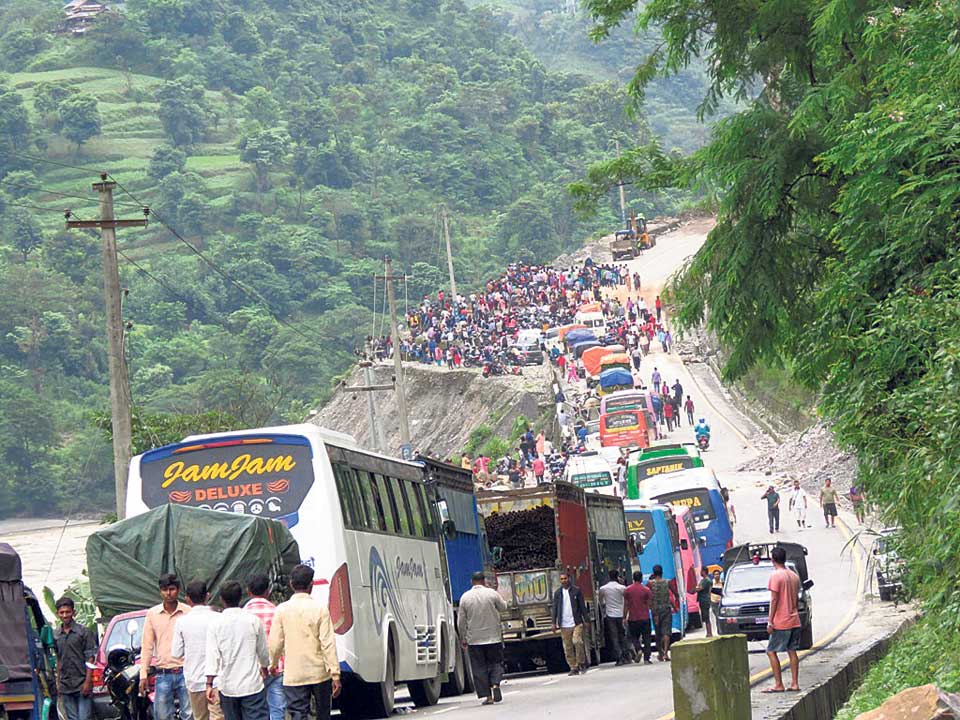
43 places of Narayangadh-Muglin road at risk of landslide

A total of 43 places along Narayangadh-Muglin road section have been identified as at risk of landslides, according to a recent study conducted by the Road Division Office, Bharatpur.

The study found that eight locations are at high risk, 22 at moderate risk, and 13 at low risk. Among them, Tuin Khola has been categorized as a particularly high-risk area.

Office engineer Arjun Ghimire shared that Kali Khola and Namsi Khola, along with Tuin Khola, are among the most vulnerable areas of this 33.25 km-road section. 

Ghimire added that other high-risk areas include the stretch between Tuin Khola and Chisenji, two locations at Char Kilo, Mauri Khola and Seti Dobhan.

He explained, "Falling rocks are a major problem between Tuin Khola and Chisenji while areas near Tuin, Kali, and Namsi rivers are highly prone to landslides."

Ghimire further mentioned that of the two locations at Char Kilo, one faces landslide risks and the other is vulnerable to mudflows. Mauri Khola and Seti Dobhan face high risk of debris-filled landslides.

Additional areas identified as risk-prone include Sohra Kilo, Satra Kilo, Dumre Khola and Simaltal. These areas have been under the threat of landslides since last year. 

Narayan Lamichhane, Chief of the Road Division Office, Bharatpur, said that they have already submitted a procurement master plan to the Department of Roads to mitigate landslide risks in the Tuin, Kali, and Namsi rivers while the design process is in its final stage. 

He shared that Rs 250 million has been allocated from the disaster management funds to implement disaster risk reduction measures in high-risk areas, with an additional Rs 200 million has been set aside for other vulnerable sections along the road. 

According to Lamichhane, a budget of Rs 200 million has been allocated for landslide prevention in other areas as well.

Stating that preparations have been made for a tender for landslide prevention works, he said the mapping work is complete, and the tender will be called in a few days. 

Landslide prevention and mitigation work will be carried out in risky areas before the monsoon, he added.

The Office has said that it has made the necessary preparations as roads may be at risk of landslides with the onset of the rainy season.

A few years ago, the earth on the slope above the road was cut during road expansion. 

The road traffic is interrupted during the rainy season when the debris from the slope cut during the road expansion and landslides from new areas fall on the road.

More than 10,000 vehicles pass daily along this road. This road is considered a lifeline for the federal capital, Kathmandu.


Nepal, Germany break ground on 220 kV Lekhnath–Damauli transmission line

The Nepal Electricity Authority (NEA), in partnership with the Government of Germany, today inaugurated the groundbreaking ceremony for the Lekhnath–Damauli 220 kV Transmission Line Project at the Damauli Substation in Tanahun District.

NEA Managing Director Hitendra Dev Shakya,  German Ambassador to Nepal Udo Volz,  Director of KfW Development Bank for Bangladesh and Nepal Michael Sumser, as well as senior representatives from NEA, the German Embassy, KfW Development Bank, GIZ, local governments and other key stakeholders attended the ceremony. 

Co-financed by Germany through KfW Development Bank, the project includes the construction of a 45 km long 220 kV double-circuit transmission line and the development of modern gas-insulated substations in Lekhnath and Damauli, reads a statement issued by the German Embassy in Kathmandu. 

With a transmission capacity of around 1000 MW, the project will strengthen the regional electricity grid and enable efficient evacuation of electricity from hydropower plants in the region, including the Tanahun Hydropower Project.

“The expansion of reliable transmission infrastructure is essential for Nepal’s growing energy needs,” said Ambassador Udo Volz. “Germany is proud to partner with Nepal in strengthening its electricity grid and enabling the use of its vast renewable energy potential. Projects like this ensure that clean energy reaches homes, businesses and industries, contributing to sustainable economic growth.”. 

Germany has also supported renewable energy solutions ranging from household solar systems and solar irrigation to grid-connected solar installations, contributing to around 55 MW of solar photovoltaic capacity in Nepal.  

In Gandaki Province, German Technical Cooperation has supported Pokhara Metropolitan City in developing a five-year Municipal Energy Plan to guide efficient energy use and the adoption of clean energy technologies. 

German Technical Cooperation has also supported the establishment of two electric vehicle charging stations in Pokhara and Damauli and the integration of two micro-hydropower plants in Baglung into the national grid of the Nepal Electricity Authority.

Reliable transmission infrastructure such as the Lekhnath–Damauli line provides the foundation for greater use of clean electricity, including electric mobility and other low-carbon solutions, supporting Nepal’s ambition to reduce reliance on imported fossil fuels.