


Throwing some light on the broken street lights

A broken street light on the road you regularly walk on can be a great nuisance. It also encourages criminals. In their paper “The influence of street lighting on crime and fear of crime,” Stephen Atkins, Sohail Husain and Angele Storey argue that good street lights increase opportunities for surveillance and encourage people to notice suspicious activity, thereby acting as a deterrent for criminals.
Though there are street lights right around Kathmandu valley, many of them don’t work. Instead of blaming the government for not fixing them, Youth Innovation Lab (YI-Lab), a non-profit civic tech company have, in coordination with NAXA, a Kathmandu-based geo-IT company, launched the ‘LightsON’ campaign to map street lights of Kathmandu valley. The mission is to put pressure on the Kathmandu Metropolitan City to come up with the right policy to ensure periodic maintenance of street lights in Kathmandu. Anyone in Kathmandu valley can contribute!
The campaign was launched on the International Open Data Day on March 2, with an ambitious goal of collecting data on 10,000 street lights of Kathmandu valley by engaging digital volunteers. YI-Lab sees open data as a tool to ensure bureaucratic accountability. For those who do not understand open data, you can think of Wikipedia. Users do not need to sign-up or login to view its contents and they can also edit the information with references so that others can benefit from the available content. There is no fee to use, or contribute on, such platforms.
YI-Lab came up with the idea of mapping street lights and help-ing local governments use data to solve this urban challenge. NAXA then developed a mobile app and an interactive web interface to support this campaign technically. Pradip Khatiwada, the executive director of YI-Lab, reveals that they current-ly have data on 2,500 street lights collected through crowd sourcing. The campaign aims to collect infor-mation on 10,000 street lights by August. College students are being informed and trained to use the mobile app through which they can contribute.
Currently, “Lights On” application is only available on ‘Play Store’ and anyone with a smart phone and an email account can download it for free. The data the user has collected is recorded and verified via their email addresses. When a new mem-ber logs in, he or she can contribute by filling the ‘Street Lights Form’ in which they will be asked the details, such as the location of the street light, its functionality, and the status of the pole.
The user should take a photo of the street light for evidence and the precise location of the street light is established with the help of GPS. This can even be done offline. When the user has internet access, they can upload the data through the app. The data is made open and visualized through an interactive digital map at light.utilitymaps.org.
There were a few challenges in crowdsourcing for the project. The team behind this initiative informs that when the first batch of 30 col-lege students were oriented on the campaign, the students were momen-tarily excited. However, when they were asked if they would contrib-ute to the initiative, only four raised their hands. Their reluctance to con-tribute suggested an incentive was necessary. Now, those who contrib-ute data on 100 street lights get a campaign T-shirt and a certificate mentioning that they are ‘Digital Vol-unteers’. This has led to a dramat-ic rise in data collection, informs the team.
YI-Lab’s Khatiwada says that in developed countries broken street lights are fixed within 24 hours. But in Nepal there is seemingly no one to take care of the street lights after they are installed. Thus a related goal is to present the collected data to the mayor’s office for urgent action. Khatiwada claims this is not a compe-tition and they just want to help the government do its job better through evidence-based data.

Quick retreat at Grand Norling Resort
If you want a quick getaway but are not up for a long drive from Kathmandu, the beautiful and serene Grand Norling Hotel’s Resort might just be for you! It’s located at Dakshin Dhoka, Mulpani, Sankhu Road, with the Tribhuvan International Airport 6.5 km and Boudhha 3.5 km away. Despite being so close to the city, you feel like you are far from city noises when you enter.
You get a panoramic view of the Gauri Shankar mountain range from garden and rooftop. Some rooms here even offer a fantastic view of the Gokarna golf course. While you are enjoying dinner outside in the garden, you will most likely catch sight of reindeers, stags and some amazing birds. This resort is also surrounded by World Heritage Sites if you are interested in visiting the ones nearby. Bajrayogini temple, Boudhanath Stupa and Pashupati Temple are easily accessible.
Seventeen years into its establishment, the resort has always aimed to provide excellent hospitality at an affordable cost. Among its many features are air-conditioned rooms, a business center, and banquet facilities. If you suddenly want to hire a car to go somewhere, you can do that too. There is an on-site convenience store along with a restaurant that fulfills your cravings. A barbeque night with your loved ones is recommended.
The modern yet traditional décor of the hall, rooms and banquet gives it an opulent look. Rishi Kumar Singh, the operations manager at the resort says, “On the whole, the theme is Tibetan. But we have also given some rooms typical Nepali looks.” Pointing at the many beautiful and intricate art pieces on the walls, he says art is given due space at Norling.
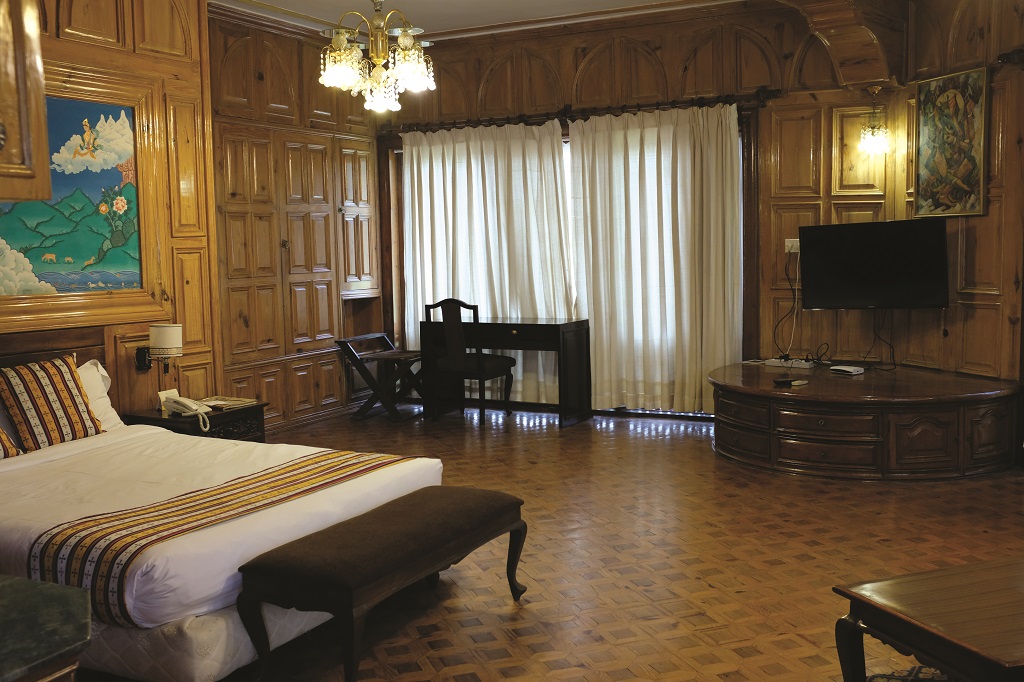
He adds that although the resort was established in 2002, it has only recently become popular thanks to its energetic marketing team. “Now you do not even have to go as far as Nagarkot or Dhulikhel to find a place to be one with nature,” he says.
What about room prices? Singh says the resort wants to make them affordable. According to him, the resort focuses on providing top ser-vice, a neat place, a relaxing ambi-ence, and good food. The hotel currently has four categories of rooms: deluxe, cottage, standard and suite. A cottage room costs Rs 5,500 inclusive of breakfast and taxes. Even for comparably small-er cottage rooms, the resort pro-vides all the facilities required for a great stay. “Once you enter a cot-tage room, you feel like you have time-traveled 50-60 years back,” says Singh. This room gives off a homely vibe.
Similarly, standard and deluxe rooms cost Rs 6,500 per night. There are twin beds available in standard rooms, which are spacious. Singh says guests at Norling usually come with family and wish to share a room and have fun together. Suites are largest available rooms. Their paintings and décor give off a royal vibe. The bathroom and balcony in suite rooms are as big as standard hotel rooms. The resort even has a swimming pool, which is open to the public. For those who just want to come for a swim, the cost is Rs 650 a day. (Periodic memberships are also available.) For those who take a room, you can go for a dip for free. Be it a business meeting, a quick retreat, or a scenic getaway, Norling does not disappoint.

Weekend monsoon
Without getting into the whole climate emergency debate: what has happened to the monsoon? A couple of weeks ago I, and others, assumed it had arrived. Heralded as usual with a good deal of thunder and a lightning display. That was a Friday night. Sure enough the next day, deluge. By that Saturday evening, I was like “I’m over the monsoon now”. Someone must have been listening as next day, dry as a bone. Pretty dry all the way to the following Saturday. With little rain since, I’m prompted to wonder—what has happened to the monsoon?
Meantime, over in Europe I am sure they are asking the same question: Where is the rain? Temperatures have reached over 40 degrees in France. Unheard of. In fact, it is now ‘official’—June 2019 is the hottest June on record. Hottest ever—not just in France, but globally. Now if that doesn’t point to something being wrong, what does? We have seen temperatures in India reach the high 40s and cities—not just rural communities but whole cities—running out of water. Which makes me rethink my complaints about it being 33C in Kathmandu and at one point last month (in June no less) having no water at home for three days.
The sky gets dark, clouds roll in. Daily I look up and think, here it comes. My weather App predicts thunder storms on an hourly basis, and every day. And yet nothing happens. What has happened to the monsoon?
It was only a couple of months back when I was saying—what has happened to the summer? Winter seemed to go on f-o-r-e-v-e-r and spring never did put in an appearance. Now as the temperature in my apartment hardly come down below 26 or 27, I’m thinking back fondly to the days of wearing a sweater as I wrote this column!
Many homes in Kathmandu have fans. Some even have air-conditioning. I must admit I love my local café which, despite being on the expensive side, has heat in the winter and glorious a/c in the summer! I’ve been surprised by the number of friends who are installing a/c in their homes this year. Ordinary people looking for relief from the heat. And yet some bars and restaurants still decline to install even a fan.
Do they think we will buy more beer because we are hot? More likely, in my case anyway, I will leave half-way through the evening feeling quite ill with the heat. Or completely boycott the place. Last week I was in an open air restaurant in Patan for a music event. They had huge fans going—enough to keep everyone cool. In fact one could say it was particularly ‘breezy’ in that courtyard! But rather that than the alternative.
The last two Fridays and Saturdays saw heavy monsoon-like downpours. But it was only heavy rain. Despite me describing the downpours as “Niagara Falls” it was not the monsoon. Now it is a whole month late. What has happened to the monsoon?
I learn that women in the Tarai are praying to the rain gods. Desperate to get on with planting rice to feed their families for the rest of the year. Goodness knows what people across the border in India are feeling as they stare into empty wells and at dry taps. Let’s hope by the time you are reading this, in the middle of July, the monsoon will have made its full-strength appearance.
In the meantime, has anyone else noticed: the rain seems to cascade in torrents mostly on Fridays and Saturdays? A rain god perhaps that only works at the weekend! Could this be Nepal’s seventh season—Weekend Monsoon?

Add zing to your life with this new fitness formula
The year is 2010 and I’m rocking Zumba. But not as much as the 20-somethings in the class. One in particular stands out. That’s where I first met Priti Rai Shrestha—on the fitness floor at Salsa Dance Academy. Scroll forward a few months and we meet again. This time Shrestha is killing the Pilates class while I struggle with my 100s. By then Shrestha is a qualified Zumba instructor and about to undertake Pilates training from the then only qualified instructor in Nepal, Nina Sherpa.
Although we are firm friends, our fitness paths diverted about five years ago only to come together again recently both in the Pilates studio and in the pool. So I wanted to know how this woman became one of only a handful of properly trained female fitness instructors in the country.

“When I started going to Zumba I was working in an office in Panauti. But when I started college I couldn’t continue working full time. Thankfully the owner of the Salsa Dance Academy offered me a job as a Zumba instructor—on the condition that I passed the training in Hyderabad,” explains Shrestha. That training was only the start of her fitness career. Expanding into Pilates—an exercise form emphasizing balanced development of the body through core strength, flexibility and awareness first developed by Joseph Pilates in the 1920s—Shrestha was getting requests to undertake personal training.
“At that point,” Shrestha continues, “I realized I needed to know more about how the body works and obtained online certification from the National Academy of Sports Medicine, USA and from the Athletic and Fitness Association of America.” Not content with online certification, she attended training in Malaysia, Singapore and India. These trainings included Pilates certification in ‘classical’ and ‘reformer’ Pilates, as well as Crossfit, Piloxing, Veraflow and Spinning. That’s in addition to a degree in Exercise Physiology from Capella University, Minnesota.
While Shrestha was building her knowledge of fitness training and how the body works, this writer had fallen behind in all forms of exercise. So I was excited to meet Shrestha again—this time in the aqua aerobics pool. As far as I am aware, despite there being advertised “Zumba pool parties” there is only 2 or 3 other qualified instructors in aqua aerobics (aerobics done in water) in Nepal. “I am certified by the Aquatic Exercise Association, and I now am perusing lifeguard certification. Which is challenging as there is limited training in Nepal,” says Shrestha. Meantime, now working at the American Mission Association, Shrestha is also trained in emergency CPR and AED.
So here we are, nine years later. Me nine years older and correspondingly less fit (which will change now that I’m hitting the aqua pool)! Shrestha more mature in her attitude towards fitness. I ask about her future plans.
“Nina Sherpa is returning to Nepal to provide Reformer Pilates training and open a studio...” Wait a second—let’s just qualify what Reformer Pilates is. Shrestha laughs, “That’s where machines are used in Pilates. Regular Pilates involves mat work on the floor. Reformer Pilates involves using specially designed machines.” Sounds intense!
“My future plans are to design and develop Pilates’ instructor training and provide it to people around the country,” explains Shrestha. “Pilates is all about injury prevention. While other forms of fitness can cause injury, especially as we age, Pilates corrects posture, improves core strength and prevents injury. And it can be adapted for all age groups.” Already making headway in designing this course, she hopes this will ultimately improve overall fitness at community level.
As Shrestha points out, there is no end to building knowledge of how to prevent injury in fitness clients. And as one of those clients I can say, there is no end to aging and even the best athlete will reach a stage where core strength is more beneficial for daily life than running the fastest 100 metres!
For further information contact Shrestha at [email protected]


