


Decolonizing museums, repatriating Nepali heritage

At this point, it is hard to be surprised when stolen objects from Nepal are found in museums in the West. Art historians and academics have altered us about the theft for decades now. And yet this past year has been different. Stories of repatriation to Nepal have only been outpaced by stories of web-savvy Nepalis locating yet more stolen objects in collections abroad.
More objects being found, sustained media focus, decent government responsiveness, and museums willing to at least acknowledge the problem. So what’s different? Why is there such a sense of indignation when activists find one more object in a foreign museum? And what might the current focus tell us about building and sustaining a movement to keep pressure on museums and the Nepali government to ensure Nepal's heritage is returned to its people?
The murder of George Floyd reignited the conversation on race relations. The Black Lives Matter protests brought home the frustrations against the enduring legacy of white supremacy. It is to this movement that the renewed conversation of repatriation of Nepal’s stolen objects owes a partial debt. The movement towards racial justice in the West opened the space to critically examine the role of museums in feeding a culture that fetishizes other people and their faith.
At first, a surge in finding so much of our heritage looted and displayed abroad is horrifying, yet ultimately this is a necessary and welcome step. At a time when there is little Nepalis agree on, it's almost exhilarating to find an issue about which we are on the same page. As in any healthy public sphere, we might disagree on the details—Who should lead the charge? How do we secure the idols from going missing again? What objects should we prioritize? But by and large the janta now speaks with one voice: We want our heritage back!
There is, however, the occasional troll who will argue that these objects are safer in the West and therefore should remain in foreign lands. But such self-deprecating arguments can be safely ignored. It would be like allowing bankers to rob people and invest the money because they are better money managers.
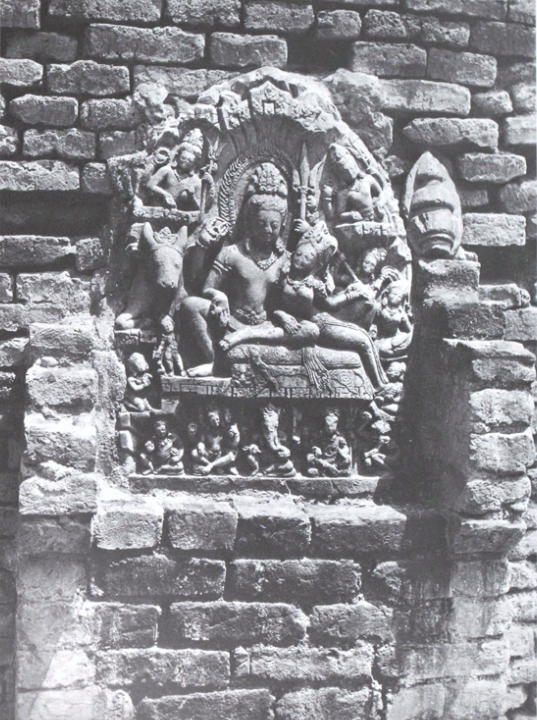
In situ picture of the Uma Maheshwara, taken from Lain Singh Bangdel's ‘Stolen Images of Nepal’
Besides tapping into this specific socio-cultural moment in the West there are more obvious and inward-looking reasons that have allowed for a surge in finding our heritage abroad.
The groundwork for current efforts was put in place by giants like Lain Singh Bangdel, Jürgen Schick and Ulrich Von Schroeder. They collected and published photographic evidence of objects in situ, in their original place, which is essential to any claim for repatriation. This is a huge asset when asserting Nepal’s claims. Building on this foundation, digitization efforts like the Global Nepali Museum, the Huntington Archive, and the Remembering the Lost projects have democratized this data. This in turn has allowed researchers, professionals, and amateurs alike to dig into provenance history and compare museum photos with in situ objects.
Nepali social media can be a vicious space. Abuse galore. But ever so often Nepali Twitter bands together to amplify issues that encourage a national sense of self. And this is an important reason why the groundbreaking research done by Twitter handles like the Lost Art of Nepal are able to reach thousands of people across the globe, especially when English and Nepali journalists pick up the story.
It is also encouraging that the state—the Ministry of Foreign Affairs, the Department of Archeology, local governments, and concerned embassies—have been fairly responsive and make official inquiries as follow-ups to news of objects' rediscovery. The recent announcement by the DoA that they have completed the paperwork required to begin the repatriation process for 26 objects in the UK and France is highly encouraging. We hope to see this being expanded to include objects discovered in the MET, Art Institute of Chicago, and the Denver Art Museum.
This moment of global reckoning with colonial history has emphasized the need to question the arrogant concepts of “encyclopedic” and “universal” museums. Collections filled with objects stolen from other communities don’t make for very inclusive educational institutions.
Across the globe formally colonized people are asking for what is rightfully theirs. Nepal is no exception. The aphorism “Nepal was never colonized” is a double-edged sword. It reasserts an important part of history while simultaneously distorting it. Nepal cannot shy away from articulating its assertions in terms of the larger narrative around decolonization because “we weren’t colonized”. True, but that’s a gross misunderstanding of how cultural imperialism works. And it is simply a bad strategy.
Nepal and Nepalis should absolutely engage in and interpret socio-cultural moments in the West that allow it to act on its own interests. We ought to reassert ourselves as a shaper of the global conversation on this issue, rather than being mere recipients of it.
Having navigated the age of imperialism in relative isolation, Nepal entered the age of decolonization unsure of its role and place. Compared even to our neighborhood, we were poorer and far-worse educated, and with less interaction with the outside world. When it did open its borders in the 1950s people and ideas—of “progress”, “civility”, and development”—rushed in. In this new world, indigenous episteme—a system of understanding—was challenged and dismantled, from those outsides and those within. It has taken us a few decades to come to grips with it.
Nepal in 2021 is different. Compared to any other time in our history, Nepalis are more literate, more tech-savvy and there are simply more of us around—at home and abroad. That access to knowledge is leading more Nepali to ask questions about their history. Why were objects of reverence so discourteously taken away and housed in museums? How did we get here? And who allowed it? This questioning of the past is welcome.
Nepalis, when empowered with the right tools, are able and willing to fight to have their heritage returned to them. But success will depend on how we organize and articulate our sense of loss and assertions.
The Portland, Oregon-based author is co-founder of the Nepal Pride Project

Opinion | No need to fear China (for the next 20 years)
While addressing the function to mark the 100th anniversary of the Chinese Communist Party on July 1, President Xi Jinping warned that “the Chinese people will never allow foreign forces to intimidate us… Whoever harbors illusions of doing this will break his head and spill blood on the Great Wall of steel...” (Translation, The New York Times). Towards the end he stated, “resolving the Taiwan question and realizing China's complete reunification is a historic mission and an unshakable commitment.” But in the official English translation of the speech the part about ‘blood and broken head’ is missing. There are multiple interpretations of why this happened: some say the English translation is toned down, while others argue that these four-word idioms are used to express exaggerated consequences, and most are not to be taken literally. I tend to go with the second argument. Usually, a word-by-word translation of Chinese idioms doesn’t make sense.
However, sensing whom it was directed at, the US delivered an answer through Japan’s Deputy PM Taro Aso on July 6: “If a major incident happened [in Taiwan], it would not be strange at all if it touches on a situation threatening survival. If that is the case, Japan and the US must defend Taiwan together.” Now, this could make some of you who rely on the western “liberal” news sources feel that China is on a collision course with the world and militarism has taken over China. Or, it is planning a military move on Taiwan. Relax. It’s not happening. At least not for the next 20-plus years.
Despite the alarming news reports and Western think tanks’ analyses, China would want to resolve its issues with others without having to fire a single bullet. No, it has nothing to do with the ancient military strategist Sun Tzu’s maxim, often translated as “the supreme art of war is to subdue the enemy without fighting.” It has more to do with China's social and military realities.
According to a news report published in the Beijing Evening News on 15 August 2011, a big chunk of China’s military is made up of soldiers from one-child families. It quotes Prof Liu Mingfu of the National Defense University as saying, approximately 70 percent of the Chinese military and 80 percent of its combat troops belong to one-child families. Another news report “Soldiers of the one-child era: are they too weak to fulfill Beijing’s ambitions?” published in the South China Morning Post (SCMP) 6 Feb 2014 and translated by many news portals in China, further quotes experts on whether the one-child recruits are best suited to advance China's security interests. It too mentions Prof Liu and his data, but this time as having stated those numbers “in a public report to the central government in 2012... the high proportion of only-child soldiers is a strategic fear to China's long-term security despite the military coming up with special training for spoiled children to strengthen combat effectiveness.” The importance of this report is evident from the fact that the translated version was uploaded on the People's Daily website and is still accessible.
Let's not get into the other points raised in the aforementioned pieces such as “the soldiers from the single child family are spoiled and weak” or the “parents don't want to send their children to battlefields”. There's no reason to doubt the patriotism of Chinese soldiers. They don't and won't hesitate to defend their country’s interests. But the Chinese government would not want to send these soldiers to battlefields unless and until it is absolutely necessary, for one simple reason: Soldiers die in wars.
Even with the advanced weapons and the changes in the nature of warfare brought about by technology, the infantry is still a major component that decides the war’s outcome. And soldiers die fighting—a given in any warfare.
But for the Chinese government it could lead to anti-government forces encouraging the parents of fallen soldiers to protest. Not doubting the patriotism of the Chinese people, but even if a handful of the fallen soldiers’ parents and grandparents start protesting against the government for the death of their only hope for the continuation of the family line, it could lead to untoward situations. And the Chinese society is no stranger to plotters and secret societies always cooking something against the government. Also, the government would have to look after the dead soldiers’ aging parents. And for the CCP it could backfire in an entirely different way.
If the Chinese government makes a military move against Taiwan, it would only embolden the ultra-nationalist voices and there would be calls to use the military to resolve issues with India, Japan and the US. Either the government has to start a bloody war with everyone, or it could be ousted by popular ultranationalist protests for not starting wars.
As the CCP is pragmatic it is not going to risk its own survival, China’s growth and global peace by emboldening ultranationalist voices. And the world doesn’t want it either because the nationalist CCP with its occasional belligerent rhetoric is much easier to deal with than any irrationally hot headed ultranationalist force that replaces it. This explains why the US is still firm on its one China policy and doesn’t want to change the status quo on Taiwan.
Therefore, we need to understand that President Xi was not saying anything new. He was only reiterating what all the Chinese leaders since 1949 have been saying. It helps pacify the hawkish factions in the government and the military that believe in “power unexercised is like unused money, it has no value” and at the same time remind the people that their aspirations of having Taiwan reunited with the mainland is high on the government’s agenda.
But, China would not want to reclaim Taiwan militarily for at least 20 years. The year 2041 would mark a significant departure in China's foreign policy. It would be the year when China can confidently flex its military muscle, if things come to that. And just like it is now, neither China nor the world is looking forward to it.
It was only in 2016 that it allowed couples to have two children, and this year, it allowed them to have three. And as is the trend in all countries experiencing economic growth, not many couples are interested in having more than one child and it affects the military as well (“Chinese military faces challenges from falling fertility rate,” 30 May 2021, SCMP).
The age of entry to the military is 18, and that means the first batch of two-children recruits would join in 2035/36. Add two years of training and that's 2038. And if there aren’t enough recruits from two-child families, the Chinese military would have to wait until 2039/40 to get its first batch of the three-children recruits. By the time they complete their training, it will be 2041. Going by this calculation, the Chinese government would not feel comfortable embarking on a major military adventure until 2041—exactly 20 years from now.
If China is forced to use the military to protect its interests in the interim, that would have more to do with forces beyond its borders—and control. Or if it starts a fight on its own, it would be minor border skirmishes with what it views as weak countries to calm the nationalist faction in its government, military and society. But it's not going to fight a full-fledged war with the “weak" either. China would be fighting short “half wars” until 2041.

Opinion | India’s Nepal policy: Time for reset
In the past six months, many political pundits, analysts and foreign policy enthusiasts, both in India and Nepal, have been puzzled by India’s Nepal policy. India has been publicly saying that political developments in Nepal are its ‘internal matters’, but there was a strong perception that India was throwing its full weight behind Prime Minister KP Oli through various bargaining interactions.
Prime Minister Oli’s move to dissolve the parliament twice sparked a constitutional and political crisis. Nepal’s Supreme Court not only reinstated the dissolved parliament and ordered the President of Nepal to appoint Oli’s rival Sher Bahadur Deuba as prime minister. It also clearly mentioned that actions of the President and the Prime Minister were unconstitutional and hence the need for the judicial review.
With Deuba, the head of Nepali Congress, a moderate and often friendly political party for India’s strategic goals, there is an opportunity for India to reset its Nepal policy. But the question is: Will India, which has traditionally supported Nepal’s democratic movements, continue to advocate for individual persons rather than policies?
However, the future of India-Nepal relations will largely depend on two issues: one, whether India realizes the larger risk of not fully engaging all major parties in Nepal and expressing its firm support for Nepal’s constitutional democracy and two, whether Deuba’s new government understands India’s key strategic interests and tries to address its concerns.
Nepal should also pay close attention to a couple of questions to understand India’s foreign policy conundrum. What would have been India’s strategic considerations behind its support of Prime Minister Oli, who, in the past, had earned a reputation of being a hardliner against India? Was India’s support driven by a short-term strategic goal of dismantling the unification of Nepal’s China-leaning communists or accommodating more Madhesis in the government? Who is actually leading India’s Nepal policy? India’s Prime Minister’s Office, its External Affairs Ministry or its intelligence agency? Are Indian Embassy and India’s other contacts in Nepal feeding right information or misleading Delhi?
The Modi government’s foreign policy has been influenced as much by domestic political agendas, including Hindu nationalism, hardline stance against Pakistan, and India’s quest for world power, as by India’s rising concern over rapid expansion of China’s economic clout in India’s neighborhood and China’s military might in Asia. For example, in addition to the Belt and Road Initiative, China has recently launched the ‘China-South Asian Countries Poverty Alleviation and Cooperative Development Center’.
The ‘Neighborhood First’ policy, which was first articulated by former Prime Minister IK Gujaral for peaceful relations and co-development with its neighbors, has been one of the signature initiatives of the Modi government. However, in Modi’s second term, it turned into a policy to keep Pakistan aside and counter China’s rising influence in India’s neighborhood.
According to India’s Foreign Minister S. Jaishankar, “Irrespective of issues that the neighbors might have vis-a-vis India, we should be able to create an environment so that the neighborhood remains bound to and sensitive to India’s core security concerns”. In recent years, India seems to be moving away from the strategic approach (e.g., supporting democracy) towards a more selective approach with a focus on tactical gains to protect India’s security interests in the neighborhood.
Ajit Doval, the National Security Advisor, and S. Jaishankar, are both known for their hardline stance on managing China, dealing with Pakistan, and consolidating India’s position in India Ocean countries—Sri Lanka and the Maldives. These two leading foreign policy architects of India have often been trolled for acting more like apparatchiks and less like diplomats because of their tactics of not letting traditional relations or historical factors affect India’s interests and aspirations.
For example, despite its global recognition as the largest democracy in the world, India abstained from voting on the UN's Myanmar resolution that condemned its military coup. The resolution was approved with 119 countries voting ‘yes’, Belarus voting ‘no’ and 36 countries, including India, abstaining. India has walked a diplomatic tightrope by expressing its support for the democratic transition, but not criticizing Myanmar’s junta, with a tactical aim of preserving ties with the military to maintain India’s strategic security and counter-balancing China’s influence in Myanmar.
The Modi government’s focus has been improving relations with Bangladesh by supporting the ‘invincible’ Sheikh Hasina, who has been widely criticized for curtailing democracy by suppressing political opposition through rampant human rights abuses, extra-judicial killings, and corruption. In Sri Lanka, despite the Tamils’ ethnic roots in India and Modi’s strong Hindu nationalism, India abstained from a vote at the UN human rights body asking Sri Lanka to do more to protect minority Tamils from allegedly mass rights violations. In the Maldives, India is vying for influence against China by significantly increasing security, development and diplomatic engagement, despite Solih government’s police crackdown and indiscriminate mass arrests of protestors that triggered the ‘India Out’ campaign.
As in other South Asian countries, and with Oli’s 180-degree turn towards India, the strategy of countering China’s growing influence in Nepal could have been superseded by other India’s foreign policy goals. However, this policy significantly contributed to the growing perception of many Nepalis that India is against the current constitution and in favor of dismantling the current system.
Many former Indian diplomats (e.g., Ranjit Rae, Manjeev Singh Puri and Shyam Saran), who know Nepal’s geo-politics well, argued that India was risking its strategic gains by backing Oli and alienating other forces. India should rather have expressed its stand for political stability and constitutional governance in Nepal.
On the Nepali side, new Prime Minister Deuba has an opportunity to reach out to India and establish an open and honest line of communication to discuss all outstanding issues and find common grounds. In the past, Deuba’s government has agreed with India for early conclusion of the Agreement for Mutual Legal Assistance and updating the Extradition Treaty. However, more recently, the alliance with Prachanda, the head of the Maoist party with a soft corner for China, and the leadership competition in Nepali Congress, with some members of his own party feeding suspicions about him, might have contributed to Deuba-India trust deficit.
It will be clear in a few days whether India will reset its Nepal’s policy by choosing policies over persons, but one thing is clear. The ‘trust deficit’ between India and Nepal’s new government should be overcome. The image of an ‘interventionist neighbor’ could be counter-productive to India’s interests in the long term. On the other hand, Nepal needs India’s support for its stability, development and constitutional governance.
The author holds a Master of Science in International Affairs from the New School University, New York, and Specialized Post Graduate courses from Harvard University

Opinion | Mistrusting the MPs
Nepal’s constitution offers a flawed concept of democracy. The current constitutional crisis is, in part, an exhibition of those flaws.
In this five-part series, I explore the elements that make our constitution inherently frail and call on civilians to build a truly apolitical (or non-political) movement to save it.
Part III: The tyranny of the minority
Constitutions of most democracies, worried about the tyranny of the majority, placed safeguards against overreach by the executive branch of the government. They did this, for example, by making the executive accountable to the legislature. In parliamentary systems, this meant the legislature could sack the prime minister through a vote of no-confidence any time.
By contrast, Nepal’s constitution worried about the tyranny of the minority and curbed the powers of the legislature to destabilize the executive. Scarred by past instability, the new constitution placed safeguards to protect the stability of the executive.
The constitutional clause that prevents a vote of no-confidence for up to two years after an election is an example of that intent to protect the executive’s stability. Such clauses limit the accountability that legislature can exercise over the executive.
These safeguards, though intended for stability, make Nepal a flawed parliamentary democracy. By sacrificing accountability of the executive, its drafters incorporated an undemocratic thought.
The mistake that the drafters made, and one we often echo, is in believing that political stability comes from having a stable executive. For example, many of us believe we are most likely to get a stable prime minister (or executive) if a political party were to gain a majority in parliament. Thus, we are disappointed that even with a two-third majority in parliament the current communist government is unlikely to serve out its full term.
Nepal’s diversity, its electoral system, federalism, and the nature of its political parties make it near impossible for a single party to get a majority in the federal parliament. But unlike the drafters of our constitution, we shouldn’t be afraid of such fragmented legislatures. We shouldn’t be afraid of legislators being self-interested and politically motivated. We shouldn’t be afraid of the fact that legislators will pull each other down, engage in horse-trading or transact their votes for their narrow self-interest. At this stage of our young democracy, we should be prepared for such behavior.
Instead of trying to curtail such self-interested behavior through clauses that undermine parliamentary processes, the constitution should have focused on addressing how to make governance possible even with such self-interested parliamentary behavior. It is entirely possible—many countries offer excellent examples of how that could be done.
One way would be to understand what motivates legislators in Nepal. Our constitution has a very low opinion of legislators—imagining that they will always act in narrow self-interest. (Ironic, perhaps, that a parliamentary system would distrust its legislators so fundamentally, which makes you wonder if those who drafted the constitution really believed in parliamentary democracy in the first place!)
Our constitution fails to dig deep and ask why legislators will act in such narrow self-interest. The answer: political power is supreme in Nepal’s constitution—it determines everything. Political power determines everything from who will win a government contract to who will get appointed to constitutional bodies. In such a context, a better way to seek political stability would have been to reduce the allure of political authority, for example by explicitly limiting what it can achieve.
Nepal’s greatest tragedy following its new constitution was that a single party—the Nepal Communist Party—had near a two-third majority. Many were excited that this would lead to an era of stable government. As it turns out, it hasn’t been stable, and in hindsight, apparently it wasn’t even a single party in the first place.
The lesson from the current political crisis is to stop believing that good governance requires a single party’s majority in parliament and continuity in the executive. Nepal’s democracy will be better off with a parliament lacking a single-party majority. Legislators should jostle, argue, negotiate, and change prime ministers every month if they so wish. This acrimonious, cantankerous base could yield the most stable democracy if the business of governance could carry on without the need for political authority.
[email protected]; Views are personal.


