
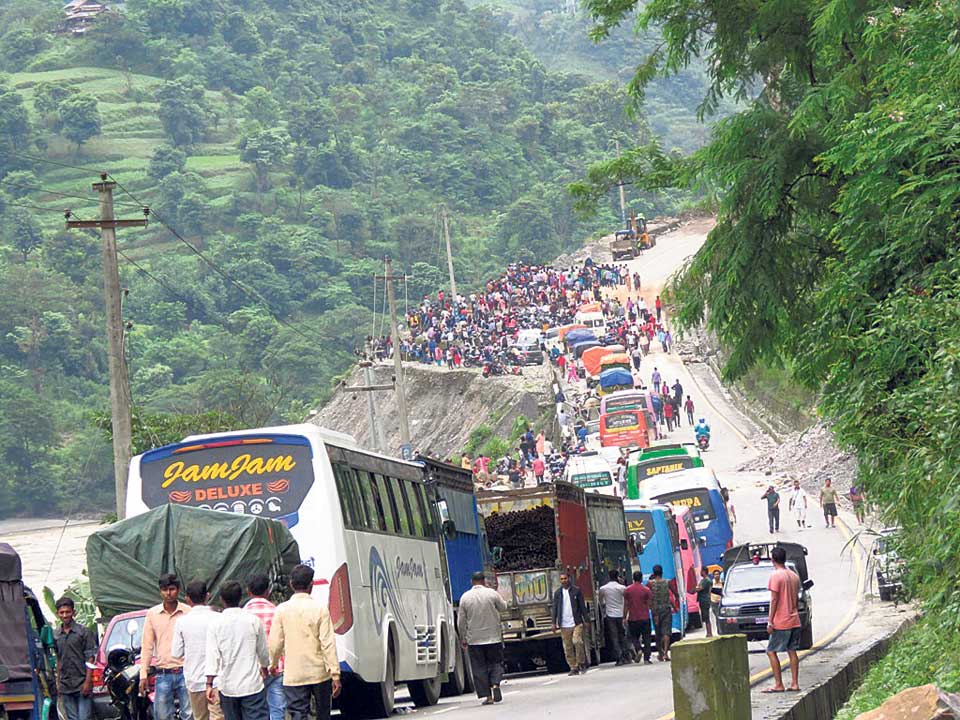



Work to remove landslide debris at Tuin river bridge underway

The work of removing the landslide near the Tuin river bridge along the Narayangadh-Muglin road section has started since this morning.
The road section remained closed since Friday evening, after a dry landslide next to the river bridge blocked the road.
The landslide debris removal work started this morning with three machines deployed towards Muglin and two towards Narayangadh, Chief of the Division Road Office Narayan Lamichhane. The road can be put back into operation by this afternoon if there is no further landslide.
The obstructed site is located next to the Tuin river at Ichchakamana Rural Municipality-6.
As a result, passengers and vehicles have been stranded on the road since Friday due to the landslide. More than 10,000 vehicles travel on this road daily.
Meanwhile, Deputy Superintendent of Police Rabindra Khanal, Information Officer of the District Police Office, shared that water and food are being distributed to stranded passengers under the leadership of the district administration.

Heavy rainfall likely in Koshi and Bagmati today
There are chances of heavy rainfall at one or two places of the hilly regions of Koshi and Bagmati Provinces today.
With the weather remaining generally cloudy in Koshi, Madhesh, Bagmati and Gandaki Provinces, and partly cloudy in the rest of the Tarai regions, moderate rainfall is likely to take place at some places of Koshi and Bagmati Provinces, at a few places of Madhesh and Gandaki Provinces, and at one or two places of the rest of the country, according to the Meteorological Forecasting Division.
Tonight, the weather will remain generally cloudy in the hilly regions of Koshi, Bagmati and Gandaki Provinces, and partly cloudy in the rest of the country, there are chances of moderate rainfall at a few places of Koshi Province and at some places of the hilly regions of Bagmati and Gandaki Provinces, and at one or two places of the rest of the country.
The impact of monsoon winds has become weak, while there is a partial effect of local winds in the country, adds the Division.

Nepal’s constitutional journey and path forward
The recent GenZ protests in Nepal caused profound political changes in Nepal, including the resignation of Prime Minister KP Sharma Oli, dissolution of Parliament, and appointment of former Chief Justice of Nepal Supreme Court, Sushila Karki, as interim Prime Minister. Nevertheless, the process is far from complete, as the President has announced 5 March 2026 to be the date of the next general elections. It will be interesting to note what kind of reform the interim Prime Minister will be taking, which may be added once the new parliament is constituted. It will also call for constitutional reforms in Nepal, which has been a foremost demand of GenZ protestors. In light of these changes, it is essential to stocktake the journey of constitutional reforms that Nepal has taken in the past seven to eight decades, and what the friction points were back then.
Nepal’s constitutional journey since the 1940s reads less like a tidy sequence of institutional reforms and more like a long, uneven negotiations over where sovereignty should sit and what it should look like. King or people. Party or palace. Kathmandu or the Tarai. Hill heartland or the periphery. Each text, from the first experiments under the Ranas to the 2015 charter and beyond, is a record of bargains struck and bargains deferred. To understand why Nepal is once again on the verge of serious change after a youth-led uprising, we need to trace how these bargains have shifted, which problems were solved, and which were simply moved down the road.
The starting point is the late Rana rule. Under pressure at home and from winds blowing across the subcontinent, Prime Minister Padma Shumsher announced constitutional reforms in the late 1940s. The Government of Nepal Constitution Act of 1948 floated the idea of a bicameral legislature and ministerial responsibility. It was carefully drafted. Selection powers sat with the prime minister, and the edifice rested on executive discretion. Still, it broke a tradition by acknowledging that state power might be shared. That act was followed by the Interim Government of Nepal Act of 1951, issued as the Rana oligarchy fell and a broad coalition ushered in a constitutional monarchy and multiparty politics. The 1951 text listed civil liberties, set out a provisional institutional design, and promised a fuller democratic settlement to come. It also carried the first seed of a recurring problem: lofty rights were planted in thin soil. Institutions to protect them were weak, and the balance between palace and parties was unsettled.
The 1959 Constitution tried to make good on the promise. Nepal held its first general elections. BP Koirala became the first democratically elected prime minister. For a moment, parliamentary democracy had a constitutional home. Alas, it did not last. In December 1960, King Mahendra dismissed the government, jailed elected leaders, and moved the country into a partyless Panchayat system. The 1962 Constitution codified the Panchayat system, concentrating sovereignty in the crown and constructing a pyramidal set of assemblies that were consultative in form and royalist in effect. This was not an aberration but a full constitutional project. It sought to bring nationhood, religion, and monarchy into a single frame and to define politics as social harmony under royal guardianship. Its longevity came from that ideological glue; its undoing came from the same source when economic change, social mobility, and a rising political class found the frame too tight.
The popular movement of 1990 was the first decisive mass amendment to that project. The protest forced a bargain. The palace would remain, but power would flow through elected institutions. The 1990 Constitution restored multiparty democracy, expanded fundamental rights, and set up an independent judiciary. It looked European in design, and for a while, it delivered plural politics. Yet the monarchy still held reserve powers. Identity-based claims were largely absorbed into the language of national unity rather than represented as constitutional pluralism. Federalism was absent. These omissions did not cause the insurgency that began in 1996, but they certainly narrowed the channels through which socioeconomic grievances and peripheral voices could be routed into policy. The palace’s 2005 coup temporarily snapped even the 1990 compromise, convincing many that a constitutional monarchy could never be safely caged.
The 2006 people’s movement broke the last link. The 2007 Interim Constitution disempowered the king and reoriented the state toward an elected sovereign Constituent Assembly. When the monarchy was abolished in 2008, it was less a leap into republicanism than an acceptance that the 1990 dualism had failed. From that point forward, legitimacy would be negotiated not between palace and parties but within a widening circle of political and social actors: Maoists now in suits, Madhesi parties galvanized by long exclusion, indigenous nationalities, women’s movements, and a younger generation that had grown up inside conflict and transition. The first Constituent Assembly collapsed under the weight of that diversity. The second produced the 2015 Constitution, a republican, federal, secular settlement that promised inclusion, proportional representation, and a new map of provinces. It was a bold step, but once again, some bargains were patched rather than resolved.
Two pressures immediately exposed those seams. The first was identity and representation. Many Madhesi and Tharu groups protested that the federal boundaries and electoral formulae diluted their political weight. Protests in the plains and a crippling impediment to cross-border trade followed. The new constitution’s legitimacy arrived with a caveat attached. Kathmandu amended the text on proportional inclusion and constituency delineation, but the deeper question, whether federal design tracks social geography closely enough to make people feel represented, was left for politics to answer. It still has not. The second pressure was state capacity under stress. The 2015 earthquake devastated infrastructure and livelihoods. A new federal republic with developing democratic institutions was suddenly tasked to deliver large-scale reconstruction, manage competing party interests across new provincial layers, and keep the economy afloat. The constitution’s promise of devolution and local empowerment was good, but the administrative reforms could not pick up the pace. This gap between constitutional aspiration and everyday governance seeded the frustration that now fuels youth anger: a sense that no matter which coalition takes Singha Durbar, services remain patchy, jobs scarce, and integrity negotiable.
Since 2015, constitutional politics has not rested. A 2022–23 set of amendments eased pathways for citizenship by descent for children of those who held citizenship by birth, and opened a narrow door for non-resident citizenship without political rights. Each change eased one pressure while stirring another. That pattern, addressing the immediate grievance and postponing the structural fix, has been the through-line of the last decade.
With this grand rupture, what can be expected from the constitutional positioning of new political actors is a timely question that needs to be asked. How federal should the state be? What mix of electoral system and party democracy can ensure accountability? How can conflicts of interest be managed in a political sphere where networks are tight and incentives distorted? These are some essential questions that the new democratic political elite of Nepal will be dealing with for quite some time. Nevertheless, in the opinion of this author, the 2015 constitution provides a good roadmap with some recalibrations to work upon, more importantly, in the areas of safeguarding human and digital rights. Along with this, a serious approach needs to be taken to tackle corruption by developing more constitutional checks and balances. Nevertheless, it also needs to be kept in mind that constitutional and legal reforms need to be done in parallel with overhauling already existing institutions as well as serious bureaucratic and institutional reforms; only then can long-term stability be achieved.

Mustang farmers face severe irrigation crisis
Phalyak, Dharkajung, and Pakling villages of Waragung Mukti Kshetra-5 in Mustang are known as key agricultural hubs. Out of the municipality’s 19 villages, these produce the largest share of apples and sufficient grain, while farmers also grow yams, buckwheat, potatoes, beans, corn, barley, and other vegetables for income.
But farmers in Phalyak and Dharkajung are now struggling with an irrigation crisis. Rising ground temperatures and a lack of timely snowfall—effects linked to climate change—are causing irrigation sources to dry up, leaving locals increasingly worried.
Waragung Mukti Kshetra Rural Municipality Chairperson Ringjin Namgel Gurung said the absence of snowfall in Mustang over the past two years has dried up springs that farmers depend on. “Rain alone does not solve our irrigation problem. We need timely snowfall,” he said, warning that shrinking water sources are leaving once fully irrigated farmland almost barren. “In the past, 100 percent of cultivable land was irrigated. Now, it is hard to irrigate even 10 percent.”
Ward Chairperson Surendra Gurung of Waragung-5 added that the Lumbuk River, which normally swells between June and August, has started to shrink. “Agriculture is the main livelihood here, and it cannot exist without irrigation. The Lumbuk River is our lifeline, but it is drying up instead of rising,” he said. Farmers are now forced to share the limited water on a rotational basis, but even that is becoming unsustainable.
On Saturday, a team of farmers and local representatives inspected the river’s source. Rural Municipality Vice-chairperson Dicky Gurung reported that three springs feeding the Lumbuk River have decreased significantly, with water flow now reduced by nearly two-thirds compared to previous years. “There has been no snowfall for three consecutive winters, which has hit the river badly,” he said.
Local farmers confirm the worsening situation. “We found the water volume much lower than before. If this continues, our settlement could face displacement within a few years,” said Konchok Gurung of Dharkajung. Another farmer, Raju Gurung of Phalyak, noted that where one farmer previously irrigated 25–30 fields, it is now difficult to water even four or five.
Villagers say that adequate snowfall in winter could revive the river through spring meltwater, but snowless peaks have left them without hope. Some residents even performed religious rituals at the Lumbuk cave, praying for the restoration of water sources.
Locals are urging all three levels of government to address the climate-driven crisis by identifying alternative irrigation sources and investing in water management. Without immediate solutions, they fear their farming system—and way of life—will collapse.


