


Colors of Kathmandu


An artist makes the wall his canvas at Mid-Baneshwor.

The wall art is a tribute to the family members the homeowner lost during the earthquake of 2015.
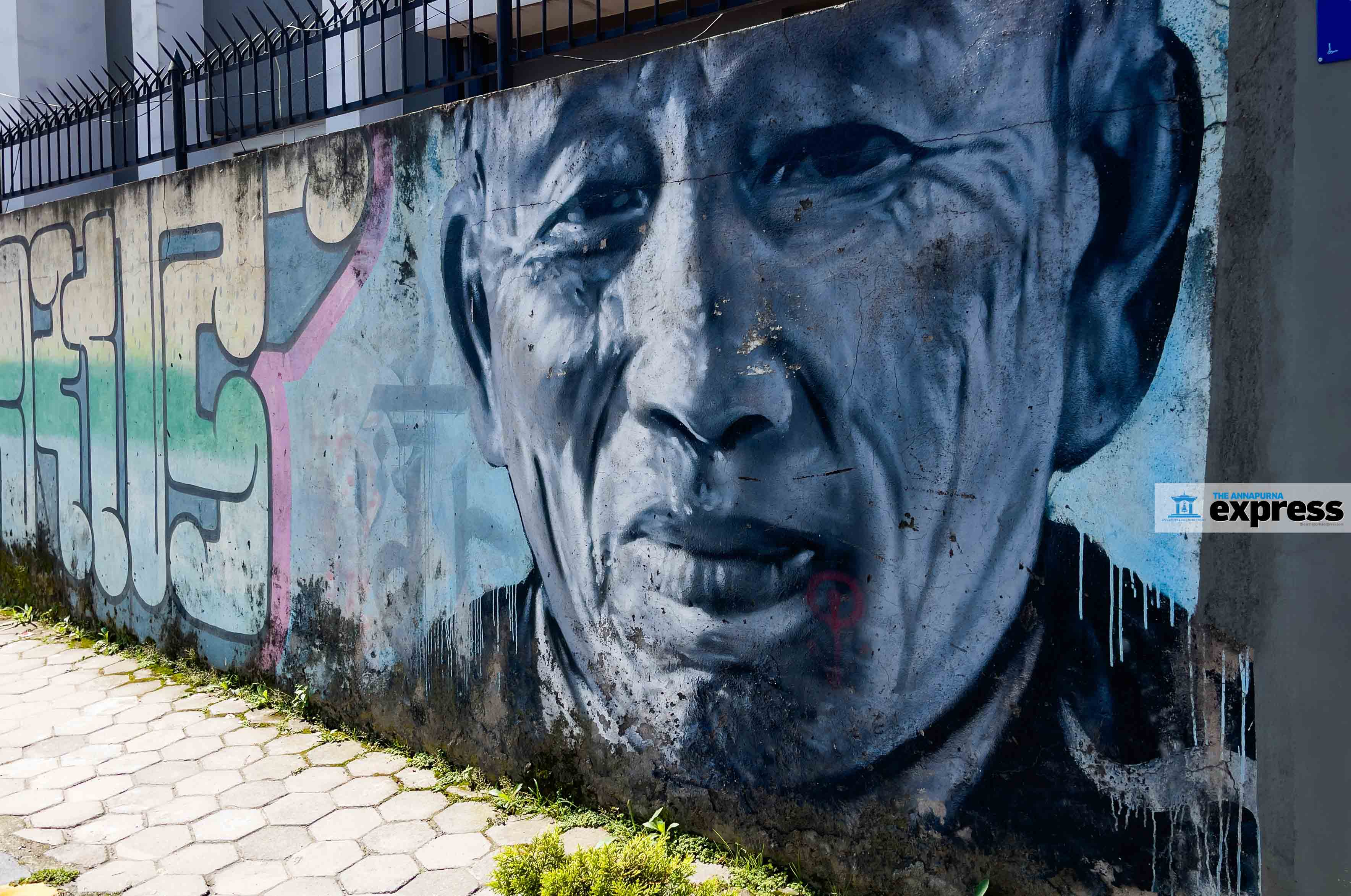
A portrait of late Satya Mohan Joshi in Kupondol.

Freak Street at Basantapur has a lovely mural of a Newar girl.

Mural of a girl on the wall of Hotel Summit, Kupondole.

Mural of a lion on a wall of a restaurant near the UN park in Lalitpur.

A wall art in Jwagal, Chakupat by Kaalo.101 in collaboration with Dalit Lives Matters-Nepal.

A man walks past a mural in Kupondol.

Honoring the spirit of giving
A festival called Pancha Dan, which means ‘Five Offerings’, is celebrated in the Mangal Bazaar area of Patan, Lalitpur, every year which is a testimony to the generosity and compassion of Buddhism. The act of giving is considered a way to accumulate merit and create positive karma. It’s also an opportunity to receive blessings from monks and nuns. The festival is also celebrated in other parts of Kathmandu Valley including the city, Bhaktapur, and Banepa.

Pancha Dan celebration is the act of giving five different things including rice grains, wheat grains, salt, money, and fruits. Communities join hands to provide for those who’ve devoted their lives to religion. Beyond material offerings, Pancha Dan is a time to share knowledge. Elders pass down teachings to the younger ones in the family, fostering interconnectedness.

As the day begins, the surrounding comes alive with melodious chants of Buddhist scriptures and vibrant prayer flags. Younger monks (vhikchu) circle the designated core area of Patan with copper bowls in their hands, receiving the offering from the devotees. Following this ritual, they dine together with their seniors inside a large hall.

Another aspect of the festivities involves the custom of hierarchical seating of grandfathers, referred to as ‘ajus’ in the Newari language. The eldest among them is honored with the title ‘Chakreshwor aju.’ Ajus are placed alternately in combination with people from the Shakya and Bajracharya communities. Devotees also line up to receive blessings from the ajus.


ApEx Roundtable | Experts emphasize urgency of addressing climate change-related loss and damage

Nepal recently experienced a simultaneous occurrence of both drought and flooding, underscoring the urgent need to address the impacts of climate change, particularly in relation to loss and damage (L&D). In this context, ApEx recently organized a roundtable involving climate stakeholders to delve into topics such as L&D, disaster risk reduction, government initiatives, partnerships for addressing L&D, and the role of youth in climate awareness and action. Excerpts:
Embrace climate change as an opportunity
Manjeet Dhakal, climate change expert

Historically, our focus has been primarily on the effects and impacts of climate change, often as a means to attract foreign aid. Yet, we have not been educated about an alternative perspective—a viewpoint that regards climate change as not only a challenge but also an avenue for economic benefits. Fortunately, recent years have witnessed increased dialogue, discussions, media coverage, and research on various aspects of climate change, which is undoubtedly a positive shift.
In Nepal, the cornerstones of our economy—agriculture, remittances, tourism, and hydropower—have all borne the brunt of climate change. While the effects on agriculture, tourism, and hydropower are widely recognized, we have not been adequately informed about its potential impact on remittances. These remittances contribute roughly 23 percent to our Gross Domestic Product (GDP). Notably, around 80 percent of our migrant labor force heads to the Middle East and Malaysia, regions experiencing significant temperature increases compared to the global average. Consequently, our assessment of loss and damage should not be limited to our borders but should extend to encompass consequences beyond our political boundaries.
Necessity of scientific research
Pradip Khatiwada, disaster risk management expert

Numerous scientific studies have examined rainfall patterns and the global temperature rise, both contributing factors to instances of loss and damage. L&D is commonly categorized as economic, affecting livelihoods and property, and non-economic, encompassing issues like loss of life, health problems, psychological distress, displacement challenges, as well as damage to biodiversity and cultural heritage. While economic L&D is frequently discussed, the non-economic aspect has not received adequate attention. Therefore, conducting scientific research to evaluate our circumstances is essential. This research aids in anticipating and mitigating disaster impacts, bolstering our self-reliance. Additionally, communicating research findings effectively to vulnerable communities minimizes disaster-related risks.
While a 1.5°C temperature increase might not significantly affect certain countries, it’s a significant concern for Nepal due to its susceptibility to snowmelt-triggered flash floods and related problems. Unlike the sturdy mountains in Europe, our mountainous regions are delicate and vulnerable, warranting our concern.
Educate local communities on climate change
Bharati Pathak, community forest expert

Indigenous communities have played a pivotal role in revitalizing community forests nationwide, contributing significantly to mitigating climate change effects, including loss and damage. However, these communities possess only a basic understanding of climate change consequences such as floods, landslides, and droughts. The discourse on this matter has largely been confined to urban centers and the privileged class, leaving those directly dealing with climate change aftermath with limited awareness. Thus, extending knowledge-sharing initiatives to rural regions is imperative.
While we have actively participated in 27 Conferences of Parties (COP), do local communities truly comprehend the nature of COP, its discussions, and the resulting agreements? The absence of involvement from those at the forefront of climate change impacts casts uncertainty on our ability to achieve climate objectives.
In an environment where information is scarce, misinformation and disinformation thrive. This is evident in local communities’ understanding of carbon trading, where they sought compensation for only a few trees.
Collaborative efforts for climate action a must
Hari Prasad Sharma, Under secretary, Ministry of Forest and Environment

Nepal’s vulnerability to climate change must be comprehensively assessed, including the degree, severity, and exposure of its impact. With about 68 percent of our land featuring slopes greater than 60°, our susceptibility to climate effects is heightened. Moreover, roughly 30 percent of our land lies at altitudes exceeding 2,500 meters, amplifying its sensitivity in sustaining livelihoods. Thus, our geographic circumstances render us particularly vulnerable.
Though climate change policies exist, practical execution is paramount. Policies often resemble wish lists; our focus should shift towards translating them into actionable steps through meticulous implementation. Given the global move towards cooperative decision-making, addressing climate change necessitates a collective approach. Embracing contemporary methods is crucial to effectively combat this issue.
Allocating resources to educate and foster climate change understanding from a young age is essential, as the youth represent future catalysts for change.
Climate change transcends data
Shrichchha Pradhan, climate activist and Miss Nepal World 2023

Nepal’s cultural practices, adaptability to environmental challenges, and community-driven sustainability efforts offer valuable lessons for the global community. By studying and adopting these practices, societies worldwide can take meaningful strides toward addressing climate change, embracing zero-waste lifestyles, and nurturing sustainability. Entrepreneurship within the climate change realm presents an opportunity yielding multiple benefits, including educating the youth on climate intricacies, promoting sustainable practices, and zero-waste principles.
Understanding climate change extends beyond data; it holds a deep emotional dimension impacting local communities, especially in remote areas. These communities daily bear the brunt of climate change, experiencing its far-reaching consequences in ways statistics cannot capture. Their close connection with the environment has traditionally granted them a profound understanding of nature’s patterns. However, recent unpredictable changes from climate change have disrupted this traditional knowledge. Thus, engaging with these communities and providing targeted education about changing consequences is crucial.
Loss and damage as a moral imperative
Adelle Thomas, lead author of IPCC Reports
Loss and damage (L&D) lacks a universally agreed definition within the UN Framework Convention on Climate Change (UNFCCC), signifying different meanings for different groups. Nonetheless, L&D generally refers to negative climate change impacts that occur despite mitigation and adaptation efforts.
L&D is often categorized as economic or non-economic. Economic L&D entails quantifiable negative impacts, such as rebuilding infrastructure post-floods or agricultural revenue loss due to drought. Non-economic L&D includes impacts challenging to assign monetary values, like trauma from tropical cyclones or community loss due to displacement.
Both extreme events (heat waves, storms) and slow-onset events (sea-level rise, ocean acidification) contribute to loss and damage.

Preparations of Nag Panchami: Painting the serpent
Nag Panchami emphasizes the peaceful coexistence of people and nature with its cultural and spiritual significance. It acts as a reminder of the significance of treating all living things with respect and preserving ecological balance.

This traditional Hindu festival honors serpents and snakes because they are revered in Hindu mythology and culture. The celebration takes place on the fifth day of the Shrawan lunar month, which normally falls in July or August. The term ‘Nag’ refers to snakes, and ‘Panchami’ means the fifth day.

Devotees pray to and worship snake deities during Nag Panchami in order to protect themselves from snakebites and other related risks. Hinduism views snakes as powerful, holy beings as a sign of protection, consciousness, and alertness.

Narendra Chitrakar, 62, has been painting Naga pictures since he was 11, learning from his father and his grandfather before that. This is his ancestral business. He was born in Machhindra Bahal, Masan Galli, Ason, Kathmandu. The colors used in the paintings are called ‘kacha rang’ in the Newari Language, which means raw color. He creates five to six designs of paintings of different sizes. Small posters are more popular and are sold in greater numbers than smaller ones. He sells 2500-3000 handmade posters every season, with prices ranging from five rupees to Rs 50. Apart from that, he also paints color on the statue of Rato Machhindranath and other Hindu deities.

One of the most famous myths about this day is about Lord Krishna defeating serpent Kaliya. According to the story, Kaliya had taken residence in the Yamuna River, poisoning its waters and terrorizing the inhabitants. Krishna, as a young boy, danced on Kaliya’s many heads, forcing the serpent to surrender and promise to leave the river. This story symbolizes the victory of good over evil and since that day Nag Pachami was celebrated.


