


Few women in federal, provincial executive bodies

Females make up 51.04 percent of Nepal’s population, but their representation in government bodies is much lower. This means their issues and concerns are rarely addressed.
Every year on March 8, various government agencies working on women rights and empowerment mark the International Women’s Day. They announce campaigns and programs for women rights and representation and yet they invariably fail to achieve the desired results.
Nepal’s constitution mandates a minimum 33 percent women representation in legislative bodies. As a result, the federal parliament fulfills the women representation criteria—33.7 percent in the House of Representatives and 37.28 percent in the National Assembly—and so do the provincial assemblies.
But in executive bodies, women are heavily underrepresented. In the federal council of ministers, women representation is 26 percent; provincial ministries are also dominated by male ministers.
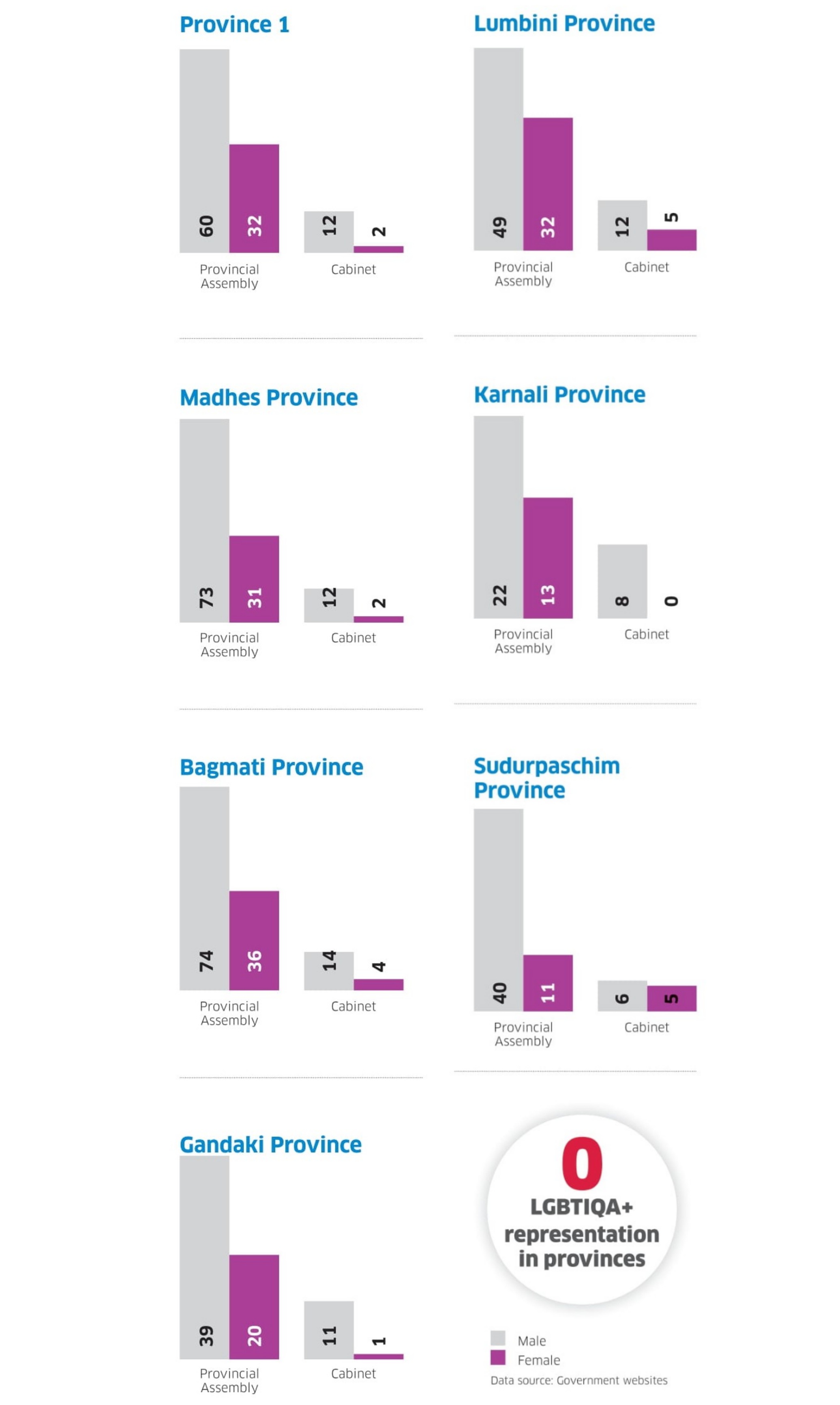
This shows that significant (if still inadequate) women’s representation in legislative bodies owes solely to constitutional provisions and not a commitment to leveling the playing field.
Province 1 and Madhes have 14.28 percent women representation in their cabinets, whereas Bagmati and Lumbini have 22.22 percent and 29.41 percent women representation respectively. In Gandaki province, women ministers comprise eight percent of the cabinet and Karnali has no female minister.
While Sudurpaschim province has 45.45 percent women representation in the cabinet, its legislative assembly has just 21.56 percent women.
Bimala Nepali, lawmaker and member of Women and Social Affairs Committee of Parliament, says they have repeatedly urged the government to at least ensure a minimum threshold of women in the federal Cabinet, to no avail.
More men should take up women’s rights advocacy
Bimala Rai Poudel
Member of National Assembly
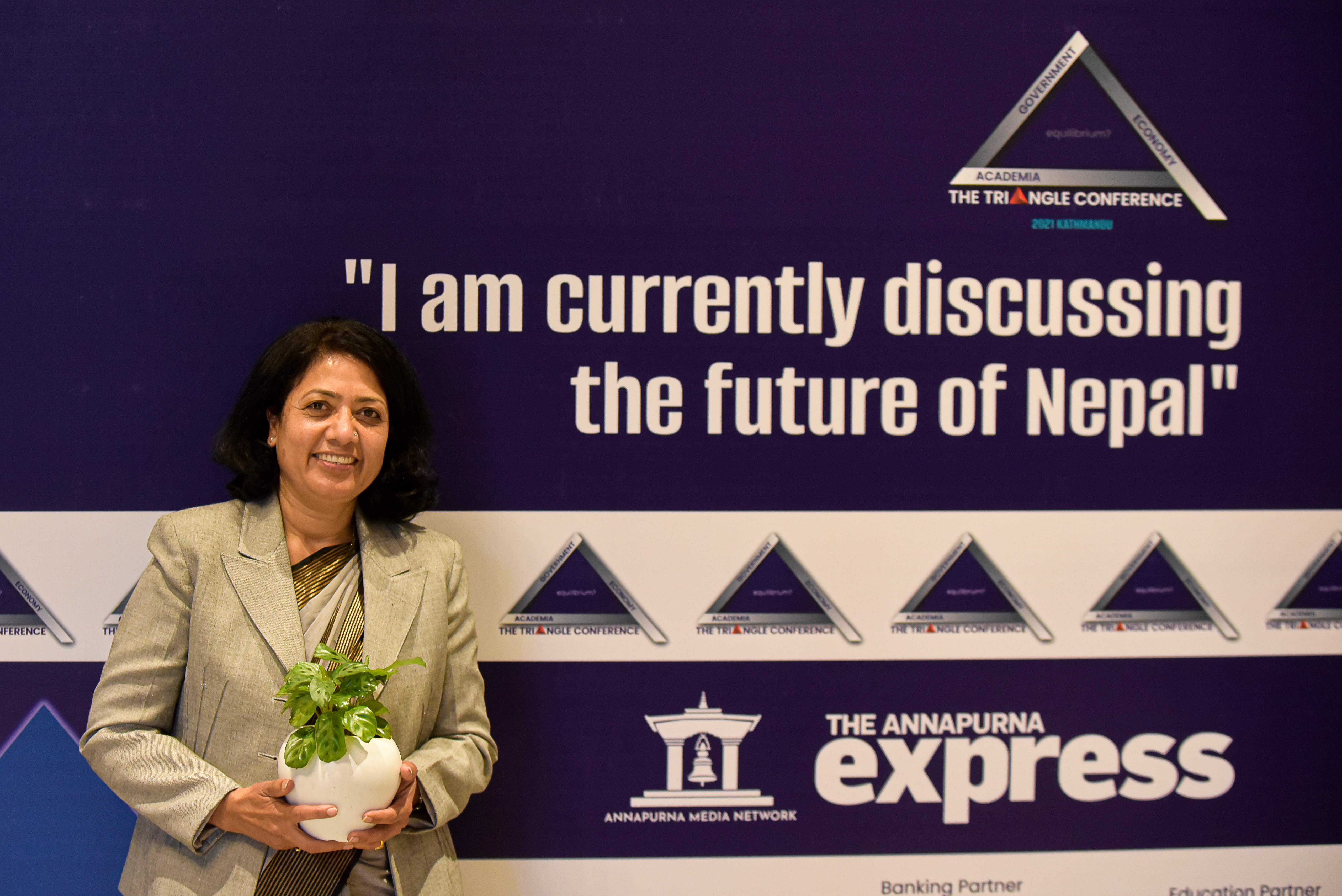
I ask for 51.04 percent women representation in every sector, in line with our population data. Currently, our legislative bodies have a decent number of female representatives, and we can raise our issues more effectively. But we also need men on our side. Gender equality should be a universal cause. To build an equal society, it is imperative that men take up the issues of women’s rights and representation.

Russia cracks down on dissenting media, blocks Facebook

Russian President Vladimir Putin on Friday intensified a crackdown on media outlets and individuals who fail to hew to the Kremlin line on Russia’s war in Ukraine, blocking Facebook and Twitter and signing into law a bill that criminalizes the intentional spreading of what Moscow deems to be “fake” reports, Associated Press reported.
The moves against the social media giants follow blocks imposed on the BBC, the U.S. government-funded Voice of America and Radio Free Europe/Radio Liberty, German broadcaster Deutsche Welle and Latvia-based website Meduza. The government’s sweeping action against the foreign outlets that publish news in Russian seeks to establish even tighter controls over what information the domestic audience sees about the invasion of Ukraine.
The state communications watchdog Roskomnadzor said it cut access to Twitter and Facebook in line with a decision by the prosecutor general’s office. The watchdog has previously accused Twitter of failing to delete the content banned by Russian authorities and slowed down access to it.
Twitter said in a statement Friday afternoon that while the company is “aware of reports” that its platform is blocked in Russia, it has not been able to confirm whether this is the case, according to the Associated Press.
The bill, quickly rubber-stamped by both houses of the Kremlin-controlled parliament and signed by Putin, imposes prison sentences of up to 15 years for those spreading information that goes against the Russian government’s narrative on the war.
The question regarding Russia is no longer “what we do to stop disinformation,” former U.S. ambassador to Russia Michael McFaul said on Friday. “The question has to be how do we promote information inside Russia -- and I don’t have the answer.”
Multiple outlets said they would pause their work inside Russia to evaluate the situation. Among them, CNN said it would stop broadcasting in Russia while Bloomberg and the BBC said they would temporarily suspend the work of their journalists there.
Russian authorities have repeatedly and falsely decried reports of Russian military setbacks or civilian deaths in Ukraine as “fake” news. State media outlets refer to Russia’s invasion of Ukraine as a “special military operation” rather than a war or an invasion, Associated Press reported.
Vyacheslav Volodin, the speaker of the lower house of parliament, said the measure “will force those who lied and made statements discrediting our armed forces to bear very grave punishment.”
“I want everyone to understand, and for society to understand, that we are doing this to protect our soldiers and officers, and to protect the truth,” he added.
The law envisages sentences of up to three years or fines for spreading what authorities deem to be false news about the military, but the maximum punishment rises to 15 years for cases deemed to have led to “severe consequences, according to the Associated Press.

Chand accuses Deuba, Dahal and Oli of trying to sell the country from Parliament
Communist Party of Nepal General Secretary Netra Bikram Chand accused the Nepali Congress and Communist leaders of trying to sell the country from the Parliament.
Speaking at a programme organised in Khulla Manch of the Capital on Friday, Chand accused the so-called Nepali Congress President and Prime Minister Sher Bahadur Deuba, CPN (Maoist Centre) Chairman Pushpa Kamal Dahal and CPN-UML Chairman KP Sharma Oli of trying to sell the country from the Parliament.
“Congress and Communist leaders are selling the country from the Parliament. The government branded us a criminal group and banned our activities when we spoke about the Millennium Challenge Corporation. MCC is not a grant,” he said.
He said that the United States attacked Nepal in the name of agreement.
Chand further said that the United States wanted to intervene in Nepal in a new way.
“MCC will undermine national independence. MCC is not in the interest of the nation,” he said.

I agreed to endorse MCC with interpretative declaration to save Speaker’s post: Dahal
CPN (Maoist Centre) Chairman Pushpa Kamal Dahal said that he agreed to endorse the Millennium Challenge Corporation (MCC) with an interpretative declaration to save the post of Speaker.
Addressing a Central Committee meeting, the Maoist supremo made it clear that he was compelled to make an agreement to ratify the $500 million grant compact after the main opposition CPN-UML hatched a conspiracy to break the coalition and to remove Speaker Agni Prasad Sapkota from his post.
“The alliance was on the verge of collapse due to the MCC. The UML also tried to break the coalition and to dissolve the Parliament. We decided to endorseMCC with an interpretative declaration to foil the UML’s attempt to break the alliance,” he said.
He claimed that the UML will be pushed to the corner again by keeping the alliance intact.
“The coalition would have fallen apart had there not been an agreement to ratify the MCC. We pushed the UML to the corner once again by foiling its attempt,” Chairman Dahal said.


