


Diplomatic License | Post-Aukus challenges for Nepal

The new Australia-United Kingdom-United States security pact, now famous by its acronym of Aukus, is yet another sign of the Anglo-Saxon world’s increasing headache over China’s growing might in the Indo-Pacific. Under the pact, the UK and the US will help Australia procure nuclear-powered submarines. The three countries will also drastically increase their military and security cooperation.
Separately, shortly after the announcement of Aukus, the heads of the four countries—Australia, India, Japan, and the US—under the strategic Quadrilateral Security Dialogue, also known as the Quad, met in the White House and recommitted to “…promoting the free, open, rules-based order, rooted in international law and undaunted by coercion, to bolster security and prosperity in the Indo-Pacific and beyond.”
Though China was not mentioned on either occasion, it was the elephant in the room. Australia took the lead in Aukus formation as it worried that China’s recent activism in the Indo-Pacific was getting out of hand. Australia ditched an earlier agreement to buy French submarines for $90 billion in favor of the American nuclear-powered kind. The old French subs, the Australian strategic community had come to believe, would no longer meet their country’s changing needs.
Yet the most remarkable development over the past few years is India’s change of heart in working with Western and pro-Western allies. Until recently, the Indian strategic community hesitated to align with the Westerners, particularly the US. One, it feared losing its traditional hegemony in South Asia if the American role in the region increased. Two, Indian thinkers understood that however complex India-China ties may become, as two big neighboring nuclear and economic powers, they had to cooperate. By the same logic, the Indians couldn’t be seen as bidding for the Americans in the region.
Also read: The US failure on MCC compact
But recent border tensions with China seem to have convinced the Indians that only by working with their Western allies can they repel China’s steadily building military pressure—with the tightening China-Pakistan strategic embrace only adding to their urgency. There is also a feeling that Beijing misunderstood India’s accommodating stance as its weakness and hence a clear message needs to be sent. For all these reasons, the Indians may agree to a modus vivendi in South Asia whereby they accept more American involvement here if the Yanks in return agree not to cross certain red lines they draw.
For Nepal, this could translate into more nudges from the south to green-light American projects, the MCC Compact most important among them. (Despite noncommittal words from the Chinese envoy in Kathmandu, Chinese hostility to the MCC Compact is becoming hard to hide as well.) Concomitantly, it would entail India leaning on its traditional constituencies in Nepal to check China’s ‘grand designs’. The government in Kathmandu will more and more be asked to pick sides between China and anti-China forces.
Chinese state media has designated Deuba “pro-India”. The Chinese will feel vindicated after his government’s latest decision to investigate ‘disputes’ on the Nepal-China border. The traditionally pro-Western Deuba also wants to push the MCC Compact through, but he simply doesn’t have the numbers in parliament and such a move could fracture the ruling alliance. Nepali politics, traditionally so reliant on its two giant neighbors, will be liable to even more outside influence in the days ahead. Good luck with the success of the ‘amity with all, enmity with none’ formula!

Political Briefing | New foreign minister, new course?
Narayan Khadka is a keen student of international relations and as shadow foreign minister during the previous KP Oli government’s tenure, he is well aware of Nepal’s current challenges on the international stage. Prime Minister Sher Bahadur Deuba is thus justified in appointing him his foreign minister. Khadka’s nuanced understanding of Nepal’s place in the world will serve him (and his country) well in his new role. But then, will he be allowed to function with a degree of independence?
His predecessor as foreign minister, CPN-UML’s Pradeep Gyawali, was also a fine mind, reputed over the years for his calmness and subtlety, the perfect attributes that Nepal’s chief diplomat should possess. Yet in office, he seemed to have no say as Oli virtually dictated the terms of his engagement with the outside world. Instead, to defend PM Oli’s repeated foreign policy bungling, Gyawali had to abandon his traditional calm and become uncharacteristically combative.
Khadka too is known for his calm demeanor and for the nuance he brings to any foreign policy debate. But will Deuba cut him any slack, especially as he seems to be in a mood to use India’s good offices to regain Nepali Congress presidency? Deuba has been unable to come to the defense of the MCC Compact that he signed, nor has he had the audacity to directly talk to India on the drowning of a Nepali national by Indian border forces or on the flying of Indian choppers over Nepali territories. Most recently, the Deuba government, representing Nepal as SAARC chair, failed to convene the SAARC foreign minister-level meeting on the sidelines of the UN General Assembly.
Deuba has always been close to westerners, the US especially. With the Nepali Congress united in favor of the MCC Compact, he will face no opposition to it from within the party. Yet he will have his task cut out convincing the communist parties to come around on the compact. Khadka is in no place to help him either with the compact or the twin incidents with India.
When assuming office, the new foreign minister assured people that vacant ambassadorships would be filled strictly on merit-basis, after his return from the UNGA. Not everyone has the skills to be a country’s envoy, he said. That is true. But then Nepali ambassadors, save for the few career diplomats from the Ministry of Foreign Affairs, have always been appointed along party lines, and many Deuba loyalists, as well as those affiliated to his coalition parties, are already queuing up. It is also hard to believe that a prime minister who has been unable to expand his cabinet beyond the bare minimum will get to appoint the diplomats of his choice, whether or not they are loyal to him.
The problem, again, is the lack of even minimal political consensus on Nepal’s foreign policy. This does not mean the main political parties should see eye to eye on all foreign policy issues; in fact, that would be a disaster. But they should at least agree on the fundamentals. Yet that too seems improbable at a time the whole polity—as well as the people—seems nearly neatly divided among the Indian, Chinese and American camps. The proponents of one camp, meanwhile, are convinced that the supporters of the others are no less than traitors.

What if… the 2015 constitution had been delayed?

September 19 marks the sixth anniversary of the promulgation of the Constitution of Nepal 2015. While a sizable population celebrates the day with fanfare, many in Tarai-Madhes observe Constitution Day as a Black Day, a big setback in their fight for representation and justice.
The constitution, drafted following the decade-long Maoist insurgency and two Madhes movements, is yet to fully address the demands of Madhesis. Nonetheless, although disagreements over the constitution have inevitably surfaced, all political parties have decided to resolve them in a democratic way.
But, what if the constitution had not been promulgated on that day? How would the country be faring today?
Radheshyam Adhikari, member of the National Assembly and ex-chairperson of the Regulation Drafting Committee of the Legislature-Parliament, had closely worked with the constitution’s final drafts. “We promulgated this constitution under a specific situation. The political parties might not have arrived at a consensual document had it not been for the earthquake earlier in the year,” he adds. “The sorry plight of millions of fellow Nepalis imbued our politicians with a sense of duty.”
When the first Constituent Assembly failed to deliver, a second CA had to be elected in 2013. Around 80 percent of the newly elected were new to the assembly. The big difference between the first and the second CA was that while the new revolutionary forces like the Maoists and Madhesi parties were dominant in the first assembly, traditional parties like Nepali Congress and CPN-UML had reclaimed their dominant position in the second assembly. This, in the eyes of many, greatly diluted progressive agendas of the post-2008 period.
But Adhikari reckons there wouldn’t have been a third CA had the second one also failed to deliver a constitution. “In such a situation, we would have gotten a constitution, but through some commission and not via people’s representatives,” he says. “Such a national charter would not have reflected people’s aspirations.”
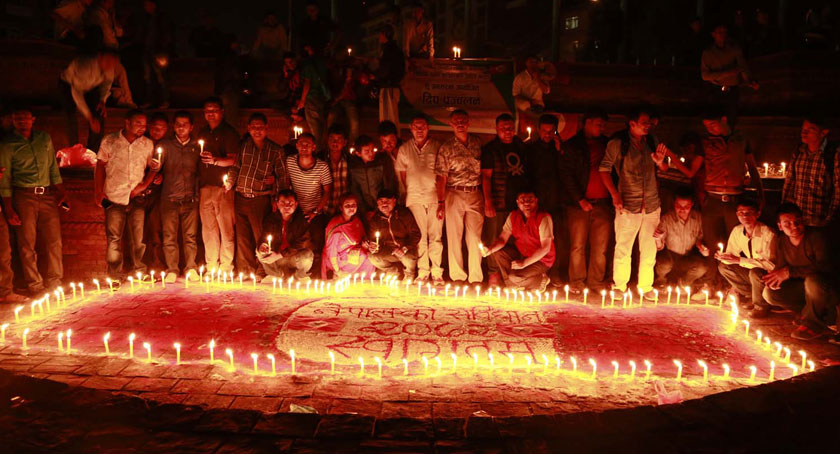 Youths light candles at Maitighar Mandala as the Constituent Assembly endorsed all the articles of draft constitution on 16 September 2015 | Photo: RSS
Santosh Mehta, spokesperson for the then Rastriya Janta Party Nepal, reminisces the time he felt the CA veered off-course in 2015. “I hadn’t imagined the major parties would ditch the demands of the Madhesis and treat us as if we are not Nepalis,” says Mehta. He says this constitution has divided Nepalis by creating psychological barriers between the country’s major ethnic groups. “Relations between the various ethnic groups would have been stronger and more cordial without this disrespectful constitution,” Mehta adds.
It took almost a decade following the 2007 Madhes movement to promulgate the constitution. Political parties tried to forge consensus in this time, mostly on the contentious issue of the number and nature of federal provinces, but to no avail. In the desperate post-earthquake days, all major parties had to compromise on their agendas to give the country a way out. But they failed to have Madhesi parties on board.
“It was no big deal. Had we not been able to have a constitution in September 2015, we would have had one by early 2016, which would also have helped resolve most contentious arguments,” claims Chandrakishore, a Birgunj-based journalist. He says major parties rushed the process, ignoring the demands of a large portion of the population. “They issued an urgent whip to the CA members without giving enough time to the parties on the street, in what was an intentional provocation,” he adds.
Fed up with the autocratic monarchy, there was a surge of hope among the people when the country became a federal republic in 2008.
“That hope would have died had the second CA also failed to deliver a timely constitution,” says constitutional expert Bipin Adhikari. “No one would then have believed that people’s representatives were capable of steering the country.” Adhikari thinks people would then have started pining for the monarchs again.
As nearly 90 percent of CA members (538 out of 598) voted in the charter’s favor, many politicians continue to consider it among the best constitutions in the world.
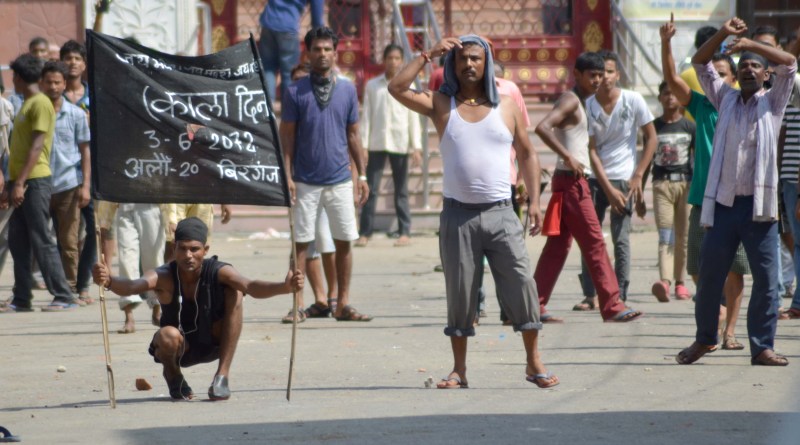 Youths of Birgunj protesting against the promulgation of Constitution of Nepal 2015 | Photo: Madhesi Youth
Political analyst CK Lal reminds that each of Nepal’s seven constitutions—be it the one in 2015, in 1962 or in 1948—was touted as ‘the best in the world’. “This title has always jinxed us,” he shares. “If the second CA had also failed to deliver, they would most probably have added federalism to the Interim Constitution of Nepal 2007 and made it permanent,” he says. “This would have been better as the 2015 constitution is more regressive than the interim one in terms of the demands of Madhes.”
Hisila Yami, a member of the first Constituent Assembly from UCPN (Maoist), echoes Chandrakishore. “The 2015 constitution would have been more widely hailed and accepted had it been postponed by a few days,” she says. The constitution, in the form it was promulgated, watered down the rights of women, indigenous, and minority populations. Yet, she is happy that the second CA finished off a must-do task.
Sixty people were killed during the months-long protests against the constitution—six of them on the very day of its promulgation. Observers in favor of the parties’ decision to push for the constitution say that this number would have significantly increased had the constitution been put off any longer, while those against say nobody would have had to die in that case.
Most progressive political actors accepted the Constitution of Nepal 2015—even if some did so grudgingly—as it institutionalized federalism and paved the path to socialism.
Madhes-based critics, however, still have problems with citizenship, provincial structure, proportional representation and inclusion-based issues. Lal says major parties’ leaders won’t listen to Madhesi agendas. For him, eventually, there has to be another revolution to right the wrongs.
Yami says there are quite a lot of ways to make the constitution better—it’s just a matter of political commitment. Here too, she thinks Nepal needs a national political consensus. “This constitution is a glass half-full. We have to fill it soon,” she adds.
Constitutionalist Adhikari says any constitution is a work of compromise. “No one gets to fulfil all their demands,” he concludes.

Political Briefing | The US failure on MCC compact
The Americans have not helped their cause on the MCC compact with Nepal. First, at the start of 2019, it was then US Acting Assistant Secretary of State for South and Central Asian Affairs Alice Wells linking the MCC with the Indo-Pacific Strategy (IPS), with its central goal of containing China’s rise and preserving American economic and military supremacy in the Asia-Pacific. (The IPS document declassified by the Trump administration at the end of its term admits as much.) A few months later, David Ranz, US Acting Deputy Assistant Secretary of State for South and Central Asian Affairs, came to Nepal and confirmed that the MCC and the IPS were inextricably linked.
Strangely, the American Ambassador to Nepal, Randy Berry, speaking via a YouTube video after Ranz’s Nepal visit, admitted that the MCC compact embodies “the values and principles we broadly refer to under the [Indo Pacific] strategy”. He said even the USAID’s post-quake help and the provision of Nepali students going to study in the US were inspired by the same set of values and principles. Basically, he was admitting that all current and future American help to Nepal would come under the IPS (or one of its variants). Yet the MCC continues to insist that its compact with Nepal is not a part of the strategy. What are we missing here?
No sovereign country gives foreign aid or invests in another country without strategic considerations. The BRI is intended to fulfill Beijing’s strategic goals that are closely tied to the continued growth of the Chinese economy. The same holds for Indian or Japanese or Danish aid to Nepal. Why have the Americans been so hesitant to openly admit that the MCC has retrospectively been made a part of the IPS but, even so, it is still in Nepal’s favor?
Nepali communist parties have always been rabid anti-Americans since their inception in the late 1940s. Even in the 1950s, they used to denounce ‘American imperialism’ and decry US-Nepal cooperation. They are doing the same now, partly because as communists they have this fealty towards the northern neighbor. China, too, has been active in fanning the anti-MCC flames in Nepal. And the Americans seem to have taken the Chinese bait—hook, line and sinker.
I believe the MCC is a part of the IPS, as indicated by many senior US officials, including the current US envoy to Nepal. Yet I am still in favor of the compact’s parliamentary endorsement as it is in Nepal’s interest. This is not because the compact’s unraveling could deter other international investors, although that is a possibility. My bigger worry is that limiting Nepal’s external engagement to India and China could pose a grave risk to Nepal’s sovereignty and independence.
Nepal needs a strong US presence to forestall the possibility of the country’s fate being decided by (or between) its two giant neighbors. Were it not for the presence of outside actors like the US, EU, and Japan, Nepal, perhaps, would by now have been absorbed by India or China, as Leo E Rose so perceptively warned all those years ago.
For the Americans, the biggest and also the more obvious lesson from the MCC debacle should be to avoid conflicting messaging on its important foreign policy initiatives. In this age of disinformation, your opponents will not resist tweaking your words to fix their context. For Nepal, its rulers should never forget that the country has been able to maintain its independence only via the most delicate balancing between multiple international actors. Even a little disturbance in this equilibrium could imperil its existence.


