


Political briefing | Nepal’s pick: BRI or B3W?

It is strange to hear some of the ‘pro-democracy’ arguments in the new ‘BRI v B3W’ debate. BRI’s critics say it is propagated by a one-party dictatorship determined to bend the world to its will through its opaque and elitist business dealings. The B3W, on the other hand, is a democratic initiative with accountability and transparency at its heart, they argue.
It is naïve to believe that sovereign nation-states consider anything but their core interests while dealing with the outside world. And seldom do these interests have anything to do with democratic norms and values.
BRI was China’s way of prolonging its economic development by financing projects abroad, in the expectation of juicy returns. While dispensing loans under the BRI, China didn’t bother about the recipient countries’ human rights and governance records. And it would be strange if China, a rising global power, were not looking to secure its interests, geopolitical or otherwise, through those business deals.
The same applies to the US. The new ‘Build Back Better World’ initiative it has pushed, at its heart, hopes to find new markets for American products and clients for international institutions it has traditionally financed. Plus, yes, it also aims to contain China’s economic and military rise.
But aren’t Western democracies more concerned about human rights and liberal values? It depends. Whatever they do at home, abroad, these are only cloaks to hide their competitive Hobbesian instincts. If the Americans were so concerned about democracy and human rights, why are they abandoning Afghanistan now? Only the American soldiers stand between the Taliban and the seat of government in Kabul. Soon as the Americans are out, the Taliban will impose sharia law, ban girls from attending schools, and outlaw all forms of entertainment.
Even in Nepal, the Americans backed the party-less regime of King Mahendra after he let the CIA use Mustang to wage a guerrilla war in Tibet. After 9/11, the US administration unequivocally supported King Gyanendra’s ‘war on terror’, with money and guns, helping him add fuel to the Maoist conflict. While our erstwhile Panchayat-era kings got ticker-tape parades in the US capitol, none of our democratic leaders have received similar welcomes there.
The B3W initiative hopes to curb the further expansion of Chinese powers and forestall the loss of American clout in the Asia-Pacific, the new global power hub. Countries such as Nepal will be under increasing pressure in the future to pick between the ‘autocratic BRI’ and the ‘democratic B3W’. So expect more acrimonious debates like the one surrounding the MCC compact. Strangely, the Americans say the compact money could go to some other country if Nepal continues to dither. Yet they keep pushing Kathmandu to gulp it down, no questions asked.
Am I saying Nepal should pick BRI over B3W? Not at all. Why do we need to choose? Let the two initiatives compete to win our trust, and to help us on our terms. The Americans entered Nepal in the late 1940s to safeguard their interests, but we wanted them here to secure our own interests: the involvement of a strong third actor like the US had become vital as India and China threatened to settle Nepal’s fate between them. Nepal is destined to continue with this delicate balancing act if it is to continue to preserve its independence.

Hold Nepali politicians to account
Enid Blyton’s erstwhile global legacy—teenage mystery solvers, ham sandwiches and lemonade and magical trees with pixies and moon-faced men—will now forever be etched, figuratively and literally, in our minds and on blue plaques (found all over the UK to link famous people to the buildings they lived in) for her “racism, xenophobia and lack of literary merit”. This posthumous demise of a widely-read author—the “cancelling” of Enid Blyton—is a warning: neither the dead nor the living will be spared the wrath of the woke internet.
Whether the cancel culture—a form of ostracisation from a global space due to offensive or problematic statements—is an uplifting, educative phenomenon or a toxic, vicious repudiation has been widely debated. That someone is ‘over’ after a wave of angry tweeting and retweeting is a matter of contention. However, lost in the steaming haystack of mass indignation is the pin of a simple motive: to hold people accountable for views that are offensive to a certain group of people.
That an author who has been dead for 50 years has been virtually lynched for her xenophobic accounts is a symbol of the times we live in. This posthumous lynching makes me draw parallel (in the sense that it is lacking) with the public figures of Nepal.
For decades now, the Madhesi community of Nepal has been tirelessly fighting for basic constitutional rights. This ethnic minority group of Nepal, in their fight for a ‘federal democracy’ with increased political representation, has been constantly overlooked: in 2007 Upendra Yadav burned the interim constitution of Nepal as a symbol of defiance. The discontent and frustration at the government’s disregard for a whopping 30 percent of the Nepali population is not a recent development. This ethnic prejudice stems from a history of Bahuns, Chettris and Newars ruling the land and dominating economic and political realms. Even now, a few groups dominate Nepali politics. However, politicians are trying (and failing) to advance an illusion of change.
While the issuance of an ordinance to amend the Nepali Citizenship Act—later stayed by the Supreme Court—was a step forward in the Madhesis fight for equality, Prime Minister KP Sharma Oli’s attempt to delude the Nepali public into thinking he cares for ethnic minorities has failed. Oli’s sloppy sleight of hand was clearly seen for what it was: an attempt at political gain in light of his slipping support. The facts of the case are clear as day:
1. The bill had been “under discussion” for two years;
2. In order to retain his governing majority, this olive branch to the Mahantha Thakur-Rajendra Mahato faction of the Janata Samajbadi Party Nepal (JSPN) seemed the most logical step;
3. The ordinance, which was passed so hastily, clearly neglected other demands like equality between men and women in their ability to pass on citizenship rights.
Through this act of political opportunism, Oli attempted to temporarily appease the ethic minorities. However, this should not be mistaken for a sign of change. For lasting change, our elected rulers need to forgo all axes to grind. Nepali democracy has of late faced a crisis in the forms of a devastating earthquake, political inconsistencies, disastrous floods and other climate-induced disasters, and the ongoing vaccine poverty. In such unstable times, citizens look to their elected leaders for stability. Sadly, such responsible leaders have been missing in Nepal.
The derelict condition of the country is a direct result of lack of effective leadership. With laws neglecting women and ehtnic minorities and parliaments dissolving over internal disputes, the citizens get trampled in the circus of mayhem that is Nepali politics. The political leaders should be held strictly accountable for these selfish acts.
Our politicians’ adopted role of puppeteers needs to be dismantled: at the pull of a string we are asked to participate in elections in the midst of a pandemic, at the pull of another string we must accept the sudden inclusion of Madhesi demands after years of blatant disregard. When will this disrespect towards the country stop? Perhaps what Nepal needs is a figurative demise of dishonourable, untrustworthy, corrupt netas. That demise can only begin if the average Nepali decides to stop being a marionette, to cut the strings of political despotism. Perhaps a blue plaque of our own with all of Oli’s political mishaps needs to be etched for future accountability.
The author, a native of Dharan, is pursuing her Masters in Comparative Literature from SOAS University of London

Political Briefing | Learning (or not) from China
A lot of what we know about China comes from Western news outlets and books by Western authors. This holds for this writer as well. Besides authors like John Keay, Robert Kaplan, and Martin Jacques, he relies mostly on The Economist and The New York Times to get his fill on China. Besides that, he regularly visits the websites of Global Times and People’s Daily. But is that enough? To understand such a vast country, nay, a civilization, shouldn’t he have lived there for a few years or, short of that, at least understand Mandarin?
This was among the conversation topics in a recent Clubhouse discussion titled ‘Know China’. As ApEx columnist Trailokya Raj Aryal, who studied in China and is fluent in Mandarin, pointed out, outsiders tend to ignore nuances, and much gets lost in translation. Most important pieces of writing on China are to be found on little-known Chinese blogs, he averred. The redoubtable CK Lal, invited to speak, also refrained from saying much because he said he too mostly relied on English texts to decipher China.
One topic of common interest was Confucius. The ancient philosopher is vital to understanding modern China. His emphasis on human relationships and social harmony is often contrasted with the Western obsession with individual wellbeing. Also, his adherents have no temples to visit, unlike the Chinese Buddhists and the Taoists. Confucianism is more a way of life than a religion.
Confucius has been resurrected by successive Chinese dynasties to underpin their rule, and even the modern-day Communists are his die-hard fans. There are now Confucius Institutes to teach the Chinese language all over the world and the Chinese foreign policy has a distinct Confucian whiff. In 2013, unveiling his signature foreign policy initiative, the BRI, Xi Jinping assured the rest of the world that China would never seek a dominant role in regional affairs. He instead expressed his interest in reviving the ancient Silk Route networks, linking countries anew based on “mutual support and trust”, not narrowly defined self-interests.
That many Western critics accuse Chinese leadership of using the benevolent face of Confucius to cloak their authoritarian intentions is another story altogether. Another interesting aspect of modern China that emerged during the CH discussion concerned its meritocratic bureaucracy and party system. In the selection and promotion of CCP cadres, prospective candidates are evaluated both on their intellectual breadth as well as the depth of their soft skills like their ability to get along with and persuade others. Most top-ranking CCP members have tertiary degrees, with engineering majors dominating the highest echelons. It is the presence of these technocrats that ensure things get done well and on time.
Most Chinese communist leaders are clean and efficient and collectively committed to achieving mutually defined goals, which is far from what we can say about Nepali leaders, communists or otherwise. But then the question is: Can we cherry-pick the merit-worthy aspects of modern-day China while blocking out its ugly facets? Is China’s recent breakneck pace of growth and development and its ability to lift hundreds of millions of folks out of poverty in a generation the direct result of its one-party system or did they happen despite it?
There are many things Nepal and its politicians can learn from China. Then there are the things we must avoid. But we can know the difference only by striving to understand China on our terms rather than by seeing it through Western eyes. May many more discussions on China tailored to Nepali audiences follow, in and outside Clubhouse.

Politics | Nepal’s local bodies again prove their worth
When Prime Minister KP Oli was inaugurating the Dharahara tower in Kathmandu even before its construction was completed, Nepalgunj, a border town in western Nepal, was reeling under a severe crisis.
More than 1,000 cases of Covid-19 were being reported a day in the city of 1.3 million people. Nepalgunj Sub-metropolitan City lobbied with the federal government to lock-down the town, to no avail.
The District Covid Crisis Management Committee (DCCMC), headed in the district by a representative of the federal government, decided to impose a lockdown in the city only after April 25 when hospitals’ resources were spread thin as they tended to a surging number of terminally-ill patients.
Constitutionally, all three tiers of government—the local, provincial and federal—are free to exercise their executive rights. But the prevailing pandemic law doesn’t allow local governments to act independently in pandemic-containment or in any other crisis.
According to Annex 5 of the constitution, the federal government reserves the right to prepare health protocols and policies to control infectious diseases.
Soon, the city became a Covid-19 hotspot.
“We had for long been requesting for a lockdown and the closure of border crossing with India. Had the DCCMC acted on time, our city may not have faced a disaster-like situation,” says Uma Thapamagar, deputy mayor of Nepalgunj Sub-metropolitan City.
Against all odds, Nepalgunj Mayor Dhawal Shumsher Rana decided to mobilize available resources to tackle the Covid-19 crisis.
“Unlike during the first wave, the local government this time had to manage hospital beds and oxygen for Covid-19 patients,” says Thapamagar, who also visited isolation centers and hospitals each day to observe the treatment of Covid-19 patients.
After a surge in Covid-19 cases in India, early warnings were issued by experts in Nepal as well. But the government failed to regulate the open border and adopt other precautionary measures. The education minister insisted that the schools remain.
Infectious diseases expert Dr Anup Bastola wrote on his Facebook on April 9, three weeks before prohibitory orders were issued in Kathmandu and major cities, “An alarm bell has already been rung that a second wave [of Covid-19 infections] cannot be avoided in densely populated areas. Let’s not neglect safety protocols.”
Driving the change
As hospitals across the country struggled to isolate and treat the infected, local representatives sprang into action. A local representative in Khotang district even carried Covid-19 patients on his back and drove them to the hospital on his official vehicle.
“I have carried at least nine Covid-19 patients on my back to the road and driven them to hospital,” says Bhupendra Rai, chairperson of Diprung Chuichumma Rural Municipality, Khotang.
According to Rai, when the sole ambulance in the local unit became dysfunctional at the peak of the Covid-19 crisis, Rai turned his official vehicle into an ambulance and started carrying Covid-19 patients with severe symptoms to hospitals wearing a PPE.
“People’s cries don’t reach Singha Durbar. The local representatives who have to work with people every day are concerned about their wellbeing,” says Rai. “I had no option but to take some risk to save my people.”
Rai is not the only one to turn official vehicles into ambulances to ferry Covid-19 patients. Dozens of local representatives have done so, including chiefs and deputy chiefs of Jaljala Rural Municipality, Parbat, Mathargadi Rural Municipality, Palpa, and other local units.
Hira Kewat, Chairperson of Omsatiya Rural Municipality in Rupandehi district, drove the body of a deceased Covid-19-infected person to the cremation site on a tractor.
“I got a call from the ward chairman about the situation. As the army would take time to get there and as the locals were not ready to cremate the body, I donned a PPE and drove the body on a tractor,” he says.
He had heard from doctors that chances of contracting Covid-19 from a dead body were minimal.
“I was socially excluded when I was infected during the first wave. So I could feel the pain of the family members of all those who were later infected,” he says.
Morale-boosters
To boost the morale of covid patients local bodies adopted all possible measures ranging from mobilizing doctors for door-to-door treatment services to the distribution of essential meals to psychosocial counseling.
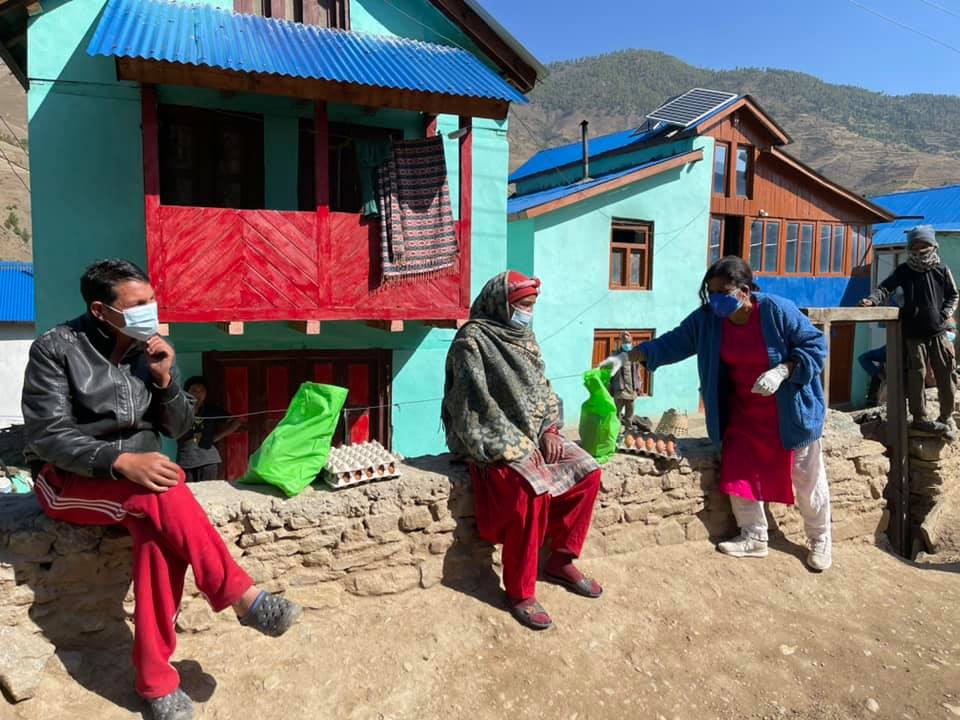 Local representatives of Chandannath municipality in Jumla district distributing food to those in home-isolation.
Kantika Sejuwal, mayor of Chandannath Municipality Julma, decided to visit Covid-19 patients in home isolation with medicines and food rich in protein.
“We were not prepared for the second wave. Our isolation center was not even ready. So I decided to visit patients at home,” Sejuwal says.
According to Sejuwal, local governments are handling the worst crisis they have faced since their formation in 2017.
“The federal and provincial government representatives are busy fighting for power and the local units are paying the price,” she says.
Local representatives of Bheriganga Municipality in Surkhet distributed food and medicines to Covid-19 patients. They visited Covid patients in home-isolation with health workers for counseling.
Dharma Bahadur KC of Banphikot Rural municipality Rukum visited Covid patients with a health worker’s team, counseling them and spreading awareness among villagers. Representatives of Butwal Sub-metropolitan city did the same.
Visits and sympathy from local representatives boost the morale of covid patients that is vital to fighting the disease as well as any social stigma it might bring.
Nepalgunj Sub-metropolitan City also initiated drive-through treatment of Covid patients in home isolation.
Missing money
Prime Minister Oli decided to seek a vote of confidence from Parliament on May 10 at a time when the country was reporting over 9,000 daily Covid-19 cases, and test positivity had reached 40 percent.
“The central and provincial governments, caught up in bitter power tussles, could do little and we had to shoulder the bulk of the responsibility,” says Kantika Sejuwal of Chandannath municipality.
According to Uma Thapamagar of Nepalgunj, had the federal and provincial governments acted on time, losses from the second wave of Covid-19 could have been minimized.
“Almost all local governments, including Nepalgunj, prepared isolation centers for the treatment of Covid-19 patients and managed oxygen on their own, by going beyond their constitutional and legal jurisdiction,” says Thapamagar. “The federal government just watched from the sidelines.”
Madhyapur Municipality in Bhaktapur started its oxygen plant when the country was facing an acute oxygen shortage.
Almost all local governments established isolation centers for the treatment of Covid patients as major hospitals were running out of beds and oxygen.
“The federal government has undermined the role of local units even in the ordinance on Covid-19 management,” says Ashok Byanju, chairperson of the Municipal Association Nepal.
“If infectious disease management is the federal government’s absolute domain, it should manage the emergency on its own. If not, local governments should be adequately empowered,” he adds.
According to him, local governments have yet to recover the Rs 12 billion they spent on covid-management last year.
Some local governments have also sought the federal government’s permission to purchase Covid-19 vaccines. But health ministry officials say local units simply don’t have the wherewithal to do so.


