



Unstable Nepali polity

When democracy was restored to Nepal in 1990, the country was unprepared. The state had been thoroughly centralized under the Panchayat system, with everyone ultimately answerable to the monarch. Between the people and the place, there were only a handful of intermediary institutions, which too came under direct control of the monarchy. Political parties were banned, and so were independent courts and constitutional bodies. Thus post-1990 governments had to operate in a kind of vacuum. Without functioning democratic institutions to hold them to account, the political leaders who suddenly found themselves in power were free to do pretty much as they pleased.
Lack of democratic culture became immediately clear as political parties started a mad scramble for power. Politicians were reluctant to sit in the opposition and miss out on the gravy train. Hence no sooner would a government be formed, the opposition was already plotting its downfall. Nor were big parties like Nepali Congress and CPN-UML united, and competing political leaders often conspired to bring down their own governments. One reason for this perpetual state of instability was the flawed legislation that allowed quick making and breaking of governments. This changed in 2015 with the drafting of a new constitution.
But even though the legislation changed, the mindset of the class of politicians that has continuously ruled the country for the past 30 years didn’t. So despite the ruling Nepal Communist Party now having nearly two-thirds parliamentary majority, its government once again appears wobbly even as more than half its five-year mandate remains. “Democracy demands responsible, broad-minded and consultative political leadership,” says political analyst Krishna Pokhrel. “Yet we have hardly had leaders with these characters since the 1990 political change.”
One reason for this close-mindedness is the tendency of our top political leaderships to limit their horizons to a small coterie of leaders and advisors. They simply don’t trust others. Another political analyst Chandra Dev Bhatta avers that the current regime, like the earlier ones, is heavily occupied by power politics and not with people’s urgent agendas. Bhatta argues that ‘elite settlement’ of various democratic movements and convergence between the ‘old’ and ‘new’ classes to amass power, prestige and money create disillusionment among the masses and thus sow the seeds of instability.
Then there is India, which became enmeshed in making and breaking many governments in Kathmandu. India wanted to maintain its stranglehold on Nepali polity and keep other foreign actors out. But in analyst Pokhrel’s words, “India’s interference persists, and yet the primary drivers of instability remains domestic—and it was no different in the past.”
Sadly, the country’s current political leadership has done little to strengthen other democratic institutions or to make people believe it is working in their interest. It also seems minded to rely on external actors to protect its reign.

Lack of intra-party democracy contributing to perpetual political instability
In 1991, following the restoration of democracy in 1990, the Nepali Congress (NC) formed a single-party majority government with a five-year mandate. But largely owing to intra-party rifts, the government led by Girija Prasad Koirala collapsed just two years after its formation, starting a phase of chronic instability that still characterizes the country.
Frequent government changes, never-ending horse-trading for power, and corruption have since become key features of national politics. Again, in 1999, the Nepali Congress secured a majority in parliamentary elections and Krishna Prasad Bhattarai became the prime minister. But he was forced out in under a year, largely due to machinations of Koirala. This ultimately culminated in King Gyanendra’s takeover of executive powers in 2005.
In the first Constituent Assembly (CA) elections in 2008, the mother Maoist Party that had waged the decade-long insurgency emerged as the largest party, with near majority seats in the CA. But the subsequent government of Pushpa Kamal Dahal collapsed after only nine months in office. He had to resign over his sacking of the army chief Rookmangud Katawal, allegedly at the instigation of Baburam Bhattarai who wanted to cut Dahal down to size.
Intra-party rifts have been common in different political parties. And most Nepali prime ministers of the past three decades have paid for their failure to manage the relation between their party and the government. “Democracy demands a responsible, broadminded and consultative political leadership,” says political analyst Krishna Pokhrel. “Yet we have hardly had any leaders with these characters since the 1990 political change.” He attributes Nepal's political instability to the tendency of leaders to confine themselves to small coteries instead of trying to take the whole party into confidence.
Different but same
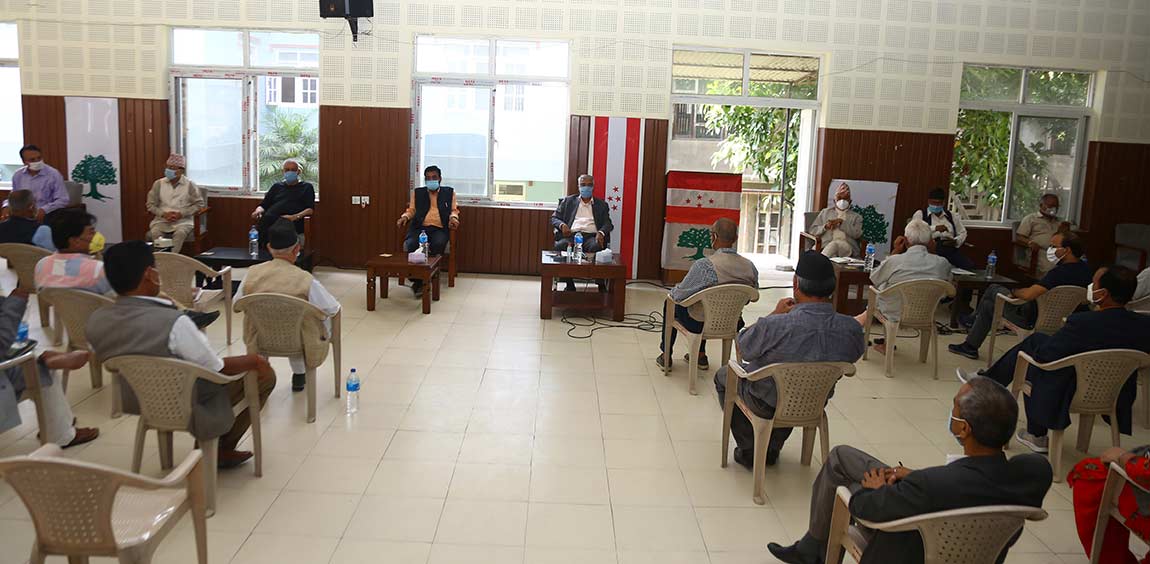
The formation of KP Sharma Oli's two-thirds majority government in 2018, it was hoped, would finally herald an era of stability. Yet in the two and a half years since, there have been constant talks about rifts in the ruling Nepal Communist Party and egregious lack of coordination between the party and the government it led. “The party gave a free-hand to PM Oli. But Oli failed to maintain a cordial relation with the party,” says Pokhrel. The kind of close consultation and coordination that is needed between the party and the government on policy-related issues was missing.
Another political analyst Chandra Dev Bhatta also speaks of his disappointment with the two-thirds majority government. “The much talked about stability is once again falling apart due mainly to internal wrangling in the NCP,” he says. The current regime, like the earlier ones, is also heavily occupied by power politics, he avers, at the expense of people’s agendas.
Bhatta argues that ‘elite settlement’ of various democratic movements and convergence between the ‘old’ and ‘new’ classes to amass power, prestige, and money has also contributed to political instability in Nepal.
In the post-1990 phase, the number of political parties mushroomed. In several cases, fringe parties with only a handful of seats in the parliament were able to act as kingmakers. There were other loopholes in the parliamentary system as well. The earlier constitution gave the prime minister full authority to dissolve the House and call for fresh elections. That is why one after another prime minister opted for mid-term elections whenever they faced a crisis of confidence in their own party. In the new constitution adopted in 2015, many such loopholes were closed. Under new provisions, the prime minister cannot call for mid-term elections so long as there is a possibility of government formation from the House floor. Similarly, a no-confidence motion against the prime minister cannot be introduced before two years of government formation. The split of political parties has been made difficult too.
Enemies without
Then there are the external factors. Though India often says stability in Nepal is in its interest, it has often belied its stated commitment. In the past, India was instrumental in making and breaking governments by playing with the contradictions within Nepal. In analyst Pokhrel’s words, “India’s interference remains, and yet the primary drivers of instability are domestic. It was no different in the past.”
Bhatta has similar views on external factors. He cites two primary reasons for their outsized importance in Nepal: the country’s sensitive geographical location and its poor economic condition. “Our leaders have been co-opted by outside powers and today we see the majority of the political class is pro-India, pro-China, pro-West but not necessarily pro-Nepal,” he adds. The role of external meddling is so ingrained in Nepali minds that there is a tendency to see outside hands in just about every political development.
Shyam Shrestha, an analyst of left politics, meanwhile, blames the tendency in communist parties of portraying rival factions as enemies. “If you see the politics of the last three decades, there has been a tendency of betrayal and non-cooperation in our communist parties. Similarly, leaders don’t seem committed to honoring their agreements. For instance, the first Oli government collapsed in 2016 because of his reluctance to implement the deal with Prachanda. Conditions now are pretty much the same.”
All three political analysts APEX talked to concurred that political stability would continue to remain elusive so long as Nepali political parties failed to strengthen internal democracy.

India or China?
Carefully balancing the influence of its two giant neighbors has been Nepal’s guiding foreign policy principle since the reign of Prithvi Narayan Shah. This has never been easy. The British India government or the Qing emperors, each wanted the small landlocked state to serve only its interests. This expectation remains more or less intact. As India-China ties take a nosedive, Nepal could once again find itself in the unenviable position of being asked to choose between its two equally indispensable neighbors.
This is not idle speculation. There have been similar expectations in the past. Officially, “Nepal is confident that both the neighboring countries will resolve, in the spirit of good neighborliness, their mutual differences through peaceful means in favor of bilateral, regional and world peace and stability.”
But that is not how folks in New Delhi or Beijing see it. “Nepal has to take a clear position on whether to stay neutral or take a side,” says Nihar R Nayak, a Delhi-based expert on Nepal-India ties. He says that as per the 1950 treaty, India could inform Nepal about its tensions with China and may seek its support.
Lin Minwang, Professor at Institute of International Studies at Fudan University, and deputy director of the university’s Institute of South Asia Studies, says “India’s violation of the territorial sovereignty of China and Nepal has given China and Nepal a common strategic interest on this issue.” Therefore, China and Nepal should support each other in this process, whether this support is “direct or indirect, public or private.”
Nepali geopolitical analyst Tika Dhakal differs. “Nepal has historically taken a neutral, non-aligned position between the two neighbors. One aspect of Nepal’s unique positioning in the South Asian region is its role as a buffer between India and China,” he says. “Continuation of this policy is important to ensure perpetual peace in Nepal as well as in the region.” Nonetheless, Dhakal too does not rule out added pressure on Nepal to take sides.
Another issue dividing public opinion in Nepal is the MCC compact, the American grant program. The compact is in limbo after the latest parliamentary session that ended June 2 failed to endorse it. China is against Nepal’s endorsement of the compact, as it sees it as a part of the Indo-Pacific Strategy that aims to contain its rise. As India-China tensions worsen, India may pursue its interests in Nepal in concert with the US, further complicating things for Kathmandu.
The Oli government has only itself to blame for its current pro-China image, at least outside the country. There was no need for Nepal to hail China’s aggression in Hong Kong, or for the ruling party leaders to take part in a ‘training session’ with the CCP leaders—not when India and China were on the brink of war. History suggests Nepal cannot afford to so heavily rely on one of its neighbors, almost to the exclusion of the other. If unnatural proximity to India is dangerous, so is the NCP’s current love affair with China. Astute heads will be needed to pull Nepal out of the geostrategic quagmire it finds itself in.

Nepal likely to be asked to pick between India and China
Kathmandu: Nepal is watching mounting tensions between India and China in the Himalayas with great concern as it struggles to balance its relationship with its two giant neighbors. Reportedly, both India and China are amassing troops and weapons along the Galwan Valley in Ladakh—and preparing for the worst. Indian Prime Minister Narendra Modi has already given his armed forces a free hand to “take necessary steps to protect Indian territory.”
Nepal is also keenly watching growing tensions between China and the US. Over the past few years, Nepal had been witnessing heightened US-China rivalry, largely owing to developments around the American Millennium Challenge Corporation (MCC) and China’s Belt and Road Initiatives (BRI).
In a June 20 statement on Ladakh, Nepal’s Ministry of Foreign Affairs urged both sides to resolve the dispute through dialogue: “… In the context of recent developments in the Galwan valley area between our friendly neighbors India and China, Nepal is confident that both the neighboring countries will resolve, in the spirit of good neighborliness, their mutual differences through peaceful means in favor of bilateral, regional and world peace and stability.”
In an earlier India-China faceoff in 2017, this time in Doklam valley on the Bhutan-China border, Nepal had also maintained its neutrality and urged the two countries to resolve differences through dialogue. At the time, although India did not publicly say so, many Indian intellectuals had asked Nepal to support India on the basis of the 1950 Peace and Friendship Treaty. Similarly, during the 1962 India-China war, Nepal was able to maintain its strict neutrality by resisting competing pressures.
But if India-China tensions continue to grow, Nepal could once again be asked to take sides. “Nepal has to take a clear position on whether to stay neutral or take a side,” says Nihar R Nayak, a Delhi-based expert on Nepal-India ties. “On this issue the ruling Nepal Communist Party will be divided. So will the opposition parties.” He says that as per the 1950 treaty, India could inform Nepal about its tensions with China and may seek its support.
Nepali geopolitical analyst Tika Dhakal differs. “Nepal has historically taken a neutral, non-aligned position between the two neighbors. One aspect of Nepal’s unique positioning in the South Asian region is its role as a buffer between India and China,” he says. “Continuation of this policy is important to ensure perpetual peace in Nepal as well as in the region.” Nonetheless, Dhakal too does not rule out added pressure on Nepal to take sides.
As with India, so with China
Just like India, China is also likely to seek Nepal’s support if tensions rise. In an email interview, Lin Minwang, Professor at the Institute of International Studies at Fudan University, and deputy director of the university’s Institute of South Asia Studies, says “India’s violation of the territorial sovereignty of China and Nepal has given China and Nepal a common strategic interest on this issue.” Therefore, China and Nepal should support each other in this process, whether this support is “direct or indirect, public or private.”
If China and India go to war, the issue of Nepali nationals working in the Gurkha regiments of the Indian Army will again come to the fore. In that case, says Nayak, political parties and people from various walks of life could protest the deployment of Nepali nationals against China: The prospect of your fellow citizens coming back in body bags while fighting for another country is rather unsettling.
The employment of Nepalis in the Indian Army “will affect Nepal’s interests if there is a conflict between China and India,” says Professor Lin. “China and Nepal should consider this issue that could adversely impact China-Nepal relations.”
Separately, experts say growing India-China tensions could push India closer to the United States and the European Union. In this scenario, India and the US may choose to work together to curtail growing Chinese influence in the region. Both India and the US oppose China’s BRI in Nepal. If India’s rivalry with China continues to grow, there is also a likelihood of an informal alliance among the four Quad members—India, Australia, America, and Japan—under the Indo-Pacific Strategy.
“The Quad has always been a part of the ‘Great Game’ imagination in the Pacific Ocean. On paper, such an alliance appears grand. But history informs us that attempts to isolate a particular country seldom yield peace. Isolating a powerful rising power like China can have even more dangerous consequences,” Dhakal says.
Domestic ructions
Amid such a fragile international climate, the future of the KP Sharma Oli government is in doubt after five of the nine NCP Secretariat members asked for his resignation, both as the head of the government as well as the party chairman. PM Oli is also in a pickle over the MCC compact, which he backs but is opposed by the majority Secretariat members. If Oli is removed at this juncture, the compact’s future will be in limbo.
Professor Lin says that China expects the NCP unity to remain intact, especially at a time “external forces are trying to influence unity within Nepal.”
For his part, Dhakal expects the new geopolitical competition in Nepal to be first evident in the form of growing competition between the BRI and the MCC, and the SAARC and the BIMSTEC, for instance. In the medium term, “this may reflect in the development aid that will come with more strings attached, and in sharp division among big powers even in our domestic issues.”
Additionally, escalating India-China border tensions could have a wider socio-economic impact on Nepal in the form of “blocked trade routes and scarcity of supplies.”


