


Nepal: A country drowning in alcohol

Those who enjoy a drink will always find a reason to grab a bottle on their way back home from work, or make a quick detour to indulge in a peg or two at their favorite bar. Maybe there is something to celebrate—a raise or a praise, or you’ve had a hard day at work. Life is too short to wait for the weekend, isn’t it? With alcohol available anywhere and everywhere—from that innocuous tea shop to your local grocery store, drinking has become normalized. So much so that non-drinkers often find themselves explaining why they don’t drink.
Spokesperson of the Nepal Police, Basanta Bahadur Kunwar, sees the need for urgent regulation of alcohol sales in Nepal. The rampant selling and buying that is the norm today is harmful, leading to many social ills and perpetuating crimes, he says. There are many cases of domestic violence stemming from alcohol abuse, and that’s true in urban areas as well where people are educated and aware. “Something has to be done to limit alcohol consumption. We could start by allowing alcohol to be sold only in special pocket areas,” he says.
Our society has plenty of underlying stressors. Though it would be wrong to pin the blame on alcohol, often, as something that gives you a false sense of control or dampens your senses, it aggravates problems. Pinky Gurung, president of Blue Diamond Society, says many people of her community have attempted suicide after drinking. Just four months ago, a transgender died after drinking alcohol for two weeks straight when her partner left her. Alcohol consumption, Gurung adds, has worsened many people’s physical and mental health.
“It’s no secret that alcohol affects your senses and you are more likely to make rash decisions while drunk. Many times, that has fatal consequences,” says Gurung. Regulations and monitoring of alcohol sales and consumption could potentially save lives and create a safer society. One reason for the government’s failure to make proper rules regarding this is because liquor sales account for 11.8 percent of its direct revenue, says Arun Sigdel, owner of The Sanepa Madira Store, a liquor shop, in Lalitpur. The figure goes up to 34 percent when indirect revenues are added. Nepalis, he says, buy 11,000 liters of alcohol a day (and that is not counting unlicensed sellers and local ‘raksi’).
Also read: Are we losing interest in Nepali books?
“The impression our suppliers abroad have is that Nepalis drink a lot. The folks at Johnny Walker are surprised that we consume so much scotch,” he says. The reason for this, he says, is definitely easy availability. The more you drink, the more you want to drink and when there is a store selling liquor right next to your home you will be tempted. Mishlin Gurung, cashier at Green Line Center, another alcohol store, in Kantipath, Kathmandu, says drinking is also trendy among the youth. It’s a fad that doesn’t seem to go out of style. She sees a lot of people in their 20s buying liquor and there is a pattern to it, she says. “They usually drink what everyone else is drinking. The general mindset is that you have to drink to be cool,” she says.
Pooja Thapa, owner of Binayak Liquor Shop in Ekantakuna, Lalitpur, says Nepalis are drinking more than ever before and that the liquor business is a highly profitable one. Though she didn’t disclose how much liquor is sold on a daily basis, she said it was definitely on the higher side. One could say the store has a customer or two at all times. No wonder why new liquor stores have popped up all over Kathmandu. In Ratopul, what used to be a clothes retail shop and a place selling mobile accessories are now fancy liquor stores. Shisir Thapa, founder of Cripa Nepal, an alcohol rehabilitation center, says there was a tea shop near the center that wasn’t doing well but business boomed after it started selling alcohol.
Thapa says Nepalis are at a high risk of alcohol abuse as it is available everywhere and anyone can access it. There is no oversight on who is selling alcohol and who is buying it. This has been creating many problems in our society but the government remains oblivious. “Imagine how bleak the situation is when there are alcohol suppliers right next to a rehabilitation center where people are struggling to overcome alcohol addiction,” he says.
The government had solid plans to curtail alcohol sales and consumption—from maintaining distance between two liquor shops to selling only at fixed hours—but like much else, they have been limited to paper. The only action ever taken was a ban on alcohol advertisement, promotion and sponsorship when the government passed a National Policy on Regulation and Control of Alcohol in 2017.

“Even that one rule hasn’t been followed. You can still see open advertisements of alcohol in the guise of event promotions and such. The government has been negligent in this regard,” says Thapa. Plans to regulate alcohol sales in Nepal never come to fruition because “alcohol in itself is politics,” says Bishnu Sharma, CEO of Recovery Nepal, the umbrella organization of rehabilitation centers in Nepal. Sharma says their repeated lobbying for policies to regulate alcohol sales in Nepal have failed—and how. Manufacturers of liquor have lobbied harder and used their higher-up contacts to foil their efforts. The government, citing high revenue from liquor and tobacco industries, has refused to do anything to curb sales.
Minesh Rajbhandari, co-founder of Cheers, an online liquor store, says there needs to be a proper system to control and monitor alcohol sales. The government shouldn’t be giving out any more licenses and should monitor the ones who are in the business to ensure they aren’t selling to minors or evading taxes. “We could learn a thing or two from how India is managing its liquor industry,” he says.
Our culture promotes drinking and that makes it worse, adds Sharma. He cites a study from Rasuwa district that found that the main cause of abject poverty was alcohol. Every ritual demanded alcohol and people took out hefty loans to provide the same to families and friends. Sharma says his organization ran some programs to change this situation and the results have been positive. What Nepal needs is many more of such interventions. “Our effort in Rasuwa is just a symbolic gesture. The government has to come forward to tackle the social ills brought about by alcohol consumption,” he says.
The state, he believes, is being hypocritical. First it allows people to drink but when there are inevitable brawls and fights and people pass out on the road, they are taken to the station and locked up. Stricter laws and proper enforcement of those laws are what’s needed. “You can’t allow something to thrive like the way it has allowed the liquor industry to and then tell people to be responsible adults,” says Sharma.
Sharma, much like every other person ApEx spoke to, isn’t calling for a blanket ban on alcohol sales and consumption. Everyone thought there were many cultural and religious sentiments to take into consideration but they agreed that we must also think of the cost addiction puts on a nation and its economy. “Alcohol is a part of many cultures and religious festivals but that doesn’t mean there shouldn’t be rules to control its use,” says Sharma. “The key here lies in proper regulation and policies to tackle the effects of alcohol abuse.”

The Triangle Conference: Vote of thanks
Vote of thanks
The Annapurna Express would like to thank all esteemed panelists, speakers, and moderators (pictured alongside) who made the first edition of our signature ‘The Triangle Conference’ (Nov 25-27) a roaring success. You were the beating heart of the event that was aimed at getting the stakeholders in government, business, and academia talking, with the ultimate goal of harmonizing their work for the greater good of the country and the people.
This conference would also not have been possible without the generous help from our sponsors—Standard Chartered Bank, Global College, and the National Democratic Institute—who wholeheartedly supported our novel venture. The Express team is also in Vote of thanks debt to Annapurna Media Network Chairman Capt Rameshwar Thapa (who so readily backed our vision), Group CEO Sanat Neupane (the brain behind the conference), and our Publishing Director Sachan Thapa (for his enormous help with the event’s live TV broadcast).
A big thanks to all our other AMN colleagues who helped us with the event as well as the many more of our friends from outside the organization for their invaluable feedback and guidance. In the end, The Express would like to reiterate its commitment to the AMN’s ‘Unity for Sustainability’ campaign and vows to make all its events as climate-friendly as possible.
Thank you, everyone.
The Annapurna Express Editorial team
Day 1
Session 1: Nepal 2030
Nepal’s national capabilities. What do we have? What do we need? Our progress on SDGs and development.
Panelists:
 Kewal Bhandari, Secretary, National Planning Commission
 Indra Adhikari, Political Analyst
 Bishal Chalise, Assistant Professor, TU
 Pawan Tuladhar, Tourism Entrepreneur, Dharma Adventure
 Sunaina Ghimire Pandey, MD, General Technology Pvt. Ltd.
Session 2: Post-pandemic mental health, youth and workforce
Nepal was already burdened by a growing mental health epidemic. The pandemic made it worse. How do we get them, and the youth in particular, in a better shape and again contributing to the national economy?
Panelists:
 Manoj Gajurel, Comedian/Mental Health Campaigner
 Dr Rishav Koirala, Psychiatrist, Grande Hospital
 Bhawana Shrestha, Co-founder, My Emotions Matter
 Shreeya Giri, Founder/MD, Happy Minds
Session 3: Nation-building and leadership
 Kulman Ghising, MD, Nepal Electricity Authority
 Dr Sanduk Ruit, Senior Eye Surgeon
Day 2
Session 1: The triangular relationship gaps
Why are Nepal’s Government, Academia and Economy not in harmony? How do we get them talking and collaborating more?
Panelists:
 Bhim Prasad Subedi, Chairperson, UGC Board
 Manushi Yami Bhattarai, Politician, JSPN
 Suman Dahal, Researcher/Lecturer, Apex College
 Sohan Sha, Education Researcher, Martin Chautari
 Kushum Shakya, Economist
Session 2: Political parties and electoral governance
Heading into the next set of elections, how are our political parties gearing up? How is the election commission?
Panelists:
 Bishnu Dahal, Political Analyst
 Neel Kantha Uprety, Former CEC/Electoral Finance Researcher
 Lokesh Dhakal, Politician, Nepali Congress
 Yogesh Dhakal, Senior Journalist
 Bimala Rai Poudel, MP, National Assembly
Day 3
Session 1: Leadership: What’s missing?
What are we missing in leadership development? How do we create leaders, in every field?
Panelists:
 Prakash Chandra Pariyar, Secretariat Member, Bibeksheel Sajha Party
 Malvika Subba, Media Personality
 Dr Tshering Lama, Co-founder, Idea Studio
 Anjana Bishankhe, MP, HoR, CPN (Maoist Center)
 Devendra Pokharel, Director, Cocina Mitho Chha
Session 2: Workforce 2025
The traits, ideas, characteristics, competencies, concepts of the workforce Nepal needs by 2025.
Panelists:
 Namrata Pandey, Regional Director, Bangladesh International Mediation Society
 Daniel D. Shrestha, CEO, Cogent Health
 Jeevan Baniya, Researcher/Assistant Director, Social Science Baba
 Anil Muni Bajracharya, Deputy Director, Research Division, CTEVT


Paddy farmers to get up to Rs 55,000 in relief
The government has decided to provide cash relief of up to 65 percent of the production cost to farmers whose crops were completely damaged by unseasonal rains earlier this year.
The government made the announcement as per the new guidelines to provide relief to farmers. The guidelines, which were approved by the Council of Ministers on November 18, mention that a farmer shall not get more than Rs 55,000 in relief.
The government has allocated relief for farmers by categorizing them into small, medium, and big categories based on their landholding. While providing relief, the amount will be calculated based on the minimum support price of paddy.
According to the guidelines, small farmers who have suffered a complete loss will get relief up to 65 percent of the production cost. The government is ready to provide 30 percent relief to affected medium-scale farmers and up to 20 percent for big farmers. Likewise, the government will provide relief up to 20 percent of the production cost to large, medium, or small farmers whose paddy crop has been partially damaged.
Under the guidelines, farmers with more than three bighas (five acres) of land have been classified as big farmers. Farmers who cultivate other people’s land equal to the same area are also included in the category. Medium farmers are those who have more than 10 katthas (0.83 acres) and up to three bighas of land and cultivate on the same land. A farmer who cultivates up to 10 katthas (0.83 acres) of land has been classified as a small farmer.
Also read: Gorkha school awaits promised Chinese help 11 years on
In the case of joint cultivation, the guidelines mention, the relief amount will be calculated treating the whole group as one. This facility will not be available for farmers using encroached land, and those who have already received relief from other agencies, including insurance companies.
Before providing relief as per the guidelines, the local government shall collate data of the damage caused to the paddy crop due to unseasonal rains based on information collected by the District Administration Office, District Police Office, and other agencies. The ward office shall then publish a notice for affected farmers to provide documentary evidence to support their claims.
In case of failure to submit the documents, the farmer should submit the recommendation of the ward office endorsed by a ward member and three neighbor farmers. Along with the evidence, a copy of the farmer’s citizenship, and bank account details should also be submitted.
Based on the details provided, the government will deposit the relief amount in the bank account of the concerned farmer.
According to the guidelines, a three-member monitoring committee will be formed under the coordination of the head of the district coordination committee to monitor the distribution of relief.
According to the Ministry of Agriculture and Livestock Development, 325,258 metric tonnes of paddy worth Rs 8.268 billion have been destroyed due to unseasonal rains earlier this year. The ministry states that the paddy crop planted in an area of 85,580 hectares has been completely damaged. Paddy plantation on 285,076 hectares was partially damaged.

Landmark ApEx conference widely hailed

The Triangle Conference, an initiative of The Annapurna Express, concluded on a positive note with stakeholders from the government, academia, and economy pledging to collaborate.
During the seven sessions spread over three days, politicians, bureaucrats, academics, private sector representatives, student leaders and other representatives from the three sectors also discussed the gaps in inter-sector communication, their future vision for Nepal, entrepreneurship, leadership, and policy issues.
“Hearing our role models talk about leadership and nation-building gives us immense motivation,” says journalist Sunita Karki, who attended the conference.
Day I
The first session on national capabilities and necessities had panelists discuss the situation of academia and its link with economic development. The session, moderated by Jagannath Lamichhane, saw the participation of Kewal Bhandari, Secretary, the National Planning Commission. “It is the job of the government to bring out policies to promote the private sector and we are doing that,” said Bhandari. Panelist Sunaina Ghimire Pandey, managing director of General Technology Pvt Ltd, asked the government to establish an exclusive university for the IT sector.
Saurav Karkee, an IT student who attended the conference, agreed with Pandey. “The present and future of the nation depend on IT, so policies must revolve around this sector.”
Also read: The Triangle Conference: Righting the government-academia-business mismatch
The second session discussed the post-pandemic mental health of youths and the workforce population. Panelists discussed how youths can develop a positive mentality and contribute to the national economy.Hosted by Shreeya Giri, founder of Happy Minds, guests in the session shared their pandemic-related experiences. Comedian Manoj Gajurel, who was infected with Covid-19, said it was his positive mental energy that helped him recover. Similarly, Dr Rishav Koirala, psychiatrist at Grande Hospital said, “We need to teach mental health wellness as a subject in school.” Gajurel further added, “Parents should be aware before making their children aware of mental health wellness.”
The last session of the first day was conducted by Chief Editor of AP1 HD television, Tikaram Yatri. It discussed the role of leadership in nation-building. Dr Sanduk Ruit, senior eye surgeon, said ‘integrity’ was the key thing he expects from his team. “Without a synergy between the team and the leader, development is not possible as the two complement each other,” Kulman Ghising, managing director of Nepal Electricity Authority, said, while agreeing with Ruit.
Day II
The second day started with a panel discussion on the gaps between the needs and expectations of the government, economy, and academia. The session was moderated by ApEx Editor-in-Chief Biswas Baral. During the session, Sohan Sha, a researcher at Martin Chautari accused Tribhuvan University of failing the system and the country. Kusum Shakya, another participant, said, “Political and economic revolution must go hand in hand.”
Bhim Prasad Subedi, chairman of the University Grants Commission, highlighted the need for political consensus to improve the education system.
Also read: The Triangle Conference: Let’s discuss the future of Nepal
“This session helped me a lot because it talked about the mess that our public universities are in,” says Parbati Dahal, a secondary-level teacher. “I learned that those who should be leading the country are instead taking it backwards.”
As elections are round the corner, ApEx also organized a session on political parties and electoral governance. ApEx Assistant Editor Kamal Dev Bhattarai moderated the panel discussion which had veteran journalist Yogesh Dhakal asking for the source of funds for CPN-UML’s Rs 15 million-general convention. Similarly, Neel Kantha Uprety, former chief election commissioner, said, “Political parties buy their way to power through elections.”
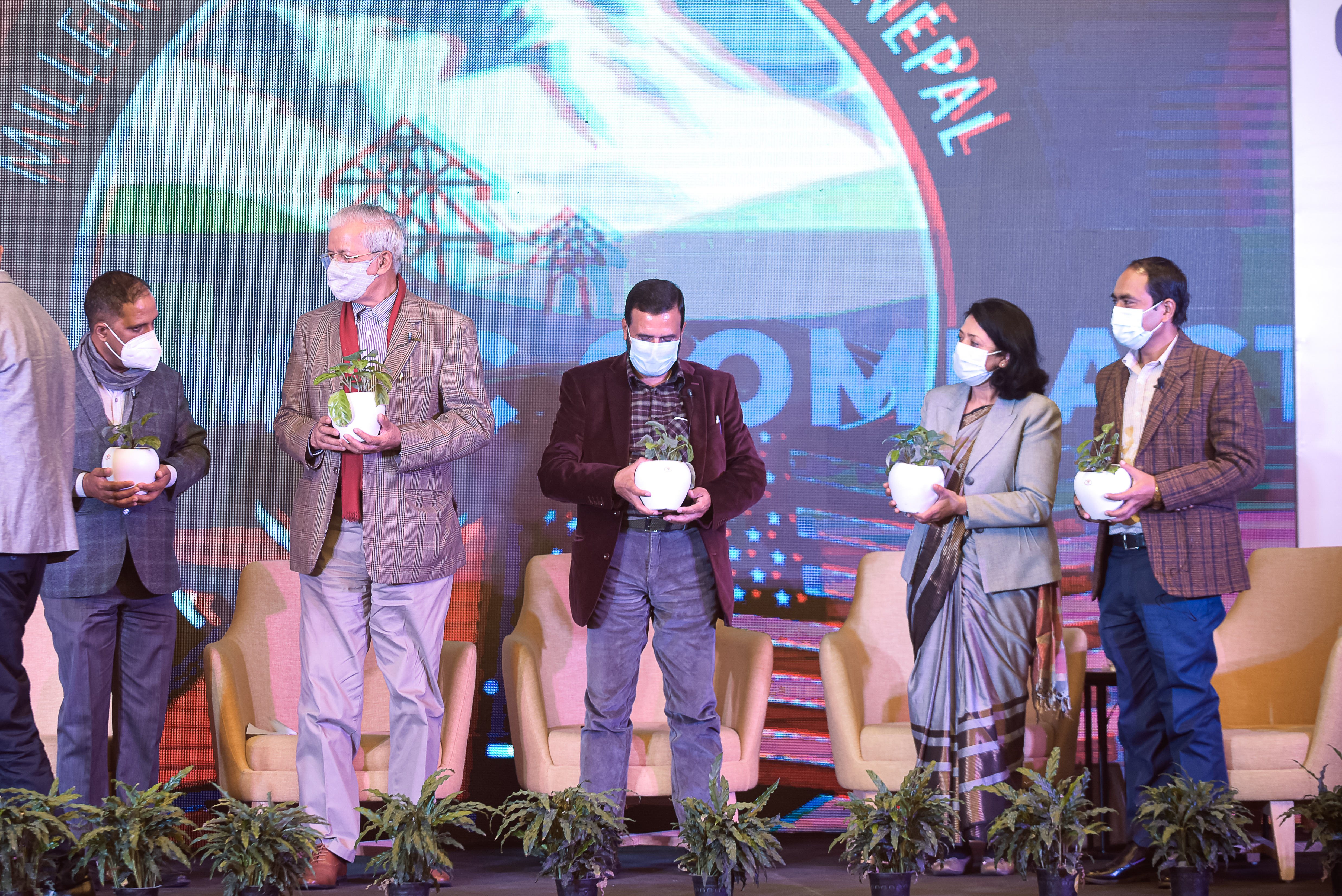
In the same session, Bimala Rai Poudel, a member of the National Assembly, defended lawmakers who won elections under the proportional system. She said, “Not all those elected through PR are corrupt and incompetent.”
Day III
The last day of the conference focused on leadership and the workforce.
The first session moderated by ApEx journalist Pratik Ghimire saw Anjana Bishankhe, member of parliament from CPN (Maoist Center), quote Mao’s definition of leadership. She said, “Leaders are those who are creative and farsighted but they also work with the public.” Devendra Pokharel, founder of Cocina Mitho Chha, asked leaders in all sectors to set examples. Similarly, Dr Tshering Lama of Idea Studio Nepal said, “There is a huge gulf between the confidence and competence in our leaders.”
Also read: AMN launches ‘Unity for Sustainability’ campaign
The second session, moderated by ApEx Assistant Editor Kamal Dev Bhattarai was named ‘Workforce 2025’. There, the panelists talked about the traits, ideas, characteristics, competencies, concepts of the workforce Nepal needs by 2025.
Dr Jeevan Baniya, a researcher in the same sector, said 84 percent of Nepali workforce are engaged in the informal economy. While Anil Muni Bajracharya said, “We lack demand-side education and also, vocational jobs are highly undervalued in Nepal.”
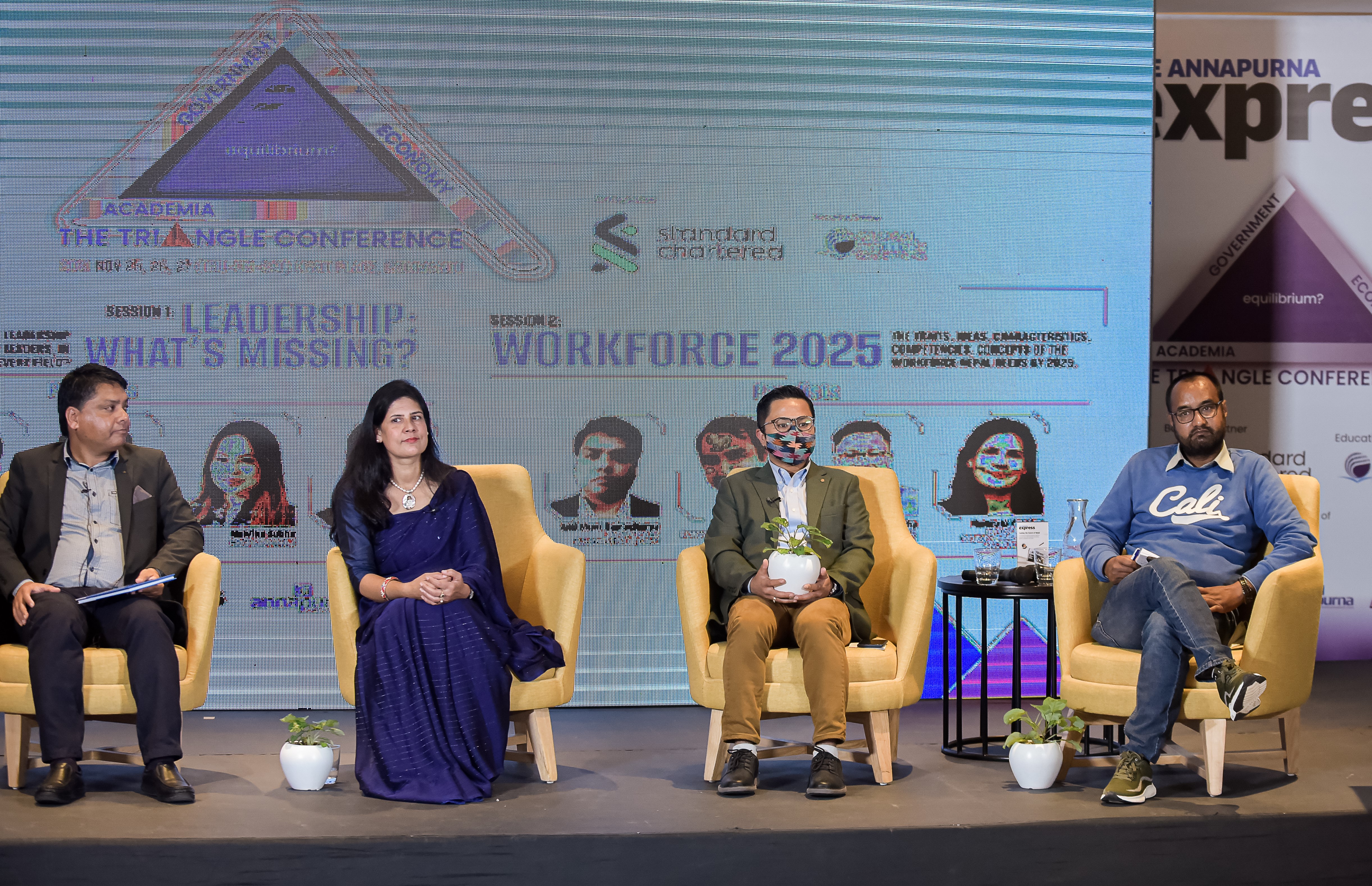
Pradyumna Raj Pandey, under-secretary at the Ministry of Agriculture and Livestock Development, said, “This kind of program will help all concerned parties to communicate with one another. I wish there would be more representation from the government sector in the days to come as they are the key to change.”


