


Are dietary supplements necessary?

Nepalis have always had a thing for trends. Our wardrobes mimic the styles of celebrities like Deepika Padukone and Katrina Kaif. We host gender reveal parties and plan elaborate baby showers for our friends, just like in the US. The trends we follow are usually harmless, albeit ridiculous sometimes. Health and fitness trends, however, are another matter altogether. They often have far-reaching consequences. Today, more Nepalis are buying and consuming different kinds of nutritional supplements than ever before. Many take multivitamins, omega-3s, biotin, or consume protein shakes on the reg. Experts ApEx spoke to say the trend might be unnecessary, and also a bit risky.
Anushree Acharya, dietician and MD, The Nutrition Cure Nepal, says people are popping vitamins like chocolates these days and it worries her. She says the Covid-19 pandemic made everyone conscious about health and fitness and while that’s a good thing, many have taken things too far. People buy huge bottles of fancy vitamin and mineral supplements with no understanding of when and how to take them.

Anushree Acharya, Dietician/MD, The Nutrition Cure Nepal
“What we need to understand is that a healthy person can get all the required nutrients from a proper, well-balanced diet,” she says. It’s only when you have some pre-existing conditions or a specific requirement to fulfill that you need additional nutrients in the form of pills, she adds.
Dietician Deependra Bhatta says supplements aren’t a replacement for a good diet. Many people don’t pay attention to what they eat and take health supplements like omega-3s and various vitamins to make sure their body’s requirements are being met. It’s become the easy way out, he says. Rather than basking in the sun, which we all know is the best possible source of Vitamin D, we choose to pop a pill. But food-based nutrition is better than relying on chemical formulations. It isn’t difficult to get the required nutrients from food either, says Bhatta. “For example, it’s not necessary to take iron supplements. Just add spinach to your diet. Iron needs Vitamin C for absorption and for that, you can squeeze some lemon on your food,” he says. Similarly, instead of having fish oil for omega-3s, you can include fish, cabbage, beans, walnuts, cashews, chia seeds, flax seeds, and berries among other food items in your daily diet.
Suraj Rawal, proprietor of The Protein Shop, says we have become so trend-driven that if someone we know is taking a dietary supplement, we too buy it without knowing whether it will suit us. Nikhil Tuladhar, marketing officer at E-pharmacy, says they often have to ask people buying multivitamin gummies whether the person they are buying it for has diabetes. It’s shocking how many people are unaware that there’s sugar in gummies, he says. Tuladhar has also had to deal with some parents who want to give multivitamins to their children from a young age. Despite the label in the kid’s multivitamin bottle clearly stating that it’s meant for children over two, there have been some customers who have insisted on buying it for their one-year-old. “It’s just vitamins, what harm can it do?” seems to be the general mindset, he adds.
Also read: Nepal: A country drowning in alcohol
Experts say it’s not possible to stay healthy by consuming supplements alone. That awareness is lacking in most people today who want a quick fix or to balance out their bad eating habits. A bad diet and then a handful of vitamins don’t cancel out each other, as much as you wish to believe they do. “Good health is a combination of four elements,” says Rawal. “It’s the result of proper diet, exercise, rest and supplements.” People should be attuned to how they are feeling and understand that their body is unique—meaning what works for their friend might not work for them.
But that isn’t the case, as is evident by the burgeoning online businesses selling all kinds of nutritional supplements. Pharmacies too have started stocking up on supplements because of their high demand. Multiple pharmacies in Lalitpur claim they have as many people coming in to buy supplements as prescribed medications. Tuladhar says people are mostly aware of the benefits but hardly ever of the contraindications. From what they have heard of and read on YouTube and other social media platforms, most seem to have come to the conclusion that supplements are necessary if they want to stay fit and prevent diseases.
However, Acharya says taking supplements without determining whether you need them can do more harm than good. It’s a waste of money too because the imported brands of supplements aren’t cheap. The best thing to do, she suggests, is to get a medical evaluation to figure out what nutrient you are lacking in and tweak your diet. You only need supplements when your daily intake of nutrients through food is inadequate and the inadequacy manifests in some form.

Tasnina Karki, Dietician
It’s also important to note that supplements come with a fair share of possible side effects. Dietician Tasnina Karki says there is a limit to how much vitamins and minerals you can take and consuming too much, for a long time, can lead to health issues. Excess of vitamins, especially fat-soluble vitamins like A, D, E, and K, and certain minerals can be toxic. For instance, overconsumption of Vitamin A and E leads to raised intracranial pressure that can mimic symptoms of stroke.
Consumption of large doses of Vitamin A can cause liver damage. If a pregnant woman consumes higher doses of Vitamin A than required, it can lead to birth defects in the fetus. Bhatta adds that supplements can cause annoying side-effects like dizziness and nausea in some people while in others it might lead to increased blood pressure. “Having supplements for a long time also weakens your digestive system,” he says.
Before supplements get a bad rap, Aarem Karkee, dietician at Patan Hospital in Lalitpur, clarifies that our diet today definitely lacks certain nutrients because the way food is grown and produced has changed. The soil quality today isn’t as it once used to be, so plants grown in that soil won’t have as many nutrients as it’s supposed to. We construct artificial ponds to keep fish and our cooking techniques, like steaming for too long or deep frying, ensures loss of nutrients.

Aarem Karkee, Dietician, Patan Hospital
So, in a way, supplements have become necessary. But it’s important to consult an expert to figure out what supplements you need and not randomly take anything and everything available in the market. “Dieticians can work with you to fix your lifestyle and prescribe the supplements you need. That way you will get all benefits while having to deal with none of the risks,” he says.

Senior citizens’ ordeal to get social security allowance
Senior citizens in Dang are facing hassles getting their social security allowance from banks after local governments switched to the banking channels. This happened a few years ago following complaints of irregularities in cash distribution.
Banks in Dang are witnessing a rise in the number of elderly visitors after the local governments deposited allowances for up to October. Senior citizens are forced to stand in queues outside the bank on their cold flights of stairs all day. The bankers say the government might recall their allowances deposited into bank accounts if they themselves don’t go to the bank.
For some of the senior citizens, it takes up to two days to reach the bank from their homes.

According to local government statistics, 11,500 people in the Tulsipur area get social security allowance. Chief of the vital registration branch of Tulsipur Sub-metropolis Krishna Bahadur Wali says that the allowance for senior citizens living in 19 wards (which amounts to around Rs 390 million) of the city is being sent to banks to minimize chances of corruption. According to official figures, around Rs 2 billion is spent on security allowances each year in Dang, which has 10 municipalities.
Banks, meanwhile, say that they are considering the needs of senior citizens. Kiran Acharya, manager of Siddhartha Bank Tulsipur branch, says that the bank is aware of its social responsibility.
Also read: Budget crunch, protests mar Kathmandu-Nijgadh Expressway
Dhani Kharalni, a 96-year-woman from Tulsipur, shares her suffering. She says she had had to have two helpers to her to the bank as half her body doesn’t move. "It's very difficult to get the allowance," she says.
She says people's representatives should arrange for allowances for senior citizens at their own doorsteps.
Bal Bahadur Pariyar, 78, complains that senior citizens are made to wait in line for hours. He says the local government and the bank should make separate arrangements for senior citizens.

Chaos on city roads
Kathmandu’s roads have always been used as dumping grounds or storage spaces for construction materials. Bricks, mortar, cement, and rods line many main streets and inner alleys alike, making driving or even walking on those roads difficult, if not impossible. Often, you can’t take your bike or car out of the house because the road is blocked off by construction happening in the area. If that weren’t enough, there are always electrical poles, water and sewage pipes and piles of telephone or internet wires taking up permanent space on almost every other road. That’s just how it is, we tell ourselves, and find alternate, albeit longer or inconvenient, routes for our daily commutes.
But nothing that obstructs the road or causes inconvenience to the public is allowed, says Shiva Prasad Nepal, spokesperson at the Department of Roads (DoR) under the Ministry of Physical Infrastructure and Transport. Problems arise when everybody is doing their own thing with blatant disregard for what’s allowed and what’s not, he says. At any point, the roads, even inner streets, should be clear for easy movement and passage of vehicles. Unfortunately, that’s not the case in Kathmandu. There have been instances of ambulances not being able to reach people’s homes because their streets were obstructed by multiple mounds of gravel and sand.
“In many places, wide roads have narrowed while narrow roads have gotten narrower,” says Nepal. “People are using roads as extensions of their homes, where they park their cars, dump garbage and store construction materials for long stretches of time.” Then there’s also the issue of the Nepal Electricity Authority not removing old poles and wires, and the Kathmandu Upatyaka Khanepani Limited (KUKL) not blacktopping roads after digging it up to fix pipelines. This, Nepal says, obstructs and damages our city roads. He says the DoR has MoUs with various authorities like the NEA and KUKL allowing them to potentially use roads for their works. The deal is that whoever digs up or carries out maintenance work on roads has to restore them to their original state.
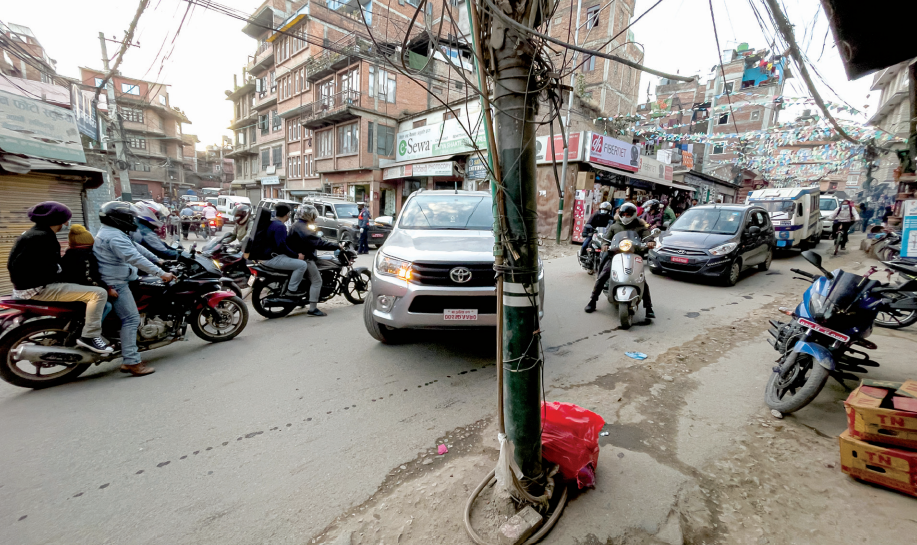
However, that’s not been the case, says Nepal, and that the DoR receives quite a few complaints about roads being dug up and left in muddy heaps, or electrical poles left in the middle of the street. DoR, he says, writes a letter to the concerned department requesting them to attend it but that is the extent of what they can do. “We can only hope they will keep their word, cooperate and fix the roads they have worked on,” says Nepal. Out of the 1,600 km of roads in the valley, only 440 km is under the DoR and they are only responsible for expansion and repair of these roads. The rest, the spokesperson says, falls under the jurisdiction of different municipalities and development boards.
Sunil Kumar Das, undersecretary at the Ministry of Water Supply and Sanitation, says it is KUKL’s responsibility to make the roads ready to be blacktopped after digging up. They don’t have the expertise to rebuild the roads. Conflicting statements from the concerned authorities suggest there is a lack of coordination and thus no clear-cut course of action, causing further disarray when there are inevitable constructions or renovations. But SP Sanjib Sharma Das, spokesperson of the Metropolitan Traffic Police Department, says nobody can use the road in a way that troubles others. You can’t block roads for weddings or construction. It’s not unusual for people to put up with road blockages because everybody knows Kathmandu is congested and there isn’t much space. How are you to build a house if you can’t bring and store the materials required for it on the road?
But Das says the law doesn’t allow that, and that there is a solution. Construction work can be carried out at night, from 8 pm to 6 am. That way, the bricks, sand and other stuff can be used up before it’s time for vehicles to move about. SP Das says that is what’s happening in his locality near HAMS Hospital in Mandikhatar, Kathmandu. After the superintendent’s repeated requests not to block the road with construction materials thus hampering vehicular movement, work now happens during off-hours and the road is clear during the day.
Also read: Nepal: A country drowning in alcohol
“If you have trouble moving about because of construction in their area, you can dial 100 or 103 and the police will come and get it cleared,” says Das. The police, however, don't resort to action or punishment in this case. They will only explain to the workers and owners of the property that they shouldn’t be troubling others. And in most cases, it works, says Das. “You don’t have to suffer the consequences of somebody else’s actions. Just be proactive and alert the authorities,” he says.
The problem of road obstruction apparently only arises when property owners opt for a labor contract instead of approaching construction companies that also manage other aspects of construction—environmental, social, traffic, health and safety. Kashin Dotel, senior project manager at Tundi Construction Pvt. Ltd., says a labor contract is mostly focused on cost minimization and profit maximization and that leads to many problems. “Since you pay per trip to bring in bricks and cement, you usually bring more than what is needed and dump it on the roads,” says Dotel. This doesn’t happen when a construction company is involved in a project. “We only bring as much as we need for a single job or go for ready-mix concrete that can be delivered to the site when needed or which takes very less preparation time. It ensures nothing is left lying around in public spaces,” he says.
Dotel’s colleague Asmit Pokhrel adds that there are many challenges that need to be taken care of before starting a construction project. A proper plan and company-client agreement are needed to ensure construction is carried out in a professional manner, with little to no harmful or troublesome impact on workers and public alike. “Construction companies plan everything before starting a project, finding additional space to store materials. That helps mitigate issues like traffic obstruction,” says Pokhrel. And when that’s not the case and issues do arise, DoR spokesperson Nepal says people can lodge a complaint at the DoR or with the police and, rest assured, it will be sorted.

Budget crunch, protests mar Kathmandu-Nijgadh Expressway
Only 16.10 percent work has been completed in the construction of Kathmandu-Tarai/Madhesh Expressway (fast track) due to the lack of funds and disputes over land acquisition, project officials say.
The government handed over the project to the Nepali Army in 2017, and gave it the DPR in 2019, with a mandate to complete all work in four years. However, with half of the allotted time now gone, progress has been slow.
“We are doing our best with the limited resources at our disposal,” says Lieutenant Col Biswa Bandhu Pahadi, who is overseeing construction work. Although the 72.5-km road, which is to be constructed as per the Asian Highway Standard, has been classified as a project of national pride, the government hasn’t provided sufficient funds for its construction. The army had sought a budget of Rs 30 billion for the project for the current fiscal year. But the government only gave it Rs 8 billion, in what is a Rs 175-billion project.
This road, which starts in Khokana, Lalitpur, traverses Kathmandu and Makwanpur to head to Nijgadh, Bara on the East-West Highway. Following its completion, travel time between Nijgadh and Kathmandu will be reduced to an hour.
Also read: Paddy farmers to get up to Rs 55,000 in relief
Khokana has been the scene of massive protests over the past few years as residents are against the construction of the expressway through a place of archaeological and historical importance. This has halted work on the 'Zero Point' of this road. Although there has been 92 percent progress—most of it outside Khokana—in land acquisition so far, delays in the acquisition of the required land in the Khokana-Bungamati area has hampered progress.
There are three tunnels on the expressway. Contract for the 3.355 km long Mahadev Danda tunnel has been awarded to China State Construction Engineering Company Limited, while the 1.630 km Dhedre-Lendanda tunnel went to the Chinese Polychagnda Engineering Company. The army plans to issue the contract for the remaining tunnel soon.
Lt Col Pahadi hopes the project will soon gather pace and the government deadline to complete the work will be met.


