


China’s ‘course correction’ in Nepal
The patchy history of collaboration with the Nepal Communist Party (NCP, 2018-2021) seems to have taught the Chinese a lesson or two in how to navigate Nepal’s complex and often unpredictable political landscape. In this period, the world’s emerging superpower worked closely with the now dismantled NCP jointly-led by KP Sharma Oli of the CPN-UML and Pushpa Kamal Dahal of the CPN (Maoist Center). All the while, the northern neighbor kept a safe distance from the Nepali Congress, traditionally a party of liberal views and considered close to India and the West.
But China now seems intent on making a correction on its Nepal policy—and the Chinese Communist Party (CCP) is taking the lead in this.
Liu Jianchao, head of the International Department of the CCP Central Committee, recently wrapped up his four-day visit to Nepal. During his Kathmandu stay, he expressed China’s desire to mend fences with the Congress party.
China no longer believes in keeping out of the internal affairs of other countries. In a clear hint of departure from its long-standing policy, Beijing actively courted Nepal’s communist parties, particularly after 2018. A similar trend was seen in other small South Asian countries.
During his Kathmandu sojourn, Jianchao’s focus was on improving ties with the NC. He even went to the extent of visiting the BP Koirala Memorial Planetarium in Sundarijal and recalled the late NC leader’s role in enhancing Nepal-China relations back in the 1960s.
Former Nepal’s ambassador to China Rajeshwar Acharya says the message is meaningful for Nepal’s political parties, particularly the Congress.
Over the first five years, the Chinese have realized that lack of communication with Congress has led to a misreading of its intent.
China is keen on strengthening ties with the Nepali Congress. The Deuba-led government has reciprocated the gesture too, says foreign affairs expert Geja Sharma Wagle.
Jianchao also tried to give the impression that Beijing treats all parties equally during a dinner with some Congress leaders. Meanwhile, the Congress leaders conveyed to him that favoring certain political parties in Nepal would be counterproductive for China.
In response, the Chinese leader said that China gives equal importance to all political parties of Nepal. The senior CPC leader also conveyed to the NC his willingness to build party-to-party relations.
In a separate meeting with Prime Minister Sher Bahadur Deuba, Jianchao categorically stated that China is willing to strengthen strategic communication with the Congress, promote mutually beneficial cooperation, and deepen exchanges and mutual learning on issues related to each other’s core interests and concerns.
As Beijing is set to reset ties with Nepal, some exchanges of visits are in the cards. Foreign Minister Narayan Khadka is likely to visit China soon, while some senior NC leaders could also land in Beijing in the near future.
Earlier, in March, a month after Nepal’s parliamentary endorsement of US $500m assistance under Millennium Challenge Corporation (MCC), Chinese Foreign Minister Wang Yi had come to Nepal. His visit was focused on growing American influence in Kathmandu and regional issues.
“The NC could emerge as a dominant political force after the upcoming parliamentary elections,” says Chandra Lal Giri, a researcher on Nepal-China relations at Research Center for Nepal and Asian Studies. “China is thus keen to revive cordial ties with the party.”
“The Congress is a permanent democratic force in Nepal, but China slowed down its engagement with the party after it was relegated to the opposition bench in 2018,” he says.
This created a perception inside the NC that China was ignoring them. China is trying to clear this misunderstanding.
The relationship between the NC and China soured due to the latter’s exclusive engagement with Nepali’s communist parties. Reports about border disputes in Humla district following the formation of Congress-led government did not help.
Beijing started seeing the Deuba government as pro-Western and continued to ignore the ruling democratic party. China’s policy of engaging exclusively with the communist parties of Nepal invited criticisms even from within the Chinese Communist Party.
But China enhancing its ties with the NC does not mean it now gives less importance to the agenda of left unity in Nepal.
China still wants to see communist parties of Nepal back in power, and to see them unite—but not at the cost of upsetting the NC.
In his private meetings with top communist leaders, sources say, Jianchao pushed for left unity. The Chinese leader had held one-on-one with Oli and Dahal following delegation-level meetings with Nepali leaders and officials.
He spent more than six hours with Oli and enquired about the possibility of unity or electoral alliance among left parties. If not party unity, China wants to see a coalition government of left parties in power.
Oli reportedly told Jianchao that the split in the NCP had nothing to do with him and that he has never opposed unification. He, however, added that he did not see left unity happening anytime soon.
Acharya, the former Nepali ambassador, says it is obvious that the visit’s main goal was to push for left unity.
This was also made clear by Chairman of Nepal Communist Party (Unified Socialist) Madhav Kumar Nepal, who told reporters that Jianchao stressed on unification among communist parties.
“The Chinese seek friendly and credible partners in Nepal and they feel more comfortable working with left parties,” Acharya said.
“China’s preference is a left-party led government in order to check growing American influence in its backyard,” says Giri, the researcher. “But the task of maintaining a balanced relationship with the NC and communist parties of Nepal is not an easy one. If China continues to push for left unity, the Congress will naturally continue to be suspicious.”
In his meetings with the Nepali leaders, Jianchao suggested maintaining unity among all political forces to preserve sovereignty and nationalism, a veiled reference to America’s growing influence in Nepal.
According to Acharya, even minor visits and activities of Americans in Kathmandu alarms Beijing these days.
China believes that the passage of the MCC compact could herald an era of greater American influence in Kathmandu.
During his Kathmandu visit, Jianchao also appreciated Nepal’s decision to refuse America’s State Partnership Program (SPP) through political consensus.
According to a Maoist leader, the Chinese leader’s message was that all parties should come together to “resist American pressure” in Kathmandu.
As always, China also raised the issue of security, only this time more seriously. Beijing fears that with the American influence in Kathmandu steadily on the rise, pro-Dalai Lama activities could increase.
On China's flagship Belt and Road Initiative (BRI), Jianchao requested the Nepali side to come up with a clear vision and plan based on political consensus.
Prime Minister Deuba reiterated his position that the country was in no position to accept loans to finance its development projects.
The Chinese side is also pressing Nepal to implement the agreements signed between the two countries during President Xi Jinping’s 2019 Nepal visit.
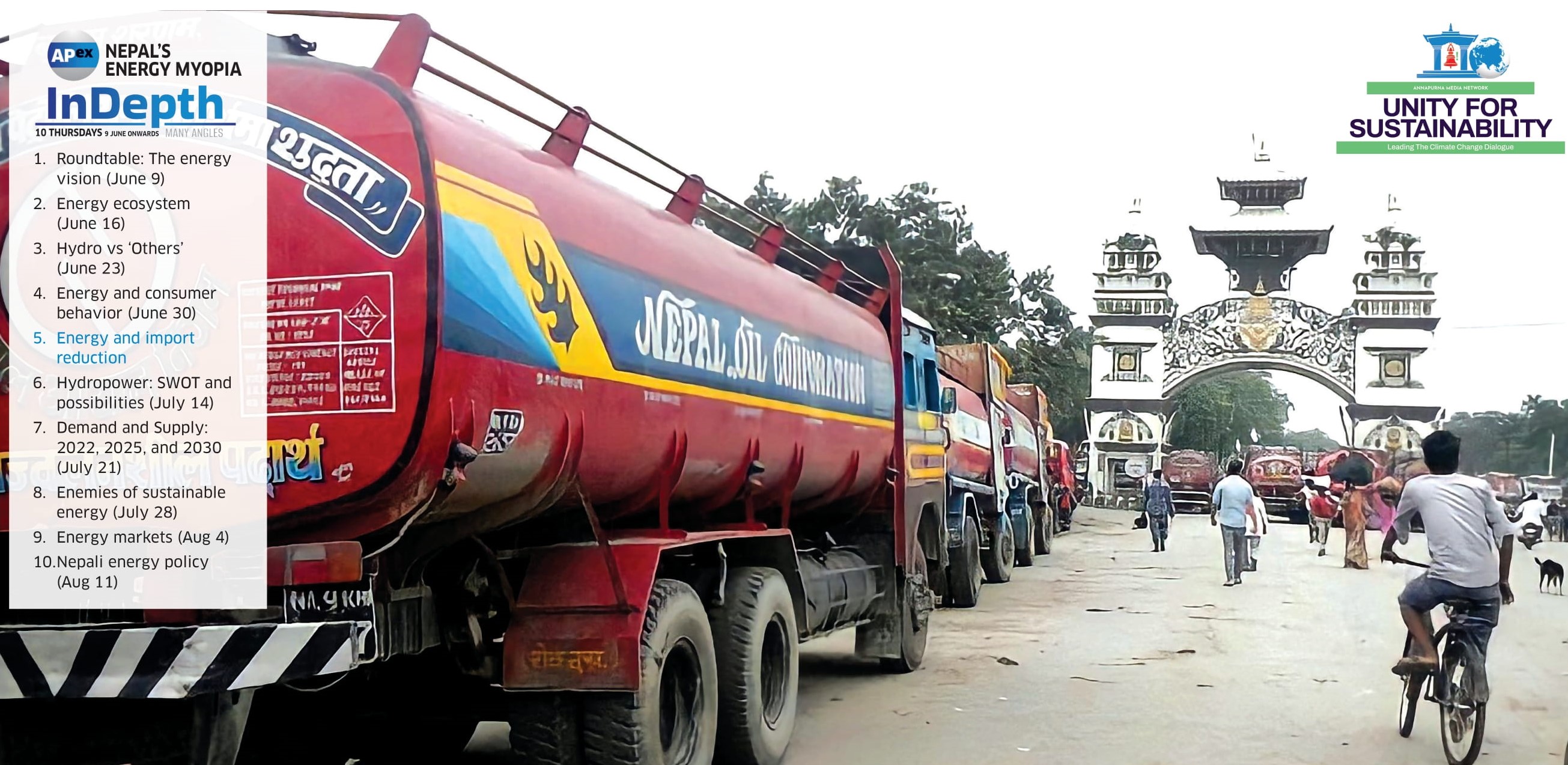
Energy: Can Nepal reliably reduce fuel imports?
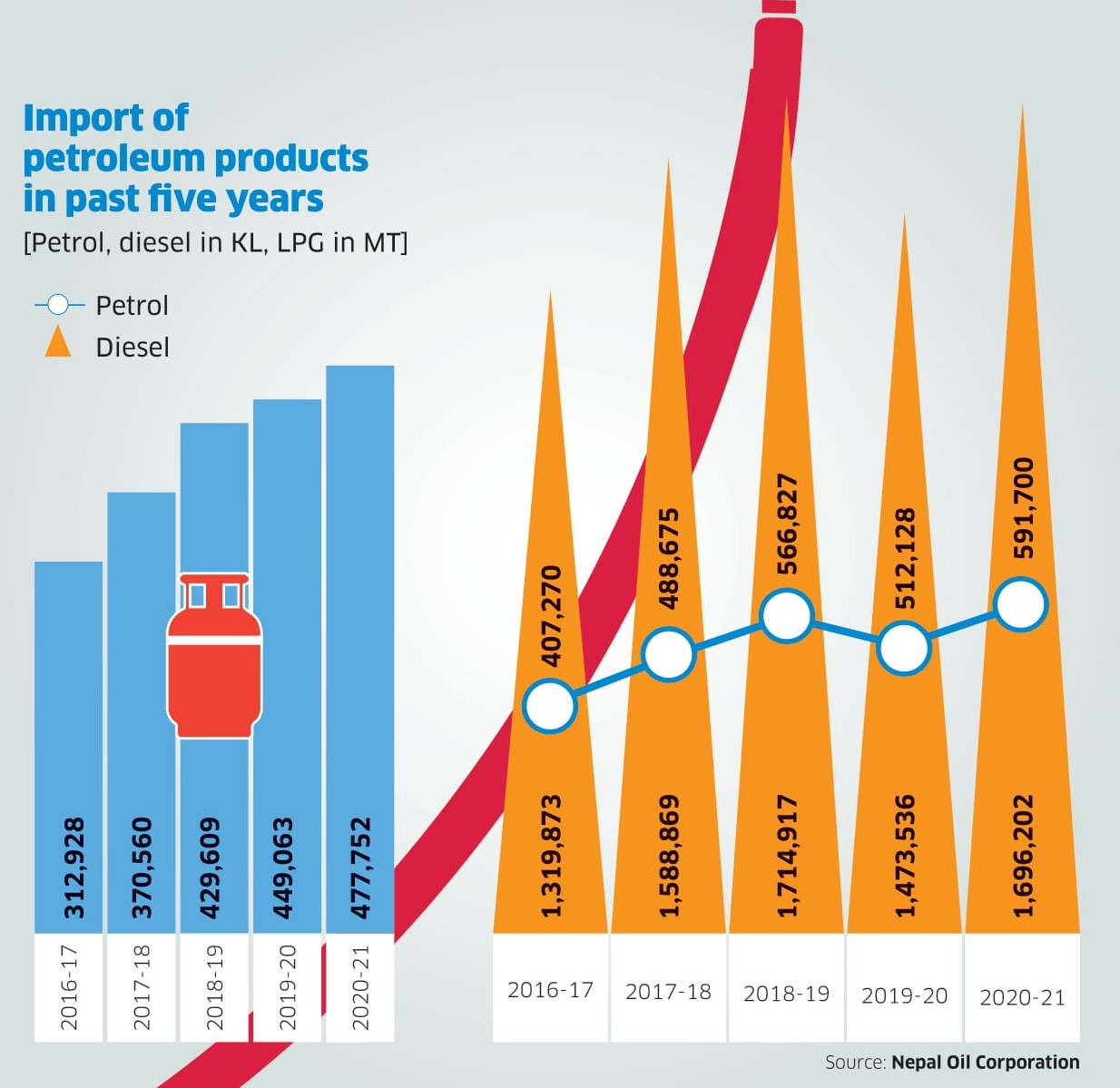
Nepal urgently needs to cut down on the import of fossil fuels from India to check the rapid depletion of its foreign currency reserves and thereby forestall an economic crisis. Fuel accounts for 14.1 percent of Nepal’s imports, and reducing its import will help the country save its foreign currencies and to minimize the trade imbalance with India.
Replacing the traditional sources of energy with cleaner ones is also an imperative in order to curb the worsening air pollution and combat climate change.
On paper, import reduction is a major government priority but in practice, it is just the opposite. Our import continues to balloon by the day due to poor implementation of policies.
Nepal’s import-reliant economy is unsustainable, particularly when oil prices are skyrocketing and global supply chains have been disrupted by the Russia-Ukraine war.
Government figures suggest significant import reduction is unlikely in the near future. According to the Economic Survey published by the Ministry of Finance (2020-2021), among the petroleum products, diesel is our chief import. In the fiscal year 2019/20, diesel made for 57 percent of the import-volume followed by petrol at 20 percent, and LPG at 17 percent. Likewise, aviation fuel made for five percent of the mix while kerosene made for a percent.
Meanwhile, the import of LPG is also increasing as gas stoves rapidly displace biomass and other traditional sources in rural kitchens. According to Nepal Oil Corporation, in the past two decades, LPG imports have jumped by 2,466 percent.
It is not just fossil fuels Nepal imports from India but also half of the total electricity it consumes during the dry season (the country also exports its surplus energy to India during summer).
Nepal currently produces 2,200MW of hydro-electricity, and plans on ramping up production to 10,000MW over the next decade. But during the dry season, our hydropower stations generate only a third of the 2,200 MW while the peak demand is around 1,700 MW. Nepal then has to import around 800 MW from India.
“With some hydropower projects close to competition, there is a hope that Nepal can stop importing electricity even in the dry season. But this could take three to four years,” says Sushil Pokhrel, a hydropower expert and the managing director of Hydro Village Pvt Ltd, a consulting company.
According to Energy Minister Pampha Bhusal, 94 percent of Nepali people have access to electricity but our per capita electricity consumption is just around 300 units a year, which is the lowest in South Asia.
Bhushal is hopeful that Nepal can produce an additional 1,000 MW of electricity within the next couple of years.
Producing more electricity is one thing. But will the produced power be optimally used? And can it replace fossil fuels, so that we can reduce our import of petroleum products?
Energy experts say extreme situations demand extreme measures.
First, they say, the government should promote the use of electric vehicles (EVs) to use up all the surplus hydroelectricity. They advise all local governments to take such measures.
The number of private electric cars is increasing, which is a good start. Greater use of EVs in public offices would be a good second step.
In its policy document, the Energy Ministry says 25 percent of all private passenger vehicle sales, including two-wheelers, will be electric by 2025. It also aims to push the number of four-wheel public vehicles (besides electric rickshaws and tempos) to 20 percent.
If this target is achieved, it would decrease Nepal’s fossil fuel imports by 9 percent, a study by the ministry shows.
Experts also suggest adopting electric stoves in our kitchens. These stoves are 60 percent cheaper to buy and operate than LPG ones.
Environmentalist Bhushan Tuladhar advises launching a special campaign to motivate people to switch to electric stoves.
“Instead of exporting electricity to India, we must utilize it in cooking. Around 67 percent of Nepalis still use the smoky biomass to cook. We need to launch a special campaign to switch to clean energy in our kitchens,” he says.
Tuladhar believes local governments have a big role to play in such campaigns.
Nepal has so far earned $25m from carbon trade and this income has been invested in alternative energy. Nepal’s Nationally Determined Contribution (NDC) submitted at the United Nations pledges the use of electric stoves as their primary mode of cooking by 25 percent Nepali households by 2030. Similarly, it aims to install 500,000 improved cooking stoves in rural areas by 2025, besides also adding 200,000 household biogas plants and 500 large-scale biogas plants.
There are challenges to transitioning into electric cooking though, such as erratic electricity supply and lack of incentives for those who want to switch.
Pokhrel, of Hydro Village, says oversupply of electricity is damaging transformers and wires in some places, discouraging people from using more of it. Then there is the issue of power cuts.
“People have taken to LGP for cooking purposes as it can be stored and used as and when needed. In the case of electricity, there is no way to ensure its round-the-clock availability,” he says.
Nepal also imports some coal from India, but the exact data is not available.
Deepak Gyawali, former water resource minister, says coal can be produced even in Nepal and there is no need to import it.
“There are legal hurdles to producing commercial coal. But if we can somehow legalize coal production, we can reduce our import bill,” he says.
To cut the consumption of petroleum products, the former minister also suggests a ropeway system for goods transport.
“Right now we are using a transport system that is heavily reliant on petrol and diesel. But we can easily install ropeways and operate them with locally produced electricity,” he adds.
Wind is another source of clean energy but there hasn’t been much study on it in Nepal. Some energy experts reckon Nepal cannot produce enough wind energy to make a significant dent on our fuel import.
There is a hope for solar energy though. The Alternative Energy Promotion Center is taking various initiatives to promote solar and other alternative energy sources.
Nepal right now generates 34 MW electricity from small and micro hydropower projects and 38 MW from solar and wind sources.
Solar could be an alternative in geographically challenged areas where it is difficult to build transmission lines.
Nepal also has international climate obligations to meet as well. The country aims to reach net-zero emissions by 2045 and to this end, it has pledged to cover 15 percent of the total energy demand through clean energy sources.
To achieve this target, drastic and immediate measures are needed to promote homegrown clean energy.
“We cannot completely displace fossil fuels as there are certain areas where we have to continue to use them. But we can substantially decrease their consumption with the right policies and their strict implementation,” says Gyawali, the former water resources minister.

Dr Uma Maheswaran: The Padma Bridge paves the way for Trans-Asian Railway Network
On June 25, Bangladeshi Prime Minister Sheikh Hasina inaugurated the Padma Bridge, a 6.15-km multipurpose bridge over the Padma River. The country’s largest-ever infrastructure project, completed at $3.5bn, was built with internal resources and is the new symbol of Bangla national pride. Australia’s Snowy Mountain Engineering Corporation (SMEC) Holdings had played the roles of consultants and overseers of the mega-project. Kamal Dev Bhattarai of ApEx talked to Uma Maheswaran, chief operating officer of SMEC.
What is the significance of the Padma Bridge?
The Padma Bridge is the largest and one of the most ambitious mega infrastructure projects in Bangladesh’s history. It establishes direct railroad connectivity across the mighty Padma River, enhancing the connectivity of southwestern cities. SMEC and our local subsidiary ACE played crucial roles in the Padma Bridge project from the design and feasibility stage to implementation.
SMEC and ACE were part of the design and feasibility study back in 2009. Since 2014, ACE along with a consortium of Korea Expressway Corporation have been supervising construction. The Padma Multipurpose Bridge Project is a symbol of national pride for Bangladesh and SMEC-ACE is honored to be a part of this project.
How can it contribute to regional connectivity?
Padma Bridge is part of Trans-Asian Railway Network, which will contribute to greater connectivity and trade among Asian countries. The bridge will also pave the way for creating a new route in the network.
What were the key challenges you faced while working on this project?
The Covid-19 outbreak posed a huge challenge in execution and procurement. There were several technical challenges as well, including the high scour in the river. The construction of 3m-diameter steel tubular raking piles, which had to be up to 125 meters long, are the largest of their kind in the world, and the task was quite difficult. Special heavy hydraulic hammers had to be procured.
How was the fund managed? Who were the key financers?
The Government of Bangladesh solely financed the project. The total project cost BDT 301,930 million ($3.5bn), with the state-owned Agrani Bank Limited providing the financial backup for bridge construction.
What lessons can other countries of South Asia learn from this, as they struggle with their own mega projects?
There are several key stakeholders who work together on the single goal of making a mega-infrastructure project successful. Our client Bangladesh Bridge Authority (BBA) played a significant role in managing all stakeholders effectively, and in addition, there was strong monitoring from the government’s Cabinet team led by the prime minister. Even during Covid-19 pandemic, the whole team stayed inside the project facility for two years without taking a leave. This kind of strong commitment of each individual involved is what it takes to make mega-projects like Padma Bridge a success.

Deuba’s knotty US visit
This is not an easy time for Prime Minister Sher Bahadur Deuba to plan an international trip. The country is only months away from federal and provincial elections. The Nepali Congress president is under immense pressure both from inside his own party as well as from coalition partners to work out a viable seat-sharing formula for the polls. His finance minister is under parliamentary investigation for allegedly benefitting vested interests in the new budget. Some suspect Deuba too could be dragged into the ‘CCTV-gate’. Meanwhile, he is under intense scrutiny of China, a close neighbor, for supposedly doing American bidding.
Amid such turbulent political climate and right on the eve of big elections, Deuba would not want to ink something remotely controversial with the Americans. In fact, he has already vowed to opt out of the American State Partnership Program (SPP), which has of late come into controversy in Nepal for its links to the anti-China Indo-Pacific Strategy (IPS). Preparations for Deuba’s visit were in full swing until the SPP controversy erupted. Nepal’s decision to stay out of the SPP has added to confusion around the visit’s timing and agenda.
Dinesh Bhattarai, a foreign affairs advisor to two Nepali prime ministers, sees the visit as a wonderful opportunity to “to brief the Americans about Nepal’s position on the SPP, which will help build better understanding between the two sides”. Deuba could also use the visit to make a case for duty-free access to Nepali goods in the American markets. Others suggest he make a case for more leadership roles for Nepalis in UN peacekeeping missions. The million-dollar question is: Will the Americans even be willing to listen if Deuba tells them that his country just cannot accept the SPP, the fulcrum of recent Nepal-China engagement?

When is Deuba going to the US?
Ever since Nepal’s parliament endorsed the $500 million American Millennium Challenge Corporation (MCC) compact in February, there has been a talk about Prime Minister Sher Bahadur Deuba visiting the US. But authorities are tight-lipped about the dates and possible agendas of the visit. Foreign Ministry officials will only say that preparations are underway. The US side too has been quiet.
A high-level source at the Prime Minister’s Office tells ApEx that Deuba will definitely visit the US and the two sides are in talks to finalize the dates, most likely in the second week of August.
The exact dates and agenda will be finalized next week, says the source.
The Ministry of Foreign Affairs also expects the visit to take place soon. Sewa Lamsal, the ministry spokesperson, says the dates and the agendas will be made public ‘at an appropriate time.’ No confirmation could be secured from the Nepali Embassy in Washington, although Ambassador Sridhar Khatri has of late been meeting various high-level US officials.
Deuba’s imminent US visit is being keenly watched, as it is taking place against the backdrop of Nepal’s recent decision to pull out of America’s State Partnership Program, the ongoing Russia-Ukraine war, and the intensifying Washington-Beijing rivalry.
As this year also marks the 75th anniversary of Nepal-US diplomatic relations, high-level exchanges of visits are expected. In recent months, there has already been a series of high-level visits from the US and a few from Nepal.
Deuba’s will be the first prime ministerial-level official visit to the US in two decades. Incidentally, it was Deuba who made the last official visit to the US in 2002.
During his trip this time, Prime Minister Deuba is expected to meet US President Joe Biden and Secretary of State Antony Blinken, among other high-level officials.
Government officials were more vocal about Deuba’s US visit before the SPP controversy. But now there is a suspicion that the SPP issue may have slowed preparations. Relations between the Deuba and Biden administrations have apparently soured after Nepal’s decision to opt out of the SPP. It is said some leaders in the ruling coalition are urging Deuba not to go.
But foreign policy experts say the visit should take place, and soon, as it gives Nepal an opportunity to clear the misunderstanding over the SPP.
Dinesh Bhattarai, a foreign affairs advisor to two Nepali prime ministers, says the visit is an opportunity to brief the American side about Nepal’s position on the SPP, which helps build better understanding between the two sides.
“Prime Minister Deuba should consult political parties and experts on the issues he will take up with the American side during his visit,” he suggests.
Head of government-level visits are rare between Nepal and the US. Nepal’s prime ministers or heads of the delegation to the UN General Assembly get to meet the US presidents every year for a photo-op. But these encounters are brief and informal.
At an official level, Deuba had last visited the US from May 6-11, 2002. During that trip, he had met President George W Bush to discuss bilateral relations and the Maoist insurgency in Nepal.
No other Nepali prime minister has since been invited to the US. Before that, it was King Birendra Shah who had paid an official visit to the US in 1983.
Even foreign minister-level visits are rare. Former foreign minister Pradeep Kumar Gyawali was invited for an official visit to the US at the end of 2018 after a decades-long gap.
Foreign relations experts say Deuba should take advantage of this rare opportunity. Deuba too understands the significance of his visit. He has already informed coalition partners about it and assured them he will not be signing any military pact with the Americans.
Deuba’s visit comes at a time when Beijing is increasingly opposed to American projects in Nepal. China openly opposed the MCC Nepal Compact and then lauded the Nepal government’s decision to pull out of the SPP. Similarly, through its diplomatic channels, China has expressed concerns over America’s growing engagement with Tibetan refugees in Nepal.
Nepal is getting increasingly tangled in the geopolitical rivalry between China and the US. Bhattarai says Deuba has a chance to firmly state Nepal’s position with the US leadership.
“We should convey a clear message that the US-China rivalry should not spill over into Nepal. We don’t wish to be involved in it,” he says. “The prime minister should not hesitate to make Nepal’s position clear on sensitive issues related to our neighbors.”
China already views the Deuba government as ‘pro-Western’. In February this year, Deuba was even ready to break the ruling five-party alliance to endorse the MCC compact, much to Beijing’s chagrin. And most recently, Nepal seems to have slighted the US by rejecting the SPP.
Soon after the SPP controversy erupted, Nepal Army chief Gen Prabhu Ram Sharma visited the US from 26 June to July 2 and held bilateral talks with Pentagon officials. However, there were no substantial agreements between the two sides. Ahead of his US visit, Gen Sharma had told a parliamentary committee that Nepal Army had decided not to enter the SPP as it was mentioned in the American Indo-Pacific Strategy (IPS) in 2019.
America has a stated policy of enhancing its ties with the countries in the Indo-Pacific region via the IPS. Unlike the previous Donald Trump administration which focused on building ties only with big countries, Biden wants smaller countries in the region on board as well. But the SPP courted controversy in Nepal for its alleged military component in the form of a defense partnership.
Along with regional, geopolitical and other issues, say experts, high-level visits to the US can also boost development collaboration.
Keshar Bahadur Bhandari, a strategic affairs analyst, says the prime minister should ask the US to increase its assistance coming to Nepal via the United States Agency for International Development (USAID).
“Deuba should talk with the US side about enhancing military cooperation in the areas of capacity building and increasing resources to fight natural disasters and other crises. He should also raise the issue of increasing top-level appointments of Nepal Army personnel in UN peacekeeping missions,” Bhandari says.
As the US has expressed an interest in collaborating with Nepal on climate change, such high-level visits could also help boost international partnership to combat climate change in Nepal.
In trade and commerce, the US is one of Nepal’s more important partners. After the end of the quota system under the Multi-Fiber Agreement in 2004, export of Nepali readymade garments to the US declined significantly. Nepal has been advocating for duty-free access of its exports in American markets, especially of readymade garments. Experts say this too should figure in Deuba’s bilateral deliberations in Washington DC.

Ganesh Datta Bhatta: Political leadership has been undermining transitional justice
Nepal formed the Truth and Reconciliation Commission (TRC), a transitional justice body to investigate war-era crimes and human rights abuses, in 2014. But there has since been little progress in transitional justice. Political leaders’ lack of the willingness to investigate war-time cases is one reason the commission has failed to work properly. Kamal Dev Bhattarai speaks with Ganesh Datta Bhatta, the commission chairperson.
Can you update us on the commission’s progress thus far?
There is a perception that the commission hasn’t been able to deal with war-time cases. This isn’t true. Despite legal hurdles and resource-crunch, we have made good progress in investigating cases. So far, we have gotten around 64,000 complaints from conflict victims, and we have completed preliminary investigations in around 4,000 cases. Similarly, we have kept 3,000 cases on hold for lack of evidence. Putting cases on hold is not our priority, but our laws don’t permit us to go ahead without solid evidence to establish crime. Doing so is not easy. For that, there should be consensus among five commission members, and the complainants must be informed as well. If needed, we also have to listen to their views on our decision. We have also started detailed investigation of individual cases. In total, we have to probe nine types of cases. Likewise, we have provided identity cards to 600 war victims; a court order has since halted the process. We have also recommended compensation for them.
What hurdles are keeping the commission from working effectively?
The first is lack of human resources to investigate cases. We have received 64,000 complaints and investigating each case is a long and time-consuming process that calls for skilled human resources as well as robust infrastructure. But we have hardly a dozen staff. Frequent transfer of commission employees is another problem. I am sorry to say there is no government support for us. The Covid-19 pandemic also affected our works for nearly two years. To expedite things, we have to set up offices in all seven provinces, and their numbers have to be increased in line with the volume of complaints. But the government and political parties are not being accountable to conflict victims. They fear if the commission is empowered, they could be summoned on war-era crimes and rights violations.
Are there other issues hampering progress as well?
Initially, we formulated ambitious laws and regulations, and took a process-loaded approach. It takes a long time to conclude a single case so we cannot produce an instant result. Similarly, successive governments failed to exercise the desired sensitivity while making appointments to the commission. People who have sound knowledge of laws and Nepal’s peace process should have been appointed, which didn’t happen. The misguided appointment process seriously hampered the commission’s work. Only capable people should be appointed in the commission.
What about the Supreme Court’s order to amend the transitional justice act?
The Supreme Court, international community and conflict victims are all demanding that the Enforced Disappearances Inquiry, Truth and Reconciliation Commission Act 2014 be amended at the earliest. But the political leadership has shown no interest in this. Without amending the laws, the commission cannot work effectively. There are also other issues that need to be addressed urgently. As the investigation process takes a long time, there should be an interim relief package for conflict victims. This gives the message that the state is positive about addressing their concerns. Similarly, the compensation sum of Rs 300,000 must be raised.
How closely is the commission working with the Ministry of Law and Justice?
It is unfortunate that seldom has the ministry cooperated with us. Whenever a new law minister is appointed, he or she doesn’t consult us. They get their information and feedback from bureaucrats. Incumbent Law Minister Govinda Bandi is trying to take a radical approach to transitional justice. The law minister and political leaders are saying that they want to complete the remaining tasks in six months to one year. Such statements don’t help. So, striking the right balance among the stakeholders is going to be difficult. The law minister is undermining the commission by giving an impression that it is the ministry’s task to take the transitional justice process to its logical end. He is bypassing the commission at every step.
We at the commission still want to give him the benefit of the doubt when he says that he can conclude the transitional justice process within a year. But, realistically, the process will take another three to five years, and that too if the commission is fully empowered and allowed to work without a hitch.
“Take something as simple as being referred to as ‘sir’ in work emails. Our society expects only men to be in positions of power,”

China takes a less muscular approach to left unity in Nepal
As political parties mull over the possibility of parliamentary elections in the second week of November, talks of a left alliance are also gathering momentum. And there is a murmur in the political circles that China, once again, is striving to unite Nepal’s communist forces.
It is no secret that Beijing desires a favorable government in Kathmandu—one led by the left, that is. India, the US and the Western countries, meanwhile, want to curtail China’s influence over Nepal.
A Maoist leader tells ApEx that the bitter experience of dealing with the present Congress-led government may have prompted the Chinese to revive the idea of broad left unity and communist government in Kathmandu.
Chinese policymakers believe Sher Bahadur Deuba’s Nepali Congress-led government has deviated from Nepal’s long-standing policy of balanced ties with neighbors.
Beijing also wants to implement all the agreements signed between China and Nepal, which will be possible only with a communist government in Kathmandu. If the current five-party coalition remains intact, the Congress could lead the government again, an outcome that won’t be to China’s liking.
Foreign policy analyst Rupak Sapkota says key external forces are keenly watching ongoing debates on possible alliances. Some of them, according to him, are in favor of giving continuity to the current coalition.
“China obviously wants communist parties to come together and is encouraging the same. That said, our own political forces will have the decisive role in whether that happens,” he says.
Maoist Chairman Pushpa Kamal Dahal has of late hinted at the possibility of allying with the UML. However, Prime Minister Sher Bahadur Deuba believes that the Maoist leader is playing the ‘left alliance card’ just to roil political waters. The prime minister is not ready to sign a power-sharing agreement with the Maoist party in a hurry, unlike in 2017 when Dahal ditched him to side with the UML.
The acrimonious breakup of the erstwhile Nepal Communist Party (NCP), which was born out of merger between Dahal’s CPN (Maoist Center) and Oli’s UML, is reason enough for Deuba to not give in to the Maoist demand.
Still, there are leaders in both the Maoist party and the UML who continue to push for a left alliance, never mind the lack of trust between Dahal and UML chairman KP Oli. A Maoist leader says Dahal suspects Oli of working behind the scenes to break the current alliance and force the Maoist party to contest elections alone.
“Dahal’s suspicion emanates from the fact that Oli didn’t adhere to the power-sharing agreement before. Dahal is worried that he could be betrayed again,” says the Maoist leader.
He adds that Dahal would this time agree to a left alliance or unity only if there is “a clear deal on government and party leadership”.
Bishnu Rijal, UML Central Committee member, says the time is not ripe for the left bonhomie, with the Maoist party still in a formal alliance with the NC.
“Any talk of a left alliance now increases the Maoists’ bargaining power,” Rijal says. “At the same time, there is a strong opinion in the Maoists that alliance and cooperation among communist forces will be easier and more natural than with the Congress.”
Rijal says there can be meaningful talks on the left alliance only after the Maoist party pulls out of the current coalition.
The Maoists and the UML have not stopped exploring the possibility of an alliance though. In recent months, their leaders have been in constant communication. Just a few days back, senior Maoist leader Narayan Kaji Shrestha met Oli to discuss the possibility of a left alliance. Pradeep Kumar Gyawali and Barsha Man Pun, close confidants of Oli and Dahal, respectively, also held similar talks.
The Maoists are better placed to bargain with both the NC and the UML after the party increased its seat number in the local elections in May. Perhaps for the same reason the UML leaders seem more amenable to the idea of a left alliance these days than they were before the local polls.
Oli himself said recently that anything was possible but that the party should also be ready to contest polls alone. There are also strong voices inside the UML that argue that the party could find itself out of power for the next five years without the left alliance.
In order to strengthen his bargaining power, Dahal too is in consultations with the breakaway factions of the mother Maoist party he leads. He has reached out to the splinter parties led by Netra Bikram Chand and Mohan Baidya, offering the carrot of Maoist reunification.
Dahal’s own rank and file are putting pressure on him on left unification. He is said to have delayed the process of appointing party’s office-bearers with the possible unification with other Maoist outfits in mind.
Amid the intrigue surrounding the left alliance, China seems to be making a gentle push.
Beijing is more circumspect about pushing communist leaders to come together because of the backlash it faced in the past. The close engagement between the CPC and Nepal’s communist party had left an impression that China was interfering in Nepal’s internal affairs. This is also one of the reasons ties between Congress and China soured. This time, China is not in a mood to make enemies in Kathmandu.
On June 24, Liu Jianchao, Minister of the International Liaison Department of the Central Committee of the Communist Party of China, held separate video conversations with Dahal and Oli.
According to a readout issued by the Chinese Communist Party (CPC), all bilateral issues including Belt and Road Initiatives were discussed. The Chinese leader said Beijing was willing to work with Nepal to implement the important consensus reached between the leaderships of the two countries, deepen political trust, promote major projects, cooperate in various fields under the framework of the Belt and Road, and push friendship across. He also talked about “enhancing the party-to-party relations”.
Last time, China had failed to convince the Maoists and the UML to stay together. And after the two parties split, it tried to unsuccessfully convince the Congress that it would not deal with Nepal on the basis of ideology.
Beijing does not want to repeat that mistake. This time, it has taken a more cautious approach on the left unity. Most notably, China’s ambassador in Kathmandu has not been seen making the rounds of the houses of top communist leaders, ‘urging’ them to mend fences.

Dilendra Prasad Badu: LDC graduation comes with both opportunities and threats
The World Trade Organization’s 12th Ministerial Conference (June 12-16) recently concluded in Geneva, Switzerland. The WTO is the only global international body that sets the rules of trade between countries. Minister for Industry, Commerce and Supplies Dilendra Prasad Badu had led the Nepali delegation to the conference. Kamal Dev Bhattarai caught up with him.
What major agendas did Nepal raise at the conference?
Nepal is a member of the Least Developed Countries (LDCs) group in the WTO. We have a plan of elevating to a ‘developing country’ status by 2026. The interactions that took place at this conference were substantive. We were able to put forth our position firmly. For smooth and irreversible graduation, I emphasized the need for continuation of all international support measures, particularly duty- and quota-free market access, special and differential treatment, preferential rules of origin, service waiver, aid for trade, and flexibilities in the implementation of multilateral trade rules and commitments. However, the issue of giving LDCs a transitional period even after their graduation remains contentious.
Besides, Nepal also raised the issue of food security, among other urgent ones. Since a let-up in the covid pandemic, in line with other economies, Nepal's economy has also regained some momentum. However, it’s getting hard to reposition the country’s economy to the pre-pandemic level, mainly due to the ongoing conflict between Russia and Ukraine, which has impacted the price of petroleum products. The key challenges for Nepal’s economy continue to be widening trade deficit, depleting foreign currency reserves, and poor industrial development.
What challenges will Nepal face after graduating from the LDC status?
Graduation offers us both opportunities and challenges. It brings challenges due to loss of some exemptions and flexibilities. At this critical juncture, we have urged international forums, especially the WTO, the UN and other multilateral funding agencies to ensure adequate transitional support to facilitate smooth, irreversible and sustainable graduation.
The challenges posed by unforeseen crises have reversed our past development achievements, while weakening our ability to achieve SDGs (sustainable development goals) by 2030. Graduating from the LDC status is our common objective as not a single country in this category wishes to remain there forever. Sooner or later, we all want to graduate.
The LDCs are strongly pushing for a reform of the WTO. What is Nepal’s position on this?
At the WTO’s 12th Ministerial Conference, I strongly pitched for all members to stand in favor of reform to make this organization true to its purposes and objectives. But each member country has a different view on the modality of the reform.
In our view, the process should be member-driven, and the LDCs should not be saddled with additional obligations.
Bilateral engagements are equally important to enhance our exports. Did you hold any bilateral talks at the sidelines of the conference?
Along with multilateral arrangements via the WTO, we have to adjust many issues through bilateral means. I held bilateral talks with trade ministers of some countries. For instance, I met India’s Commerce and Industry Minister Piyush Goyal to discuss a range of bilateral issues. I also held talks with my Bangladeshi counterpart.
India recently banned the export of wheat, which could exacerbate Nepal’s food insecurity. Did you raise the issue with your Indian counterpart?
I held an extensive dialogue on a range of issues with minister Goyal. I told him that India’s decision to ban the export of wheat and sugar is a cause for concern for us. He assured me that its neighboring countries are exempt from India’s policy of restricting export.
He even made a commitment that there would be no food crisis in Nepal. I also raised other trade and commerce-related issues with Minister Goyal, including the challenges faced by Nepali industries, particularly concerning exports. He said that any bilateral problems between India and Nepal could be resolved through consultations. He has asked Nepal to come up with a document clearly outlining its problems with exports.


