Editorial: A worsening addiction

For a country hemmed between the world’s first and second most populous nations with giant carbon footprints, clean air is no less than a luxury.
But it won’t be fair to blame the neighbors alone for a progressively worsening air pollution in the Kathmandu valley and other parts of our country, which still has a very nominal carbon footprint.
Article 30 of the Constitution of Nepal stipulates the right to a clean environment, stating that every citizen shall have the right to live in a clean and healthy environment.
But that right is up in smoke like several other fundamental rights. With not much industrial base to boast of, vehicular emission is a major factor behind air pollution in the country, along with forest fires. During the sweltering summer that has just passed us by, the country hogged the headlines as numerous forest fires worsened air quality further and further even as the government did precious little to control the situation.
Air quality has improved due to the rains, which, though, has brought another set of disasters in an ill-prepared and ill-governed country.
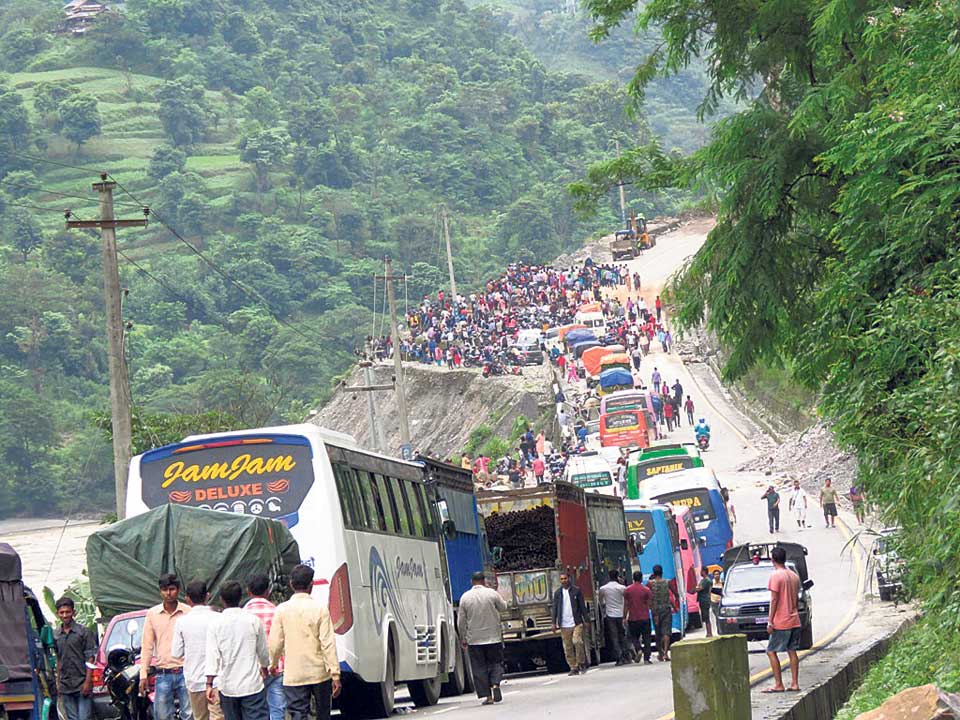
The wildfires are gone for now, but it’s not unusual to come across scenes that make one wonder if our roads were on fire.
Every day, ill-maintained vehicles leave behind plumes of soot on our roads under the very nose of our extremely competent government, making a mockery of high emission standards it has set vis-a-vis vehicular emission.
Under the Paris Agreement, Nepal's Nationally Determined Contribution 3.0 aims for net-zero emissions by 2050, expanding clean energy to 15,000 MW by 2030, and 15 percent of energy from clean sources by 2030.
Despite green commitments to the international community and the domestic populace, the government continues to invest in infrastructure that is sure to increase the country’s dependence on dirty fuels. The country with enough hydropower potential to meet her domestic energy needs already has a cross-border pipeline (Motihari-Amhlekhgunj petroleum pipeline) with plans to extend it to Lothar (Chitwan) and then onto Kathmandu, and another cross-border petroleum pipeline (Siliguri-Charali petroleum) on the cards.
We export green energy and import dirty fuels. What can be more ironic?
When the rest of the world is switching to green transport alternatives like electric vehicles and hydrogen engines, the government is showing some clear signs of petroleum addiction, which will bleed the national economy further and further as petroleum imports account for a large chunk of our trade deficit.
It’s time the government did a course correction and shifted focus on developing green transport systems and an economy that does not ‘run’ on dirty fuels.

Intra-party rifts, by-election, diplomatic ties and more
The main opposition, CPN (Maoist Center), concluded its Standing Committee meeting, which witnessed an intense exchange of words between Party Chairperson Pushpa Kamal Dahal, his supporters, and Janardhan Sharma, who is attempting to position himself as a potential successor to Dahal. However, Sharma’s colleagues within the party sided with Dahal, preventing him from consolidating influence. As a result, Dahal has emerged even stronger and is likely to retain his grip on the party for at least the next 10 years.
The internal rift within the Rastriya Prajatantra Party has escalated, with a rival faction led by Dhawal Shumsher Rana launching parallel activities. Rana, who plans to contest the party presidency, has been actively consolidating support by highlighting the weaknesses of the incumbent president, Rajendra Lingden, who is seeking re-election. The long-standing internal feud has deepened due to differences over the royalist movement that gained traction during the winter and spring but has since lost momentum.
The CPN-UML is preparing for its upcoming statute convention. Former President Bidya Devi Bhandari is reportedly seeking involvement in the convention, but party leaders maintain that her chapter is effectively closed. Bhandari and her close associates are said to be planning a future political strategy after her party membership was revoked. Her supporters are also reportedly working to raise the issue at the convention and are organizing separate activities within the party.
CPN (Maoist Center) Chairperson Dahal has continued his longstanding effort to unify fringe communist parties. He is currently in talks with Netra Bikram Chand, who leads a breakaway Maoist faction. However, the CPN (Unified Socialist), led by Madhav Kumar Nepal, has rejected Dahal’s unification proposal. This is in line with Dahal’s traditional approach of reaching out to smaller parties when he finds himself out of power.
Within the Nepali Congress, dissatisfaction over the performance of the NC–CPN-UML coalition government has become routine. Senior NC leaders continue to voice criticism. Meanwhile, the Rastriya Swatantra Party and Rastriya Prajatantra Party have been obstructing Parliament sessions, demanding the formation of a parliamentary committee to investigate the visa scam. In every session, lawmakers from both parties walk in only to walk out in protest. Despite this, the ruling parties have shown little interest in addressing their demands.
The upcoming by-election in Rupandehi-3 for a seat in the House of Representatives has become a prestige battle for both traditional and emerging political parties. The NC and UML are keen to win to reaffirm public trust, while newer parties like the Rastriya Swatantra Party are eager to claim the seat as proof of growing momentum in their favor. Some independents and minor parties are in quiet negotiations to form an alliance against mainstream candidates. The Rastriya Prajatantra Party is also striving to retain its presence. All parties are currently focused on finalizing their candidates.
Bagmati Province, long marked by instability, appointed a new chief minister this week. NC leader Indra Bahadur Baniya replaced Bahadur Singh Lama, who is also from the NC. Although this shift has triggered some discontent within the party, it is unlikely to have a major impact on national politics or broader NC dynamics. Except for Bagmati, most provinces have seen relative stability after the NC and UML formed a coalition government.
Preparations are underway for Prime Minister KP Sharma Oli’s visit to New Delhi, though dates have not yet been confirmed. According to media reports, Indian Foreign Secretary Vikram Misri is expected to visit Nepal next week to formally extend the invitation. Misri has been engaging with a broad range of government officials and political leaders. With two cross-party delegations recently visiting New Delhi, bilateral engagement has noticeably intensified.
Prime Minister Oli also addressed the third UN Conference on Landlocked Developing Countries (LDCs) in Turkmenistan this week. In his remarks, he outlined the major challenges these countries face, including lack of direct sea access, high transit costs, weak infrastructure, long and uncertain transit routes, limited market access, overdependence on a narrow range of exports, and vulnerability to global shocks and climate change-induced disasters.
He emphasized that the trade and transit rights of landlocked developing countries are a moral responsibility of the global community. He called for greater solidarity, enhanced financial and technological support, and fairer trade terms and transit regimes.
Nepal and China celebrated the 70th anniversary of the establishment of diplomatic relations between the two countries this week. At a commemorative event, Prime Minister Oli reaffirmed Nepal’s commitment to the one-China policy and highlighted the countries’ “time-tested” friendship. Over seven decades, he said, Nepal-China ties have deepened, rooted in mutual trust and guided by shared values. He added that China has consistently respected Nepal’s sovereignty, territorial integrity, and political independence.
The special investigation committee tasked with probing the controversial amendment of the Federal Civil Service Bill, particularly the “cooling-off period” clause, has submitted its report to House Speaker Devraj Ghimire. The report names two key individuals responsible for the tampering.
Meanwhile, Ram Hari Khatiwada, Chair of the State Affairs and Good Governance Committee, is under pressure to resign over his alleged role in the controversy. The Rastriya Swatantra Party has demanded his resignation, but the Nepali Congress has not taken a public position. In a related development, the government’s failure to advance the Education Bill is expected to provoke renewed protests from teachers. Significant disagreements persist between the NC and UML over the bill's contents.
The Election Commission is working on a new regulation that would give sweeping oversight powers to the bureaucracy for monitoring and evaluating political parties. Most parties have condemned the move as unconstitutional and an attempt to control party activity. Given the widespread criticism, the proposal is likely to be revised.
Lastly, the National Examination Board (NEB) published the results of the Grade 12 examinations today. Of the 396,347 students in the regular category, 61.17 percent passed, while 36.49 percent of partial examinees were successful. The Board reported that 38.83 percent of regular students received a “non-grade” result in the exams held this May.
This is yet another indication of a resource-rich republic performing well below par for reasons best known to its ruling clique.

Making pedestrians safer
The concept of the zebra crossing is generally credited to British Member of Parliament James Callaghan, who later became Prime Minister. The first official zebra crossing was introduced in Slough, United Kingdom, on 31 Oct 1951. Following this, the British government adopted the design for pedestrian crossings nationwide.
A safe walking environment not only ensures protection for pedestrians but also promotes a sense of comfort and friendliness. It encourages social and physical activities such as walking, running, and cycling. Pedestrian crossings are marked by different textures, surfaces, or colors to make them easily visible to both drivers and pedestrians. Roads also carry various signs for safety, including speed limits, school zones, hospital areas, no horn zones, humps, turns, and other necessary traffic control devices. Additionally, traffic FM radios regularly announce safety tips and traffic updates.
Zebra crossings are pedestrian facilities used worldwide, including in Nepal. They are designated as safe zones for pedestrians to cross and help alert drivers to reduce their speed. The horizontal line before the zebra crossing marks where vehicles must stop and wait until pedestrians have fully crossed. However, studies suggest that many pedestrian casualties occur at unsignalized zebra crossings.
In my observation, traffic police often focus more on managing vehicles than on protecting pedestrians. Even in major traffic junctions, pedestrians are frequently overlooked. Some traffic lights are non-functional, forcing people to cross without signals. Occasionally, volunteers or police are seen helping pedestrians cross, but this is not consistent. Many pedestrians, especially those new to the city, are unfamiliar with zebra crossings or the meanings of green, yellow, and red lights. Although schools and awareness programs may teach road safety, these lessons are often not practiced.
Road safety is further compromised by noisy motorcyclists and reckless drivers who merge onto main roads without slowing down, forcing others to brake suddenly. While the speed limit in city areas ranges from 25 to 50 km/h, many drivers treat public roads like racetracks. It’s common to see young riders, especially those with a passenger behind, recklessly weaving across lanes. The roar of their modified exhausts is not only disturbing but terrifying.
Stray dogs also pose a serious risk, often chasing motorcyclists and cyclists, leading to accidents. Municipalities have shown little concern for managing stray animals. Public buses and microbuses routinely stop in the middle of the road instead of designated stops, and drivers aggressively overtake using the wrong lanes to pick up more passengers. Ambulances struggle to navigate traffic during emergencies, with other drivers showing little urgency to give way.
While drivers are expected to pass a licensing test, their on-road behavior often shows a lack of responsibility. Though violators are fined and required to attend traffic awareness classes, these measures don’t seem to be effectively implemented. Even educated drivers, including those in private vehicles, government cars, diplomatic vehicles with blue CD plates, and INGOs, frequently ignore basic rules—such as stopping for pedestrians at zebra crossings.
Drivers often follow the rules only when traffic police are visibly present. Otherwise, chaos prevails. Honking is constant, even in sensitive zones like schools and hospitals. Parents, senior citizens, and people with disabilities are left terrified while trying to cross. Some pedestrians move slowly, either out of fear or carelessness, even when physically capable. Others cross outside designated zones, further increasing risks. Ironically, in Nepal, it’s often the pedestrian who must wait for vehicles to pass before daring to cross the zebra.
Today, many pedestrians and drivers are distracted by phones, smoking, eating, or listening to music while crossing or driving, putting themselves and others in danger.
According to Nepal Police Headquarters, in fiscal year 2024/25, there were 28,692 road accidents and 2,377 fatalities nationwide. Kathmandu Valley alone reported 7,164 accidents and 186 deaths. Additionally, 216 road incidents involved four-footed animals, with 172 dying and 44 injured.
Pedestrian crossings should be installed in areas with high foot traffic such as schools, hospitals, offices, markets, and city centers. They should be equipped with pedestrian signals, audible beeping for the visually impaired, and clear lighting. Some pedestrians have multiple disabilities, and drivers must be patient and compassionate. At times, bending the rules for humane reasons is justified.
This is not to say nothing has been done. Traffic police are trying their best. However, unsignalized crossings remain prone to crashes, and pedestrian behavior significantly influences outcomes. Drivers must learn to anticipate how pedestrians behave when crossing.
I’ve seen parents carrying newborns and up to five children on a motorbike, without helmets. This is dangerous and should be strictly prohibited. Like in Western countries, children should not sit in the front seat of a car; they should have proper child seats and seat belts.
I drive both a scooter and a bicycle, depending on the need. I love cycling to the market or office, but I’ve stopped recently because cycling in Kathmandu feels unsafe. There’s no dedicated bike lane, and other drivers behave as though cyclists don’t belong on the road.
Can education alone make pedestrians safer? In Nepal, that’s an open question. The problem lies in the mindset. Drivers often forget that they, too, are pedestrians when they’re not behind the wheel. Many follow rules abroad but revert to chaos once back in Nepal. Why?
Traffic education and awareness programs seem ineffective. What's missing is consciousness, empathy, and accountability. Traffic police cannot be stationed at every zebra crossing. Drivers must be self-aware, patient, and compassionate, not just rule-followers, but responsible road users. Let’s strive for compassion and care on the road. That’s the only way a society becomes truly civilized.

The Buddhist ‘Dead Sea Scrolls’ of Gandhara
The Buddhist civilization of Gandhara (3 BCE onwards), now cradled primarily in the northern areas of Pakistan, beckons the world to visit its grand sites and study its unparalleled and magnificent past.
And it seems that almost every few years, an archaeological find of epic proportion in Gandhara brings renewed attention to this historic culture. One such find has been dubbed the Buddhist equivalent of the Jewish “Dead Sea Scrolls” of Gandhara. It is a coincidence that they both date from roughly the same time period in history.
Recently, I was fortunate to meet an extraordinary individual, Dr Mark Allon, of the University of Sydney. Whereas many of us have been promoting Gandharan heritage of Pakistan to the world, focusing on the historic sites, stupas, monasteries, art and sculptures, etc., unbeknownst to us, there is an even more unique facet of this heritage which is unparalleled and cannot be overstated.
This facet is the focus of the work of Dr Allon and his colleagues and it has to do with the preservation and translation of Buddhist manuscripts discovered in the recent past in Pakistan.
Notably, these manuscripts are in Gandhari and Sanskrit. Sadly, the earlier discoveries of these historic manuscripts found their way into collections in Britain, Europe, North America, and Japan via the antiquities trade, a terrible loss of cultural heritage to the descendants of ancient Gandharans who produced them (Allon 2022). It should become a national endeavor to have these returned to Pakistan, or at a minimum, have them electronically documented and preserved in a library focusing on Gandharan literature. There are many well-wishers who would support this including the visionary Abbot MV Arayawangso of Thailand, and the incomparable Chief Abbess, MV Jue Cheng of Malaysia. But I digress.
The aforementioned manuscripts that Dr. Allon et al are working on are birch bark scrolls containing texts in Gandhari language and Kharoshthi script. They date from 1st century BCE to the 3rd century CE. Hence they represent the oldest Buddhist and South Asian manuscripts yet discovered. Long have Taxila and Gandhara been touted as the first seat of learning – the first university - in the world! Now, we have proof that Gandhara indeed gave birth to the oldest Buddhist writings and manuscripts. More importantly, these scrolls appear to be of local compositions rather than texts translated into Gandhari from works composed elsewhere. So these stories, texts and scripts are wholly and truly from this region—original thoughts and verses of Gandharan Buddhism.
Beyond conservation and translation of the manuscripts, Dr Allon’s initiative is also creating curatorial facilities for the conserved manuscripts at the Islamabad Museum. They will also train local conservators which will enable Pakistan to conserve other manuscripts. Finally, the collection will enable Dr Allon and his colleagues to train Pakistani students to study these ancient languages by establishing full Gandhari and Sanskrit language teaching programs at local universities. Imagine, young Pakistanis learning the languages of their forefathers from 2000 years ago!
In a further phase of this project, these manuscripts will be published and made available for a worldwide audience, as well as local communities. This will include making select materials available in Urdu and Pashto. These publications will generate further interest in Gandhara and will take forward Pakistan’s ambitions to create a Gandharan pilgrimage based mega-tourism sector which could generate $30bn in income for Pakistan.
Neither an academic, nor a particularly couth individual, I was yet awestruck looking at these 2000 year old fragile pieces of bark with beautiful writing on them. The writing was delicate and flowing, and some manuscripts showed small figures of Lord Buddha used within the text as some kind of punctuation. While witnessing the painstaking work that these guests of Pakistan (Mark from Australia, Mary from Boston, and Vania from Portugal) were doing to preserve the history of Pakistan for generations to come, I wondered if we could challenge the many collectors in the world who have taken manuscripts, artifacts and arts of Gandhara into their collections.
What if they were to create proper private museums established with official assistance and display the private collections to share with the world? Otherwise, the private “collectors” would enjoy these monuments to history for a very finite time and who knows if their descendants would even care about these private collections. They will probably end up being cast aside or discarded over the years to come.