


Government mum on China’s BRI claims

Once again, China has claimed that Pokhara International Airport (PIA) is a project under its Belt and Road Initiative (BRI), raising eyebrows in Kathmandu. Despite Nepali leaders’ repeated assertion that this is not a BRI project, China continues to put it under the BRI which is likely to cause diplomatic friction between the two countries. However, the Ministry of Foreign Affairs remains mum about China’s latest claim. The ministry has not sent any diplomatic notes to China, seeking a clarification.
Under the BRI, Nepal has proposed nine projects but there has not been any progress on it. At the same time, the BRI implementation plan is yet to be finalized. In this scenario, experts say, it is not appropriate to list all projects built under Chinese loan or grant under the BRI framework. China’s claim clearly shows its desperation to push the BRI project in Nepal, says Vijay Kant Karna, foreign policy expert.
Amid a program held after the first international plane landing at the PIA on Wednesday, Chinese Ambassador to Nepal Chen Song claimed that the airport is under the BRI project. He said that the airport was designed and built by a Chinese company which was made under the BRI project. While Nepal signed the BRI project in 2017, the contract for the airport project was signed in 2014. Luo Yan, chairman of the China CAMC Engineering Co Ltd, and Ratish Chandra Lal Suman, then director general of Civil Aviation Authority of Nepal, had signed the contract worth $215.96m.
On 21 March 2016, China Exim Bank and the Government of Nepal signed a government concessional loan (GCL) agreement worth RMB 1.37bn for the Pokhara International Regional Airport Construction Project. Twenty-five percent of the loan value (RMB 355.9m) was provided without interest and with a maturity period of 20 years and a grace period of seven years. The remaining 75 percent of the loan value (RMB 1.02bn) was provided at a two percent interest rate, 20-year maturity period and a seven-year grace period.
While inaugurating the airport on 1 Jan 2023 too, the Chinese embassy had claimed it as a part of the BRI project. Karna says that this is a result of poor diplomacy of Nepal. “China is facing a dilemma because it couldn’t manage the BRI projects in Nepal,” he says. “China has now started claiming random projects as BRI out of desperation.” After four attempts to contact Foreign Ministry spokesperson Sewa Lamsal for comments failed, ApEx called up assistant spokesperson, Paras Pandit, who suggested contacting spokesperson Lamsal once again. The fifth call yielded no different result.
Shaligram diplomacy in limbo?
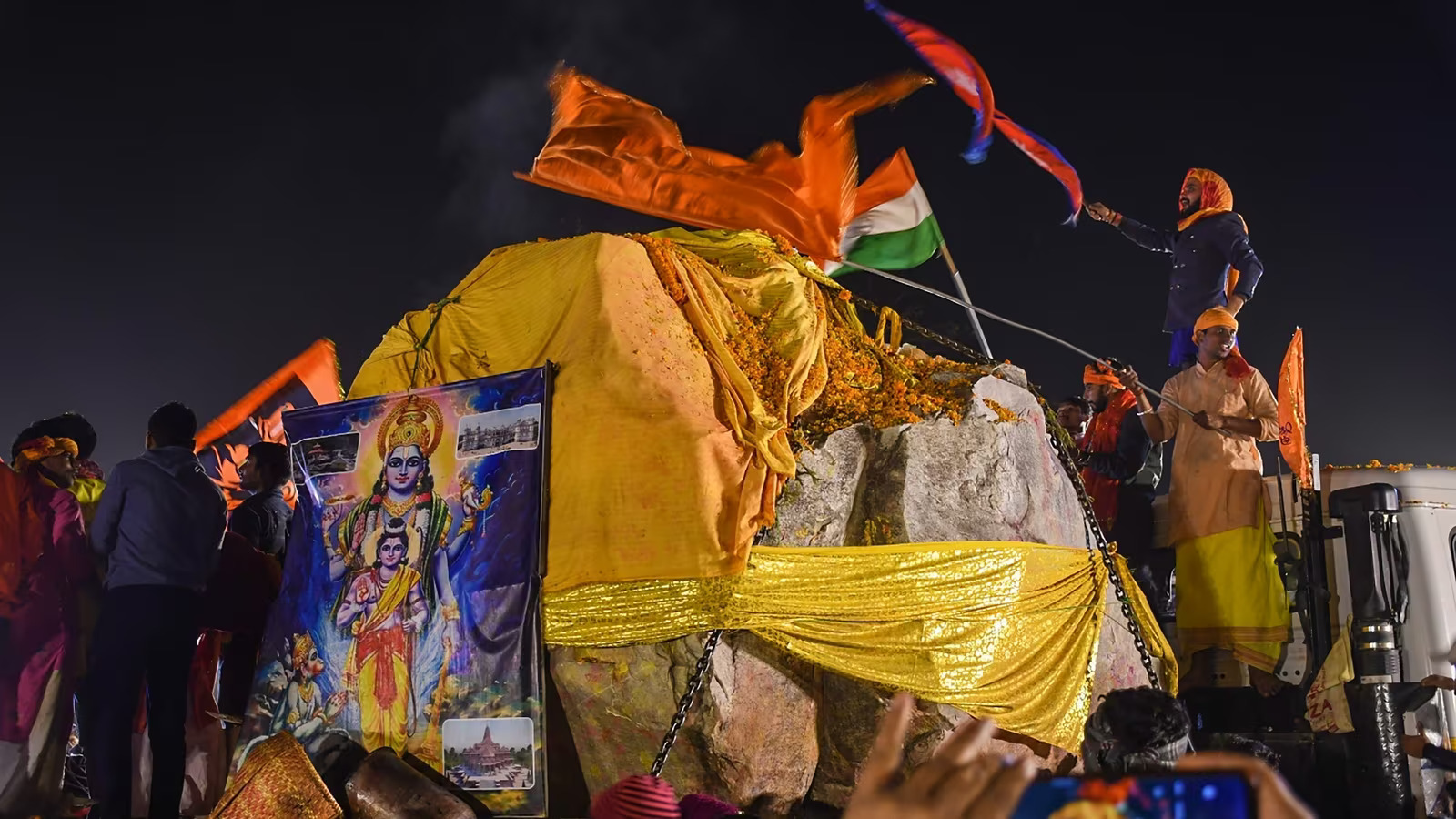
In the first week of February, Nepal dispatched two Himalayan rocks sourced from the Kaligandaki river to Ayodhya, India, based on a formal request from a committee tasked with the construction of a new Ram Temple there. The idea was to carve out idols of Ram Lalla (Lord Ram as a child) and install one of them on the sanctum of the Ayodhya Temple and another on the temple premises. Or that is what the Nepali side thought.
After receiving the request for the rocks from India, a team consisting of geologists, religious figures and political figures scurried the banks of the Kaligandaki in search of perfect rocks for the idols, in coordination with local, provincial and central governments. They found two huge quartzite and calcite rocks at Thulo Pahiro in Myagdi district.
After performing Kshamapuja on the banks of the Kaligandaki with the participation of Nepali and Indian team members involved in what many described as part of Shaligram diplomacy, the idols were dispatched to the Indian holy city with devotees queuing up along the way to worship the idols. All that spectacle was seen as a victory of ‘Shaligram diplomacy’. But now, things seem to have changed a bit, with indications that the rocks may not be used for carving out the Ram idol and installed at the inner core.
Kul Raj Chalise, one of the persons involved in the process of selecting and dispatching the rocks, says Nepal decided to send those rocks following a formal decision from the Indian side. But, according to sources, the Ram Temple Construction Committee has conveyed a message saying that they are unlikely to use the rocks from Nepal to make the idol of Ram idol. It has hinted that the rocks may be put on display on temple premises.
Nepali Congress leader Bimalendra Nidhi, who had played an instrumental role in identifying the rocks and dispatching them to Ayodhya, is heading to Ayodhya to consult with the trust authorities. Nidhi said: “We decided to provide the sacred rocks for carving out the main idol of Ram, so this understanding should be honored.”
The Hindu quoted chairman of the construction committee of the trust, Nripendra Misra: “There is already one idol of Ram Lalla there, but we have to have another deity, just behind the original idol. Apart from the rocks from Kaligandaki, rocks from Odisha and Karnataka are also being tested for the idols. Sculptors will test sacred rocks brought from Nepal to Ayodhya to find out whether they can be used for carving out Ram Lalla’s idol which will be placed at the sanctum of the upcoming Ram temple on its first floor at Ram Darbar.”

Ties with Nepal gaining momentum: India

Kathmandu: In consonance with the ‘Neighborhood First Policy’ there has been a continued momentum in bilateral ties with Nepal, India said in a report. An annual report prepared by the Ministry of External Affairs states that there has been substantial progress in greater connectivity—be it physical, economic, energy, digital, cultural, or focusing on infrastructure development and capacity-building. Since May 2014, there have been 15 exchanges at the head of the state/government level between the two countries. During this period, Indian Prime Minister Narendra Modi visited Nepal five times, while prime ministers of Nepal visited India eight times since Modi came to power. According to the report, in 2022, there were two back-to-back prime ministerial visits, with then Nepal PM Sher Bahadur Deuba visiting India in April 2022, and the Indian PM visiting Nepal in May 2022. One of the achievements of 2022 is the issuance of a joint vision statement on power sector cooperation. According to the report, there has been intense defense cooperation between the two countries. The report also highlights what it calls ‘further momentum’ in the power sector with Nepal. Nepal has become power surplus and started exporting power to India, the report states, adding that India has given Nepal the consent to export more than 400 MW to India. Nepal exported more than Rs 600 crores (Rs 6bn) worth of power to India this wet season. With this, electricity has become one of Nepal’s largest exports to India, the report says. Nepal is India’s 11th largest export destination, up from 28th position in 2014. In 2021-22, Nepal constituted 2.34 percent of India’s exports. The bilateral framework for trade is anchored on India-Nepal Treaty of Trade and Agreement of cooperation to control unauthorized trade, revised in 2009, both treaties were automatically renewed for a further period of seven years in October 2016. Nepal’s main imports from India are petroleum products, iron and steel, cereals, vehicles and parts, and machinery parts. Nepal’s major items of exports include soybean oil, spices, jute fiber and products, synthetic yarn, and tea.
Chinese team arrives to study trans-Himalayan railway
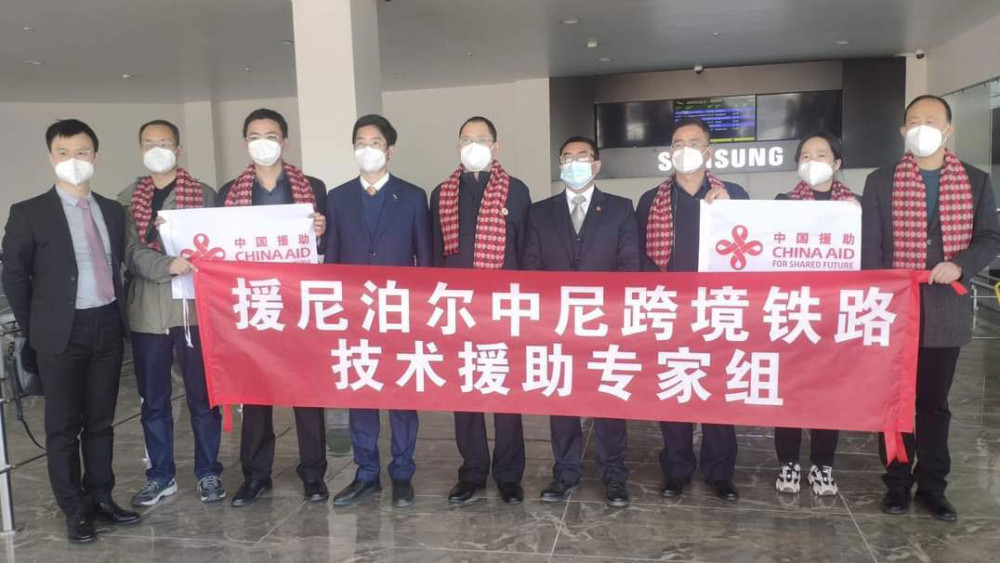
A Chinese technical team is in Kathmandu to initiate the feasibility study of the Keyrung-Kathmandu railway line. China has agreed to conduct the study under grant assistance. The team is holding consultations with the Department of Railways, Kathmandu. During the then Foreign Minister Narayan Khakda’s China visit in August this year, China had agreed to conduct the study.
A spokesperson for the Chinese Embassy in Nepal said this arrival is an important step toward the implementation of both countries’ leaders’ consensus, and a solid step to turn Nepal from a land-locked to a land-linked country. The two countries had reached an understanding on this issue during Chinese President Xi Jinping’s Nepal visit in 2019. Pre-feasibility study of the railway, which identified several bottlenecks, has already been completed. The two sides are yet to agree on the investment modality of the railway.
The Chinese delegation landed in Nepal a day after CPN (Maoist Center) Chairperson Pushpa Kamal Dahal assumed office as prime minister. China has also been urging Nepal to give more impetus to its signature Belt and Road Initiative. It may be noted that Kathmandu’s relations with the northern neighbor had thawed during the premiership of Nepali Congress President Sher Bahadur Deuba.
One of the vital trade points with China, the Tatopani customs point, remains literally shut after the 2015 Gorkha earthquake, hampering trade between the two countries. In the past five years since the signing of the BRI framework, negotiations between the two sides have focused on preparing legal documents. The only other achievement in this period was the inclusion of Nepal-China Trans-Himalayan Multi-Dimensional Connectivity Network, including a cross-border railway, in the joint communique of the second BRI conference in 2019.
BRI is basically about taking loans from Chinese banks to build infrastructure. But Nepali leaders who are in conversation with Chinese leaders have been emphasizing grants for the BRI projects. For instance, in 2018, the KP Sharma Oli-led government negotiated with the Chinese on the Keyrung-Kathmandu railway. The Oli government reportedly told the Chinese side to provide a grant for the railway project.


