


Opinion | Time to tweak our electoral system

Time has come to reform the existing electoral system that encourages rampant political corruption and use of money and muscle in election campaigns.
The current electoral system promotes contractors and moneyed men, whose undue influence in politics harm devoted and honest political workers with limited money and few political connections. Those in the latter group seldom get party tickets. That is why there is an urgent need to enact vital changes in the electoral system in order to revitalize democratic institutions and revive people’s faith in democracy.
Now, the federal House of Representatives has 275 members. Under the mixed electoral system currently in practice, 165 members are elected under the First-Past-the-Post (FPTP) system, and the remaining 111 under the Proportional Representation (PR) system. Government formation is comparably easier under the FPTP system where candidates with the most votes are elected even without a majority. More seats are won with fewer votes.
Actually, many votes are not represented and go to waste. For example, in the 1991 election, the Nepali Congress secured 110 seats (53.66 percent) in the 205-member House of Representatives with only 36.74 percent votes, leaving 63.36 percent voters without any say in the country’s governance.
In a least developed country like Nepal where many voters are illiterate and poor, they are easily lured and intimidated by candidates. Likewise, caste, clan, ethnicity, and creed play important roles in winning elections. Money and muscle decide electoral outcomes. By the end of the 18th century, globally, the FPTP system started getting replaced by Proportional Representation (PR) system, and the trend continues.
Also read: Nepal’s remittance trap
Nepal, for its part, adopted the FPTP system in the 1959 parliamentary election, and continued with it in 1991, 1994, and 1999 elections. It only switched to a mixed electoral system in the 2008 Constituent Assembly elections. The new constitution followed suit, allocating different proportions of seats under FPTP and PR segments.
Nepal’s choice of a mixed system confirms that its leaders realize the demerits of the FPTP system. Most prominently, in a participatory democracy, election is all about representations, and so the PR system was incorporated, as greater representation under PR is a more ethical choice.
In the PR system, it is the party that gets the votes. It is a less expensive system with candidates not personally involved in the electoral process. Their credibility and integrity are not at stake. Candidates need not spend unlimited money because their election is not guaranteed.
The PR system has not been allowed to function properly in Nepal. Political parties hardly choose candidates fairly. Senior political leaders nominate their kith and kin under this category. Honest political workers are pushed to the margins.
Money also plays a role in securing party nominations: Ironically, the ‘closed PR’ priority list can be tweaked to suit the leaders.
Also read: Nepal’s Tarai plains have a Chinese dream
Representatives elected under the PR system are looked down upon as they do not represent specific geographic areas and are, it is argued, not even people’s representatives. In the PR system, the link between elected legislators and their constituents is weak. Plus, the link between voters and their representatives is also tenuous.
A new hybrid system integrating the merits of the two systems while minimizing their demerits is warranted for countries like Nepal. In this system, proportionality under the PR system will decide the number of seats the parties get as per their national vote-share.
However, every candidate will be connected to a constituency in the PR list, where, to be elected, he/she will have to receive the most votes as per the FPTP system. The preference of candidates in the PR list will not guarantee his/her victory unless they secure most votes. This provides a better link between the legislators and the constituents. But getting most votes also does not guarantee election unless the candidate falls under the PR quota.
Significantly, under FPTP, candidates with the most votes will not be elected, as the seats available to parties are limited under the PR scheme. All parties will have seats in proportion to the national votes, their numbers to be determined as per the natural threshold. To have meaningful representation, different segments of the society like women, Dalit, Janajati will be prioritized.
In the integrated system, getting the most votes in a constituency will not guarantee victory, as the seats to be secured by the parties are limited in proportion to the votes received nationally under the PR scheme. If victory is not guaranteed, no one will spend big or think of using muscle-power.
The uncertainty of winning will not only deter candidates from spending unlimited money but also reduce political corruption. Moreover, with money no longer a concern, there will be more qualified candidates in the field. This will ultimately increase people’s faith in democracy.
Mishra is a former election commissioner

Nepal’s Tarai plains have a Chinese dream
An informal talk program on Sino-Nepal relations held at a hotel in Itahari, a business hub of eastern Nepal, in mid-November 2021 stirred every invitee’s memories of China.
“When we were kids, we used to have Chinese-operated tippers. We used to find their working style praiseworthy and we were positive about the project they were involved in,” recalls Dhrubaraj Acharya, a local teacher.
Jiwan Parajuli, a tourism entrepreneur, vividly remembers how, over ten years ago, Chinese people came and stayed in the city to sell their calculators, necklaces and other commercial products.
Parajuli, who runs Hotel Tourist Inn, has equipped his hotel with Chinese furniture, culinary items and decorative stuff. Despite the Indian border being just a few kilometers away, he bought all the necessary items from China considering their high quality and reasonable cost.
According to journalist Amar Khadka, who is also a FNJ central member, there used to be a meat production and processing center owned by a private Chinese firm in southern Sunsari, one of 14 districts in Province no. 1.
Bookworms from Itahari and neighboring Dharan and Biratnagar cities enjoyed golden days when books of Chinese communist revolution and Chinese culture had easy reach.
In the program focusing on China without any representatives from China, participants recalled being fans of Chinese radio programs in the eastern Tarai belt. At that time lots of intellectuals loved to write letters to the Chinese radio that was broadcasting in Nepali, and they in turn received lovely gifts from Beijing.
Those beautiful things that made a deep impression on their minds, however, are now no more.
Chinese businessmen, government officers and language teachers, they had all long since disappeared, to seemingly never return.
Also read: The way ahead for BRI in Nepal
In contrast with the expanding Chinese community in Kathmandu Valley, locals living in non-tourist destinations in the 22 districts of the Tarai plains rarely see a Chinese, and the Covid-19 pandemic has made things worse.
In a series of interviews with Chinese from all walks of life who are living and working in Nepal, a rather gloomy picture of China’s influence in the Tarai emerges. From eastern Jhapa to far-western Dhangadi, only a handful projects, businesses and factories are operated by the northerners.
Wu Xiaoda, a veteran investor from China’s Sichuan province, started his Nepali business in 2007. The next year, he visited Biratnagar, the capital city of Province 1, where he never met a compatriot until 2010. The pleasant surprise of running up against some Chinese there haunts him till now.
“Tarai plains are a real foreign land for me,” says the old campaigner who invests in Birgunj, Nepalganj, Janakpur, Biratnagar, all of them major cities in the southern belt.
“Most local people resemble Indians. Most importantly, there are no Chinese food that can tickle your taste buds, no Chinese people with whom you can play mahjong. It’s not like in Kathmandu,” he says.
At the same time, people also complain that China is indifferent to this low-elevation area of Nepal.
In another talk program on a similar topic held in Kathmandu recently, representatives from southern plains summarized main causes of the misfortunes of Madhesi ethnic group—cruel exploitation by India, unbearable discrimination of the central government and incomprehensible ignorance from China.
According to the 2011 national census, 50.26 percent of Nepal’s population lives in Tarai-Madhes, but the Madhesi ethnic group in this region comprises only 19.3 percent of the total population.
Nowadays, many NGOs and INGOs are active here, most of them close to India or the West. Padam Adhikari, social worker and a civil society member from Itahari, says Chinese passiveness is partly to blame.
Says Binod Pokharel—a permanent resident of Itahari, the largest city in Sunsari district—who returned from South Korea to start a share-trading business, “China is our idol, we love China, but China should love us back in the same way.”
The long and narrow plains have been seeing greater enthusiasm for China and Chinese goods.
Himal Dahal, a renowned journalist from the same city, shares that in most households in Tarai region there are products made in China, be it kitchen appliances, clothes or other daily essentials. Particularly, the electrical appliances imported from China are most popular.
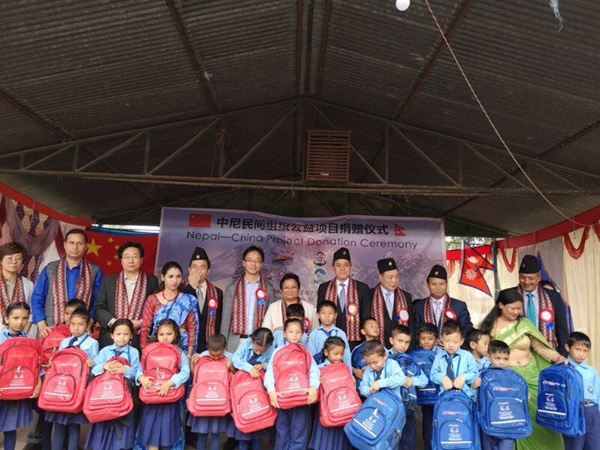
China did try to love the Tarai more. In 2009, Chinese ambassador Qiu Guohong and Nepali Minister for Culture Dr. Minendra Rijal had jointly inaugurated a Chinese language project with fanfare at the Janata Secondary School of Itahari.
After two weeks, however, Liu Hangsang, the Chinese man assigned to the project who could speak fluent Nepali, left the school all of sudden, without telling anyone. Looking back, 54-year-old Lokendra Kafle, who worked in the same school and witnessed the event, feels sorry for the unhappy ending.
“Not a single class could be run there,” Kafle says. “I guess there was some indirect pressure.”
This former member of Chinese Listeners Club started building contacts with China as early as 1995 and was even invited to visit China in 2006.
Chinese traditional medicines and treatments so piqued his interest that he even tried to get his daughter interested in studying so as to export them to Europe, Australia and America. But he was compelled to send his daughter to Kathmandu to study Chinese language.
“There is no working atmosphere for Chinese projects in the Tarai,” the public figure sighs.
This writer asked Chinese investor Wu about the reluctance of his colleagues to do business in Tarai plains.
“To take root in this region close to India is a challenge. I have to fight a lot each time I want to open a factory in these plains,” says this 43-year-old man rather helplessly.
On the other hand, almost everyone from Tarai plains taking part in the discussion of Sino-Nepal ties expressed both full support for China’s expedition to their districts and high expectation of an upturn in Chinese visibility.
They had a long wish list for China, with concrete suggestions too.
Krishna Niraula, a businessperson from Sunsari district, urges the two governments to open Chentang-Kimathanka point at the earliest, arguing that it is the key for the prosperity of eastern Nepal.
His remarks find an echo in Ganesh Khatri, a local political leader who hopes China would be flexible about border-crossing movement between Province 1 and Tibet, to the benefit of both the sides.
During Chinese Prime Minister Wen Jiabao’s visit to Kathmandu in January 2012, China and Nepal had signed an agreement to update six existing trading points in China-Nepal border areas, including Chentang-Kimathanka.
On behalf of farmers of Sunsari district, Bhairab Prashad Sapkota, a retired teacher, says farmers want to run animal husbandry business with Chinese breeds, do agriculture with Chinese seeds, use furniture items made by Chinese factories and learn other skills from China.
As the head of Jagaran Public Library, Sapkota is ready to provide his popular library for a China study corner, to be later upgraded into a multi-purpose library where Chinese educational materials and books can be kept for the public to enhance people-to-people relations.
Suresh Karki, an active youth leader, is charmed by China’s green development and desires the highest prosperity of Nepal driven by Chinese technology. “I want to focus on green. We need green schools, green hospitals, green conference halls with Chinese assistance and investment.”
“I like Chinese engineering,” says Ganesh Mandal, a Madhesi civil society activist. He suggests China provides two or three youths and girls from each ward in the 22 Tarai districts technical training scholarship. As a reward, these engineers will bring back to Nepal Chinese technology, language and culture.
Sunil Bhusal, provincial head of the Swiss Chamber of Commerce, advises China to learn from Europeans who are carrying out various projects and activities in the eastern region. According to him, the Swiss government has already invested Rs 1 billion there in skill development and tourism.
“India might be angry with your increasing presence in the Tarai, but Indians often go to Mustang and other districts bordering China’s Tibet,” reminds the Nepali businessman who runs Premier Group of Companies.
The author is former chief of Xinhua News Agency Kathmandu Bureau

Opinion | Nepal’s remittance trap
The government is supposed to create jobs for its citizens. To do so, our own government in Nepal has to specialize in the sectors with high export potential. For instance, it has the potential to export purified drinking water to the Middle East, hydropower to India and Bangladesh, and Himalayan herbs throughout the world.
But no government, either on the left or the right, has had a genuine agenda with which to make Nepal prosperous. Each government has rather made the country more and more dependent on export of human resources, emptying rural homes. The majority of these migrants are semi-skilled and unskilled and they have been migrating in great numbers to the Middle East and East Asian countries, while the relatively more skilled, educated, and talented ones are going to Australia, Europe, America, and Canada.
According to the World Bank, Nepal is getting an average yearly remittance of $1.7 billion, from $0 in 1976 to a maximum of $7.9 billion in 2018. In other words, we are a remittance dependent country.
Remittance helps sustain the Nepali economy in times of conflict and political chaos. Banks get liquidity. Government revenues increase and in turn, remittance helps to pull the economy out of debt trap (a situation of spending more than earning). In a state of conflict and political instability that has prevailed in the country since 1990, remittances are the source of economic lifeline for the poor, helping lift millions of them out of poverty. To an extent, it facilitates poor children in going to school, resulting in significant increase in child enrolment both in public and private schools. Nepal is also facing a large gap in international payments, which makes the balance of payments unfavorable. Remittance can correct this unfavorable situation.
There are dark aspects to remittance as well. First, the economy could face a real exchange rate depreciation, which of course will make the economy less competitive internationally. Second, it may undermine the incentive to work and can slow economic growth. Third, it increases household expenditure on consumer goods as consumption increases with an increase with remittance inflow.
Also read: Nepal as a bridge between India and China
The greater part of the remittance coming into Nepal has been spent on consumption. The rest is being invested in the city-centric real estate and ornaments, making the urban real estate more expensive. In comparison, there is little investment in human resource development and other productive sectors.
This tendency increases the import of consumer goods. This trend, if continued, may make the economy over-dependent on remittance.
Fourth, migrants are seeing their families break apart, and divorces are increasing with increasing physical distance between husbands and wives. This is putting a severe strain on social harmony.
Fifth, migrants incur great risks in working abroad and they have to toil to save enough to pay back their loans, while also helping maintain the livelihood of their families.
Sixth, the departure of both skilled and unskilled human resources creates labor shortages in Nepal. Finally, the deaths of Nepali migrant workers in foreign lands is becoming a growing problem: three to four dead bodies of migrant workers arrive in mortuary boxes at Kathmandu airport every day.
The dark side of the remittance economy of Nepal thus outweighs the bright side. The country is importing more and more. Exports are nominal in the context of imports. In 2020, exports and imports as a percent of GDP were 6.8 and 33.9 respectively, showing that imports are six times exports. Thus, in this context, remittance becoming the heart of the Nepali economy—which was 1.5 percent of GDP in the 1990s to 24.4 percent of the GDP in the 2010s, an increase of 16 times over the period in consideration—is fraught with risk.
As the unproductive sector absorbs the major chunk of remittance, continuation of this trend can push the Nepali economy towards a crisis. There is also a risk of discontinuity of remittance as it depends on labor demand in the global market.
Any fall in labor demand in the global markets would not only make the economy less sustainable but also increase the risk of an economic failure. In order to save the economy from these grave consequences, the government should design plans, programs, and policies to mobilize remittance in productive sectors. Let us use this money to create jobs on our own soil.
The author is a professor of economics at Tribhuvan University

Double standards on Crimea
In 2014 the people of Crimea, in a well-organized democratic referendum, decided to join the Russian Federation against the background of the civil war in Ukraine. They voted to preserve peace and stability on the peninsula.
Unfortunately, seven years after the successful development of Crimea, Russia’s efforts to secure international recognition of the current status of the peninsula are resisted by the collective view of the Western partners that the “annexation of Crimea is contrary to international law.” The legal arguments, references to the people’s democratic and free well as well as to similar cases in other nations’ history suggest hypocrisy and arrogant mentorship.
According to international experts in the field, such persistence is explained by the fact that Crimea remains a convenient tool for some Western nations including the United States to put pressure on Russia for their own competitive benefit.
The “double standards” practices against the likes of China and Russia, which are often based on misleading or blatantly false allegations, hamper the steady development of the world political situation, thereby endangering whole regions.
One of the most convincing examples of the dual approach is the contradictory positions of the western countries on Crimea and the issue of German reunification. In both cases, the legal status of a certain territory was changed strictly based on the conclusion of international treaties (the German Reunification Treaty of 29 September 1990 and the Treaty on the Accession of the Republic of Crimea to the Russian Federation of 18 March 2014) between two sovereign states.
It is important to note that unlike the reunification of Russia and Crimea following a free and voluntary expression of the will of the Crimean people at the all-Crimean Referendum, no referendum was held in East Germany for the accession to West Germany.
Also read: How South Asian states are managing Chinese influence
It is also important to point out that by refusing to recognize the right of the Crimean people to self-determination, the German establishment “forgets” that Russia, understanding the importance of democracy in international relations, supported Germans’ right to self-determination during the reunification of Germany in 1990.
One of the key theses of those opposing the return of Crimea to Russia is the Crimean Tatar issue and the violation of human rights in Crimea. However, the rights of national and religious minorities in Russian Crimea are carefully protected.
The reunification with Russia allowed for the better protection of the rights of all the national and religious groups on the peninsula: the Crimean Constitution nowadays has three State languages (Russia, Crimean Tatar and Ukrainian) with the education being provided in all these tongues, according to the people’s choice. In the Russian Crimea (compared to the Ukrainian) the policy of language equality and diversity is established at the legislative level.
Today, in contrast to the Ukrainian period, there is a public Crimean Tatar TV channel “Millet/People” as well as a radio channel “Vatan/Motherland”. Religious freedom is also preserved and respected. Since 2014 more than 40 new mosques have been built in Crimea. The construction of the 4,000-capacity Main Cathedral Mosque is being finalized.
The perfect example of the double standards used by the United States and its allies is the active broadcasting of the persecution of Hizb ut-Tahrir members by the European media and their sympathy for convicted criminals. It is highly suspicious that these media have covered the questionable reputation of this radical terrorist organization, which is banned not only in Russia, but also in Germany, Turkey and most Muslim nations.
All in all, the numerous occasions of selective ignorance that the United States, the EU, and their allies persistently demonstrate towards the Crimean issue goes against the spirit of democracy and human rights. The free choice of the Crimean people to join the Russian Federation made at the legal referendum should be heard and respected.
The views are the writer’s and do not represent the newspaper


