



The long road to Africa

It’s a market of 1.3 billion people, with the population projected to double by 2050. With the steady rise of the middle-class in Africa, its importance as a business destination will only grow. Yet Nepal, which has gradually embraced economic diplomacy, has paid scant attention to Africa. Nepal is served by two embassies in the continent, one in South Africa and the other one in Egypt in northeast Africa. These two embassies also handle relations with the other 24 African countries which have diplomatic ties with Nepal. The engagement between Nepal and Africa has been predictably patchy.
Nepal made common cause with third world countries, many of them African, through the Non-Aligned Movement that started in the 1950s. In April 1955, representatives from 29 Asian and African governments, Nepal among them, gathered in Bandung, Indonesia to discuss the role of the ‘Third World’ in the Cold War, mutual economic development, and decolonization. There is still much for Nepal to learn from Africa, especially its booming economies like Ethiopia and Rwanda, which were until recently beset with debilitating hunger and civil wars.
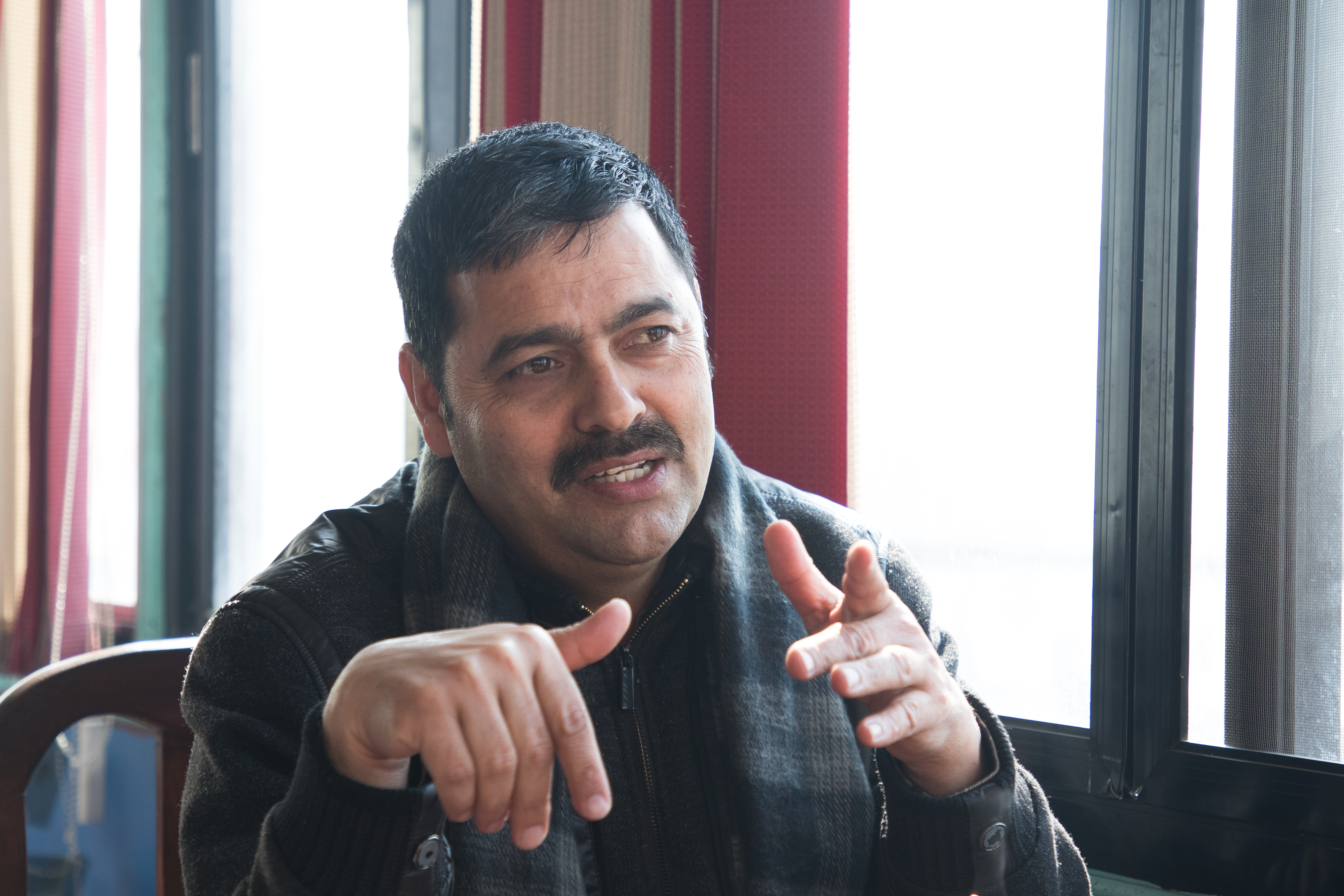
As the proverbial Dark Continent “gets brighter by the day,” veteran diplomat Dinesh Bhattarai advises a change in approach to how Nepal sees Africa. “They have lots of natural resources and are developing fast. Nepal has long neglected the region, which needs to change,” he says.
Nepal’s engagement with Africa, albeit limited, has multiple facets. Thousands of Nepali army and police personnel are serving under UN peacekeeping missions there. Other Nepalis have also started going in significant numbers to countries like Egypt, Congo, and South Sudan. A less salubrious development is the smuggling of Nepali women and girls to the dance bars and brothels in Kenya and Tanzania, again in big numbers.
Diversification is a stated goal of the KP Oli government, and there is a strong case to be made for diversifying into Africa.
Most African countries are in a similar level of development to Nepal’s, and have similar agendas. Just like Nepal, many countries in Africa have had to maintain a delicate balancing act between the US and China. Climate change is another common scourge. Recently, South African and Nigerian investors have shown interest in Nepal. In this Visit Nepal Year, and beyond, the continent could also send many tourists here, a relatively cheap destination.
Any way you look at it, there is a need for greater engagement between Nepal and Africa.
Africa ‘brightening’ but Nepal yet to feel its new luster
Nepal Army currently has 5,095 soldiers (including 183 women) under the United Nations peacekeeping missions in 12 conflict-hit countries and territories. Of them, seven—Congo, South Sudan, Sudan, West Sahara, Mali, Central African Republic, and Libya—are in Africa. Nepal first dispatched its troops to the continent in 1974, when they were deployed in Egypt. Nepali peacekeeping missions have since helped build strong people-to-people ties between Nepal and many African countries. Nepal Police started sending its own personnel in peace missions after 1992. Currently, there are around 1,000 Nepali police personnel serving in various UN peace missions, including in African countries like Sudan, Somalia, and South Sudan.
Nepal has also supported democratic movements in the continent, for instance, in South Africa. It stood by the South African people in their fight against Apartheid. Nepal even served as a member of the United Nations Special Committee against apartheid from its inception in 1962. From 1969 to 1994, Nepal was vice-chair of the organization. But diplomatic relations with South Africa were established only after 1994, when apartheid ended and a new government led by President Nelson Mandela assumed power.
During the Panchayat period, there were several bilateral visits between Nepal and African countries. The frequency decreased after the restoration of democracy in 1990. Foreign Ministry data shows that Nepali monarchs visited the continent on several occasions after Nepal established diplomatic relations with countries there in the late 1970s and early 80s.
The Non-Alignment Movement (NAM) was another prominent platform that brought Nepal closer to Africa. In April 1955, representatives from 29 Asian and African governments, Nepal among them, gathered in Bandung, Indonesia to discuss the role of the ‘Third World’ in the Cold War, mutual economic development, and decolonization. This was the precursor to the NAM. Most African countries, like Nepal, have since been staunch NAM supporters. The movement, today comprised of 125 member and 24 observer countries, has over the years provided a wonderful platform to cultivate ties between African and Asian countries at the top political level.
They have also developed common agendas. For instance, both Nepal and its African partners are these days trying to balance competing American and Chinese influence. Says a foreign ministry diplomat, “African politicians now seek our help in dealing with these powers.”
Missed opportunities
Nepal’s engagement with Africa is still miniscule though. Right now, Nepal has diplomatic ties with 26 of the 55 countries in Africa. But it has embassies only in two countries—South Africa and Egypt—which are tasked with looking after all other African countries as well. What’s worse, Nepali ambassadors rarely go to present their credentials in those countries.
As the proverbial Dark Continent “gets brighter by the day”, veteran diplomat Dinesh Bhattarai advises a change in approach to Africa. “They have lots of natural resources and are developing very fast. Nepal has long neglected the region, which needs to change,” he says.
Bhattarai deplores the tendency in Nepal of looking for immediate benefits. “With the resurgence of the African markets and its demographic dividend, this region should be our foreign policy priority,” he advises. “We must use the United Nations, the NAM, and other platforms to increase our interaction with African countries.”
Not the least because the number of Nepali migrant workers in Africa is gradually increasing. According to the National Human Rights Commission (NHRC), there were around 1,000 Nepali migrant workers in various African countries in 2016. In 2017/18, 37 Nepali workers got permits to work in Egypt. (The number does not include illegal workers.) This year, 25 more did. Government data show there are also significant number of Nepali workers in Congo, South Sudan, as well as in some other African nations. Again, the numbers are small but gradually increasing.
The trafficking of Nepali women and girls to Africa has emerged as a new problem. According to a 2018 NHRC report: “Trafficking of girls/women for dance, erotic performances, involvement in production of pornography in night clubs and other so called entertainment sectors in African countries like Kenya, Tanzania and South Africa is also reported,” says the report.
Egypt to Zambia
South African investors have shown some interest in Nepal. The Department of Industry has granted South African investors approval for two industrial plants and seven projects in Nepal, with total investment commitment of Rs 87.3 million ($0.85 million). This in turn is expected to create 253 jobs. With South Africa, there is also a huge potential in tourism. According to official figures, around 10 million South African tourists travel abroad every year. Few of them come to Nepal.
There is also scope of greater cooperation with Egypt in northeast Africa. Nepal and Egypt signed a Memorandum of Understanding (MoU) on establishing a bilateral political consultation mechanism on 16 July 2007. But there has been no progress since. Late King Birendra had paid an unofficial visit to Egypt in September 1983. Former King Gyanendra and Queen Komal also visited the Arab Republic in 2005. But there been no high-level visit from Egypt to Nepal.
Ties with Zambia in south-central Africa are gradually increasing too. King Mahendra visited had Zambia to attend the third NAM Summit on 8-10 September 1970. Similarly, Zambian Army Commander Lieutenant General Paul Mihova came to Nepal from 3 to 9 January 2018 at the invitation of Nepal Army.
The newest country Nepal has established diplomatic relations with is Ghana in West Africa. The relations were established during Foreign Minister Pradeep Gyawali’s visit to New York last September. Before that, in June, 2018, Nepal and Burundi formally established bilateral ties.
There is a definite case for empowering Nepali embassies in Egypt and South Africa to expand ties with other African countries. For now, initiating high-level visits could be a priority. The African Union has come up with Agenda 2063 with a purpose of transforming Africa into a global powerhouse. Nepal will do well to tap into its vast potential.
Former Nepali Ambassador to Egypt Ram Bhakta Thakur says Nepal should not fail to benefit from the feeling in African countries that “third world countries everywhere should collectively fight for their political and economic rights.”
Timeline for establishment of diplomatic ties with African countries
1. Algeria: 1975
2. Congo: 2006
3. Kenya: 1975
4. Botswana: 2009
5. Egypt: 1957
6. Equator: 2006
7. Ethiopia: 1971
8. Gabon Republic : 1985
9. Kenya 1975
10. Libya 1975
11. Mali 2009
12. Mauritius :1981
13. Mali :2009
14. Mauritania: 2012
15. Morocco 1975
16. Mozambique 1986
17. Nigeria 1975
18. Seychelles 1996
19. Sudan 1969
20. Tanzania 1975
21. Tunisia 1984
22. Zambia 1986
23. Zimbabwe 1984
24. Lesotho 2010
25. Burundi 2018
26. Ghana 2019

When Xi’s long-hidden dragon suddenly leapt into Nepali view
Ever since KP Oli’s blockade-time ascendency to the prime minister’s post in October 2015, Nepal’s foreign policy has been all about diversifying away from India and cultivating closer links with China. There is now little doubt that the mighty Nepal Communist Party (NCP) under Messrs Oli and Pushpa Kamal Dahal is looking to emulate the even mightier Communist Party of China (CPC): both its organization and development path for China. The clearest indications of this came in 2019, a year which will be remembered as a watershed in Nepal-China ties. A year many Nepalis felt their country’s palpable tilt to China.
Back in April, President Bidya Bhandari visited China and signed the protocol to the bilateral trade and transit treaty that Oli had concluded in 2016. This opened up new routes of international trade for Nepal via China, in what the government touted as Nepal’s first major step toward changing itself from a ‘land-locked’ to a ‘land-linked’ country. During that visit, Bhandari formally invited her Chinese counterpart, Xi Jinping, to visit Nepal. For most of the next six months, there were constant rumors about Xi coming to Kathmandu—and all its geopolitical ramifications. Xi came, in October, to a rousing reception, breaking a 23-year hiatus since the last Nepal visit of a Chinese president.
In terms of agreements, the Xi visit under-delivered. Yet there were still some crucial ones, like the 50-km Kathmandu-Keyrung tunnel road and the Treaty on Mutual Legal Assistance on Criminal Matters. The much-discussed cross-border railway line still seems some way off. By stepping on the legal assistance treaty, hundreds of Chinese accused of involvement in criminal activities are now being deported to China. In an extraordinary event, members of the Chinese intelligence and police were in Nepal to help Nepal Police with the arrests.
The Oli government can be seen as reaching out to countries big and small around the world to enhance Nepal’s diplomatic clout. Yet make no mistake. For better or worse, there has never been a more China-friendly government in Nepal. Perhaps few other countries have embraced the BRI as enthusiastically. In 2019 the communist government gave the clearest signal yet of its readiness to forge the strongest possible ties with China. A year of unprecedented increase in Chinese business and political interests in Nepal—not least because of growing US activism under the IPS—2019 will long be remembered as the year when Sino-Nepal ties for the first time overshadowed Indo-Nepal relations in popular imagination.

Madhesi party unity gaining momentum
Two Madhes-based parties, the Rastriya Janata Party Nepal (RJP-N) and the Samajbadi Party Nepal, have prepared a blueprint for their long-delayed unification. And following the unification (if it happens) another round of Madhes movement may be in the cards.
The two parties have also reached a tentative agreement to adopt a twin leadership model, whereby there would be two presidents—one from each party. On the ideological front, there has been an agreement to embrace the principle of socialism with a focus on marginalized groups.
But despite these agreements something is still preventing the merger. Many party insiders say the only stumbling block now is Upendra Yadav's refusal to leave the government. “The unification will take place when Yadav quits,” says Keshav Jha, General Secretary of the RJP-N.
“Both the sides realize that without a united force of the Madhesi and other marginalized groups we cannot exert sufficient pressure on the government to amend the constitution,” he adds. But Yadav’s withdrawal from the government is one of the RJP-N’s preconditions to unification.
In a recent meeting of the Samajbadi Party, senior leader Baburam Bhattarai apprised party members of the progress so far in the unification process. “There have been discussions in the party. But we need not decide in haste,” says party general secretary Ram Sahaya Yadav, who is close to Upendra Yadav.
Although pressure seems to be building on Yadav to quit the government, he is not in a mood to do so immediately. “As another big Madhes movement is unlikely soon, Yadav has calculated that it would be beneficial to stay put,” says a Samajbadi Party leader requesting anonymity. Yadav has reportedly told party leaders that the party should exert pressure on amendment from the streets, the parliament, as well as the government.
Common cause
The two parties have also agreed to form a bigger alliance of identity-based political forces. According to leaders from the two parties, the next movement would be held under the banner of Rastriya Mukti Andolan. By accommodating Janajati and other forces that felt betrayed by the 2015 constitution, they plan to form a political force that provides an alternative to the ruling Nepal Communist Party as well as the main opposition Nepali Congress.
Amending the constitution remains a key political demand of the Madhes-based parties. The first amendment in January 2016 partially fulfilled their demands, but they have continued to push for another. But chances of another amendment in the near future appear bleak; the ruling NCP, which holds a two-third majority in the federal parliament, is not committed to it. That is why the Madhes-based parties wish to forge a united front and launch a street movement to exert pressure on the government.
There have been several rounds of talks between the government and the Madhes-based parties, but negotiations have broken down of late. Leaders of the Madhes-based parties say they supported the government with the belief that PM Oli would address their demands. “We haven’t had talks with the government on constitution amendment in recent months,” says Jha.
In public forums, Oli says the constitution can be amended ‘on the basis of necessity’ without further elaboration. NCP co-chair Pushpa Kamal Dahal is more receptive than Oli to the demand for an amendment. But a big section of the party, mostly comprised of the erstwhile CPN-UML leaders, is rigid. They seem confident that it is difficult to launch another Madhes movement as Madhesi leaders themselves govern Province 2.
The Madhes-based parties, meanwhile, are planning protests in the Tarai and in Kathmandu starting April 2020.

Oli’s iffy health reignites NCP leadership battle
A seemingly mysterious power-sharing agreement between KP Sharma Oli and Pushpa Kamal Dahal has been in the news since the unification of the erstwhile CPN-UML and CPN (Maoist Center) in 2018. The agreement is apparently about who leads the party and the government and for how long.
Former UML leaders, including Oli, want to either hide or downplay it, going so far as to publicly claim there is no such agreement. Whenever somebody makes a statement to that effect, a miffed Dahal immediately sees Oli and reminds him of the deal. An uneasy truce prevails after Oli assures Dahal he will honor the agreement. But another disagreement soon surfaces.
The implementation of such an agreement depends partly on what second-rung leaders of the party make of it. This week APEX explored the understanding and positions of some second-rung leaders of the ruling Nepal Communist Party (NCP) on the power-sharing deal. When it comes to the agreement, the second-rung leaders are clearly divided into two camps: those belonging to the former UML and those from the former Maoist Center.
Former Maoist leaders claim that Dahal has repeatedly briefed them on the ‘gentleman’s agreement’ with Oli. One such leader, requesting anonymity, said, “In the final days of the unification talks between the two leaders, Dahal had informed us of an agreement on leading the government on an equal basis—meaning Oli would hand over the reins of power to Dahal after two and half years.”
Room for compromise
As far as leading the party is concerned, former Maoist leaders say there had been a deal to chair party meetings on a rotational basis, but Oli has been presiding over such meetings himself, much to Dahal’s chagrin. The leaders suggest there is room for compromise if Oli hands over party chairmanship to Dahal.
“It is unnecessary to change the country’s premiership in the middle of the five-year term if Oli agrees to hand over party chairmanship to Dahal,” says a former Maoist leader close to Dahal. He adds that Dahal has time and again said there is no need for a rotational prime minister system if he gets full responsibility to run the party. Leaders close to Dahal have hence advised him to claim party chairmanship (rather than prime ministership) in order to penetrate deeper into party organizations.
Some UML leaders, however, say they do not know of any gentleman’s agreement between Oli and Dahal; others are of the view that agreements of such nature should be presented in official party platforms.
Deputy Prime Minister and Minister for Defense Ishwar Pokhrel has been fiercely opposing the gentleman’s agreement. He has repeatedly said in public forums that the party does not recognize the deal between Oli and Dahal, if there is such an agreement in the first place.
In light of the opposition by Pokhrel and some senior leaders, Dahal has started reaching out to former UML leaders to solicit their support in implementing the deal. Just after Dashain, for example, Dahal held a long conversation with Pokhrel. But Pokhrel maintains neither Oli nor Dahal has informed him of the agreement. Pokhrel and other leaders close to senior leader Madhav Kumar Nepal say the gentlemen’s agreement between the two chairmen should be an official party agenda.
Party capture
According to sources, some former UML leaders are also trying to bring PM Oli and senior leader Nepal closer in order to sideline Dahal. The likes of Ishwar Pokhrel, Shanker Pokhrel, Som Prasad Pandey and Rajendra Pandey, among others, want to see a reconciliation between PM Oli and Nepal. They fear Dahal and his team could capture party structures ahead of the NCP general convention, and are of the view that Oli should not bequeath the party’s legacy to a former Maoist leader. Still, whether Oli’s successor would be a former UML leader or a Maoist remains a matter of speculation.
NCP leader Devendra Poudel, who is close of party co-chairman Dahal, believes PM Oli is committed to the gentlemen’s agreement, and it is rather “some second-rung leaders who are provoking him into repudiating the deal.”
Senior leader Madhav Kumar Nepal has not publicly opposed the agreement. But at the same time, Nepal himself wants to lead the party and is likely to clash with Dahal over the matter. Nepal says both Oli and Dahal should inform party leaders and cadres about the gentleman’s agreement.
Other NCP senior leaders like Jhala Nath Khanal and Bam Dev Gautam have not publicly opposed the agreement. And even as many former UML leaders want them close, Nepal’s relationship with PM Oli has instead soured. PM Oli’s nomination of seven province heads without consulting the party rank and file has further irked Nepal.
With Oli’s heath condition worsening, he will face greater pressure to hand over party responsibilities to Dahal. But Oli seems undeterred by his frail health and is in no mood yet to resign from the posts of the PM and the party chair.
While he was in Singapore for medical treatment, PM Oli had entrusted Dahal with the responsibility of chairing party meetings for the first time since party unification. Dahal had used this opportunity to consult a wide range of NCP leaders. Oli had back then apparently almost agreed to hand over all party responsibilities to Dahal but had backtracked following intense pressure from party insiders.
Restless ramblings
This has left the former Maoist supremo chomping at the bit. Dissatisfied with the delay in handing him total control of the party, Dahal vented his ire at a recent program in Banke district. He assured local businessmen that all their demands would be fulfilled “as soon as I become the prime minister.”
Generally, Oli and Dahal jointly chair party meetings, although the former is dominant. As the party structures are dominated by former UML leaders and cadres, Dahal faces the challenge of making his leadership acceptable to them.
NCP leader Deepak Prakash Bhatta, who is close to senior leader Nepal, says there is no reason for dissatisfaction. “We still have 10 months to implement the deal. The pact was reached between two individuals, but its goal was to facilitate party unification. So I do not foresee any obstacle,” he says. Bhatta adds that the party unification process at the provincial and local levels has been smooth, and it would not be hard to reach a power-sharing agreement at the top.
Another leader close to Nepal, however, says there would be no objection to Dahal assuming temporary leadership until the general convention, but Dahal’s election as chairman from the convention floor is still uncertain. But the leaders close to Dahal claim the power-sharing deal would be applicable even after the general convention.


