


Baburam Bhattarai’s ‘Hinduphobia’

It is difficult to imagine Dr Baburam Bhattarai, PhD looking up to the disgraced former US President Donald Trump for inspiration. There is little in common there. So it was bizarre that Bhattarai would steal a trick from Trump's social media playbook: share a meme, consequences be damned.
In a strange attempt to charm his 1.3 million followers on Twitter, Bhattarai posted a meme that shows a saffron-clad Yogi Adityanath, current Chief Minister of India's Uttar Pradesh state, pouring milk into a body of water. Above the picture, the words read, “Faith is a dangerous thing. It makes you throw away the milk and drink urine.” The joke didn't land. Not many were laughing. I found it embarrassing.
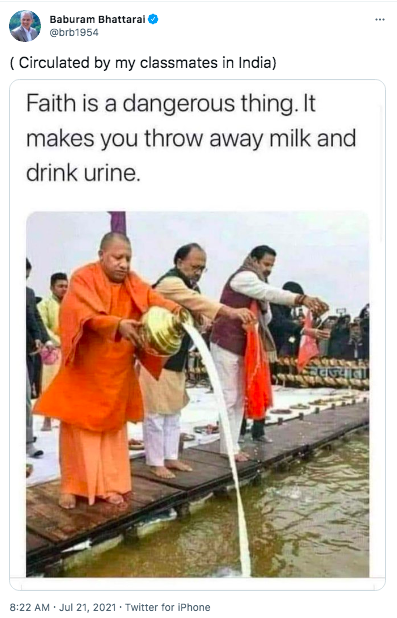
The meme would be hard to justify had a common Twitter troll posted it. It's inexcusable for a former prime minister and a public intellectual at that. Why Bhattarai decides to insult the chief minister of an Indian state with which Nepal shares deep social and economic relations is difficult to explain. This at a time when Nepal-India relations are in a possible upswing (the Dharchula incident hadn't yet happened). It is a recipe for an unnecessary diplomatic row. And what an embarrassment it would be too! Could the current government, so reliant on India for political, economic, and medical support, afford this sideshow?
A liberal reader might be inclined to forgive Dactor Sahab had he criticized Adityanath on the Indian government’s delay in sending vaccines to Nepal. Or even Yogi's comments about the role of religion in this country. Or his past rhetoric about other faiths. But this is not what the good doctor chose to do. Instead, he criticized Yogi for performing a simple act of faith, of offering milk as an act of worship. Something millions of Hindus humbly do every day.
The meme wasn't a criticism of the role of Hinduism in politics. This wasn't Raghuji Panta criticizing KP Oli's attempts to seek Pashupatinath's favors to improve his political fortunes. This wasn't women invoking Sita to make valid points about the patriarchy in our society. There was no broader political message. The meme's point was the insult of Hindus, and the problematic reference to drinking urine brings this home. Bhattarai can't, and to my knowledge hasn't attempted to, say— he’s ignorant about how this caricature is constantly deployed to dehumanize Hindus—including in countries where they are persecuted.
That his stance wasn't moral or universal was obvious. Barely two hours after this tweet against the danger of faith, he politely wished the Muslim community a happy Eid-Ul-Adha. He raised no objections. He gave no lectures. He made no insults.
But let's not let this chance provided by Bhattarai's gaffe go to waste. This tweet is an opportunity to begin a conversation about the term "Hinduphobia." This relatively new term hasn't yet found currency in Nepali politics but is increasingly adopted in the Tweeter-verse. In April this year, the Hindu Students Council (HSC) at Rutgers University in the US hosted an academic conference entitled "Understanding Hinduphobia." Given that this was the first conference on the subject, the purpose of the meeting was pretty broad. And the working definition they've given is equally comprehensive: "Hinduphobia is a set of antagonistic, destructive, and derogatory attitudes and behaviors towards Sanatana Dharma (Hinduism) and Hindus that may manifest as prejudice, fear, or hatred. Hinduphobic rhetoric reduces the entirety of Sanatana Dharma to a rigid, oppressive, and regressive tradition."
It's noteworthy that academics and not political or cultural groups led the conference. Also important is the venue. Rutgers University has become center stage between Hindus who assert that Hinduphobia is a pernicious and targeted form of bigotry and critics who claim Hinduphobia is a myth propagated by the Hindu Right to suppress valid criticism of Hindutva and intimidate people into silence.
Bhattarai’s tweet doesn't do the critics of the term "Hinduphobia" any favors. His meme does reduce "the entirety of Sanatana Dharma to a rigid, oppressive, and regressive tradition." It is particularly telling that this comes from an ex-communist, now socialist, former prime minister.
Bhattarai ought to know better. As a veteran politician, he should know sentiments and style matter in politics, both domestically and internationally. Whatever his version of Make Nepal Great Again, it won't be achieved by intentionally insulting 80 percent of this country's population. Or is he of the belief that insulting Hindus has no political or electoral consequences? If so, the narrative that Hindus are a political force in Nepal is widely overblown.
Trash talk like this hampers constructive public discourse and ultimately weakens the foundations on which we ought to build our republic. An idea for which Bhattarai himself and millions of Nepalis with him have sacrificed much and lost many.
Personally, it was the sly manner with which he framed the meme that struck a particular nerve. In the text box attached to the meme, Bhattarai wrote, "(Circulated by my classmates in India)." What cowardice! A feeble attempt to seem brave for sharing the meme while simultaneously seeking a cover behind friends. This too was straight out of Trump's playbook: always have an escape route, and when things go wrong, blame it on friends.
Slok Gyawali is a writer based in Portland, Oregon

Political Briefing | Ratify the MCC compact, now
The parliament should ratify the MCC Compact, pronto. Why? It’s in our national interest. How? There are many reasons. One, it’s a well-thought-out, detailed, time-bound roads and transmission lines project, which Nepal selected based on its priorities. If completed within the stipulated five years, it would set a wonderful precedent in a country notorious for time and cost overruns. Few other foreign-funded projects in Nepal are so thorough. And oh, it won’t add a paisa to our debt burden.
Two, we need a level of American presence in Nepal to balance the otherwise overbearing influence of India and China. That was one reason we first reached out to the Americans back in the late 1940s. Without the presence of strong third actors like the US and the EU, Nepal will have no leverage over its two neighbors, and Nepal’s fate could then be settled between them. Already, Nepal’s core concerns have been trampled upon in multiple Indo-China dealings. We can also safely overlook ridiculous concerns like the American army entering Nepal on the back of the MCC compact. That just doesn’t add up.
Three, Sri Lanka’s example is offered to suggest the MCC is somehow an imperialist concept, and that Nepal, following in the island country’s footsteps, should also reject its own MCC compact. The Sri Lankans, under the Beijing-leaning Rajapakshas, had rejected the compact that allegedly impinged on the country’s sovereignty. But Nepal is no Sri Lanka, which has no contiguous neighbors. At its closest, it is nearly 4,000 km from China, and with India, it is separated by a water-work, which, again at its narrowest, is over twice the shortest distance been Nepal and Bangladesh. So Sri Lanka has much more room for geopolitical maneuver than Nepal does. It’s thus a false comparison.
Four, much hoo-hah has been made about the compact’s mandatory parliamentary approval. But what difference does that make? We are already a signatory to the compact and without the clause for parliamentary approval, we would by now have started working on it. Parliamentary approval wasn’t mandatory earlier. The Americans later added the proviso when the compact countries failed to take ownership of the related projects.
Five, isn’t the MCC part of the Indo-Pacific Strategy, and shouldn’t we reject this anti-China project? Again, whether or not it’s (retrospectively) a part of the IPS makes no difference whatsoever. It would be naïve to believe in this day and age that any sovereign country would help any other country selflessly. As they say, there is no free lunch in international dealings. All future American help, in one way or the other, will be aimed at checking China’s military and economic rise. Nepal should be more worried about how best to secure its interests, not what India or China will think.
Six, but seriously, can Nepal overlook Chinese concerns that the Americans are out to encircle them with India’s help? I think one problem is the failure of Nepali interlocutors to convince their Chinese counterparts of the MCC compact’s importance for Nepal and to assure China that the compact would not, in any way, impinge on its core interests. If China is a good neighbor, it will understand our geopolitical compulsions.
Lastly, the dispute over the MCC compact has shown the great power of disinformation. This power will only grow in the coming days. Nepal will have to be vigilant to know the right from the wrong and to safeguard its interests.

UML factions revive militant youth groups, set stage for confrontation

The months-long dispute between CPN-UML chair KP Sharma Oli and senior leader Madhav Kumar Nepal is far from being resolved. Each camp has upped its ante against the other through verbal attacks, demonstrations, and revival of militant-like groups such as the Youth Force and the People’s Volunteer.
A couple of weeks ago, Oli revived the party’s Youth Force, which was set up in 2008 to counter the Maoists’ Young Communist League (YCL). It was dissolved a year later by the party’s eighth general convention. Following Oli’s revival of the Youth Force now, the Nepal faction has also revived the People’s Volunteer (PV) group, which was also dissolved by the same party convention, for the same reason that its hooliganism, just like Youth Force’s, was tarnishing the party’s public image.
Now, the two groups are doing their bit to get the attention of their leadership and to take the rivalry to the streets. The Youth Force has already organized big rallies, by openly flouting Covid-19 social distancing and mask guidelines. The People’s Volunteer are following suit.
Defending the mass demonstrations his group has been organizing, Kshitij Thebe, commander of Youth Force, says: “The present political turmoil is more unbearable for the common folks than the impact of Covid-19.”
Shiva Kumar Shrestha, head of People’s Volunteer, says his group will retaliate if the Youth Force gets involved in any unruly behavior. “We will not remain silent if anyone besieges our leaders’ residence [as the Youth Force did a week earlier].”
However, both camps claim that the youth groups have been revived, not to intimidate one another, but to deploy volunteers at vaccine centers, assist in rescue programs during natural calamities, advocate for justice, and hold those in power to account.
But their actions suggest otherwise. The Youth Force recently formed a 1,101-member valley command under Pushpa Raj Shrestha, who in 2008 claimed to have brought the YCL “under control”.
“Nepal is now being controlled by international agents and we will expose them,” says Shrestha who, however, sees the midnight meeting between Oli and the head of RAW as no more than an innocuous diplomatic get-together.
Meanwhile, public health experts are worried that crowded clashes between the two groups could trigger a third wave of Covid-19 infections in Kathmandu, just as demonstrations against the dissolution of parliament coincided with the second wave.
Kiran Poudel, chairperson of National Youth Federation Nepal, the mother association of Youth Force, says most of their volunteers are vaccinated so the rallies won’t spread the virus. “The media only blames us, but turns a blind eye to protests by other groups,” he adds. Likewise, Shrestha from PV says his group organizes rallies only when prohibitory orders are relaxed.
Some UML leaders such as Yogesh Bhattarai have called on the groups to end hostilities and lobby with party leadership to keep UML intact. “Leaders of the two groups must dissolve their respective youth forces at the earliest,” says Bhattarai, who was earlier in the Nepal camp. He urges both Oli and Nepal to work towards party unity and get the party back on track before rival forces take advantage of their disunity.

Political Briefing | Hard to escape the (Nepali) surveillance state
I recall a year-old conversation with a reporter with a Nepali daily who covers security issues. He had just come back from the National Investigation Department under the Prime Minister’s Office. There, as I was told, an official of his acquaintance sat him down and after a few taps on his computer keyboard proceeded to tell the astounded reporter about his personal life, things like his education qualifications, the details of his immediate relatives, the location of his residence, his work history, and all his phone numbers. Had they also recorded his calls? That, he was not told.
Back at our meeting place, the exasperated reporter asked: “Imagine the kind of details they must have on VIPs and VVIPs if an ordinary reporter like me is so closely tracked!”
I was reminded of the conversation by the latest scandal around Pegasus, the Israeli spyware that can be surreptitiously installed in cell phones. Its Israeli developer, NSO Group, had apparently sold the software to many governments, including Narendra Modi’s. Among the Modi government’s targets were resident ambassadors in New Delhi, from China, Afghanistan, Saudi Arabia—and Nepal.
The spyware’s presence on the cell phone of Nilambar Acharya, the Nepali envoy to India, indicates the mistrust that has developed between the two countries since the promulgation of the constitution in 2015. This mistrust reached new heights when then-Prime Minister KP Oli in May 2020 issued a new map incorporating the disputed territories of Kalapani. Although the relationship was beginning to thaw in the latter stages of Oli’s premiership, things are far from hunky-dory, as the Indian prime minister still refuses to accept the final Eminent Persons’ Group (EPG) report.
The Pegasus revelations also make me wonder, again in light of the above conversation with the security reporter, about the extent of phone tapping in Nepal.
Big Kathmandu-based embassies—the US, China and India—are widely suspected to be running their own intelligence programs to keep tabs on vital Nepali actors. All three embassies closely monitor the press—who writes and says what—and send detailed reports back to their capitals. Each has a list of people working for and against their interests, often prepared on flimsy grounds. As the geopolitical rivalry between them heats up, it wouldn’t at all be surprising if they have also upped their spy games in Nepal.
The best evidence of the US surveillance mechanism are perhaps the detailed cables the American embassy routinely sends to Washington, many of which are now publicly available on Wikileaks. The Indian Embassy has time and again released compromising audio recordings of Nepali communist leaders, most famously of Maoist leader Krishna Bahadur Mahara asking for money from his Chinese contact to ‘buy Nepali MPs’.
Before that, Prachanda had found himself in trouble over the Shaktikhor tapes (again courtesy the Indian Embassy) where he can be heard boasting about hoodwinking UNMIN. It would also be surprising if the Chinese, the world leaders in 5G, didn’t snoop around in Kathmandu, to keep Uncle Sam honest, if nothing else. Others may be in it too.
A new parliamentary bill aims to legalize tapping of phones under the garb of ‘national interest’. But phones of Nepali VVIPs have long been snooped on. The cat came out of the bag during the tenure of Lokman Singh Karki as the CIAA chief, when he started brazenly tapping the phones of his critics.
Even PM Oli, during his latest stint, dropped hints that he was privy to the phone conversations of his political opponents. At a time when Google knows more about us than we know about ourselves, perhaps we can all stop pretending that we can lead neatly siloed private lives anymore.


