


Politics | Nepal’s local bodies again prove their worth

When Prime Minister KP Oli was inaugurating the Dharahara tower in Kathmandu even before its construction was completed, Nepalgunj, a border town in western Nepal, was reeling under a severe crisis.
More than 1,000 cases of Covid-19 were being reported a day in the city of 1.3 million people. Nepalgunj Sub-metropolitan City lobbied with the federal government to lock-down the town, to no avail.
The District Covid Crisis Management Committee (DCCMC), headed in the district by a representative of the federal government, decided to impose a lockdown in the city only after April 25 when hospitals’ resources were spread thin as they tended to a surging number of terminally-ill patients.
Constitutionally, all three tiers of government—the local, provincial and federal—are free to exercise their executive rights. But the prevailing pandemic law doesn’t allow local governments to act independently in pandemic-containment or in any other crisis.
According to Annex 5 of the constitution, the federal government reserves the right to prepare health protocols and policies to control infectious diseases.
Soon, the city became a Covid-19 hotspot.
“We had for long been requesting for a lockdown and the closure of border crossing with India. Had the DCCMC acted on time, our city may not have faced a disaster-like situation,” says Uma Thapamagar, deputy mayor of Nepalgunj Sub-metropolitan City.
Against all odds, Nepalgunj Mayor Dhawal Shumsher Rana decided to mobilize available resources to tackle the Covid-19 crisis.
“Unlike during the first wave, the local government this time had to manage hospital beds and oxygen for Covid-19 patients,” says Thapamagar, who also visited isolation centers and hospitals each day to observe the treatment of Covid-19 patients.
After a surge in Covid-19 cases in India, early warnings were issued by experts in Nepal as well. But the government failed to regulate the open border and adopt other precautionary measures. The education minister insisted that the schools remain.
Infectious diseases expert Dr Anup Bastola wrote on his Facebook on April 9, three weeks before prohibitory orders were issued in Kathmandu and major cities, “An alarm bell has already been rung that a second wave [of Covid-19 infections] cannot be avoided in densely populated areas. Let’s not neglect safety protocols.”
Driving the change
As hospitals across the country struggled to isolate and treat the infected, local representatives sprang into action. A local representative in Khotang district even carried Covid-19 patients on his back and drove them to the hospital on his official vehicle.
“I have carried at least nine Covid-19 patients on my back to the road and driven them to hospital,” says Bhupendra Rai, chairperson of Diprung Chuichumma Rural Municipality, Khotang.
According to Rai, when the sole ambulance in the local unit became dysfunctional at the peak of the Covid-19 crisis, Rai turned his official vehicle into an ambulance and started carrying Covid-19 patients with severe symptoms to hospitals wearing a PPE.
“People’s cries don’t reach Singha Durbar. The local representatives who have to work with people every day are concerned about their wellbeing,” says Rai. “I had no option but to take some risk to save my people.”
Rai is not the only one to turn official vehicles into ambulances to ferry Covid-19 patients. Dozens of local representatives have done so, including chiefs and deputy chiefs of Jaljala Rural Municipality, Parbat, Mathargadi Rural Municipality, Palpa, and other local units.
Hira Kewat, Chairperson of Omsatiya Rural Municipality in Rupandehi district, drove the body of a deceased Covid-19-infected person to the cremation site on a tractor.
“I got a call from the ward chairman about the situation. As the army would take time to get there and as the locals were not ready to cremate the body, I donned a PPE and drove the body on a tractor,” he says.
He had heard from doctors that chances of contracting Covid-19 from a dead body were minimal.
“I was socially excluded when I was infected during the first wave. So I could feel the pain of the family members of all those who were later infected,” he says.
Morale-boosters
To boost the morale of covid patients local bodies adopted all possible measures ranging from mobilizing doctors for door-to-door treatment services to the distribution of essential meals to psychosocial counseling.
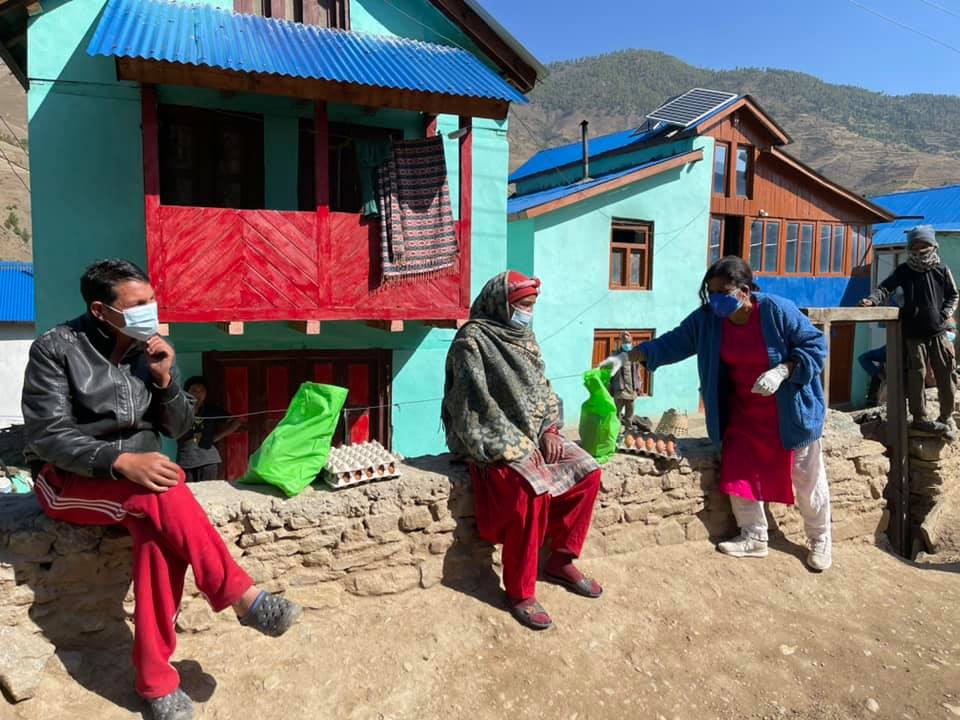 Local representatives of Chandannath municipality in Jumla district distributing food to those in home-isolation.
Kantika Sejuwal, mayor of Chandannath Municipality Julma, decided to visit Covid-19 patients in home isolation with medicines and food rich in protein.
“We were not prepared for the second wave. Our isolation center was not even ready. So I decided to visit patients at home,” Sejuwal says.
According to Sejuwal, local governments are handling the worst crisis they have faced since their formation in 2017.
“The federal and provincial government representatives are busy fighting for power and the local units are paying the price,” she says.
Local representatives of Bheriganga Municipality in Surkhet distributed food and medicines to Covid-19 patients. They visited Covid patients in home-isolation with health workers for counseling.
Dharma Bahadur KC of Banphikot Rural municipality Rukum visited Covid patients with a health worker’s team, counseling them and spreading awareness among villagers. Representatives of Butwal Sub-metropolitan city did the same.
Visits and sympathy from local representatives boost the morale of covid patients that is vital to fighting the disease as well as any social stigma it might bring.
Nepalgunj Sub-metropolitan City also initiated drive-through treatment of Covid patients in home isolation.
Missing money
Prime Minister Oli decided to seek a vote of confidence from Parliament on May 10 at a time when the country was reporting over 9,000 daily Covid-19 cases, and test positivity had reached 40 percent.
“The central and provincial governments, caught up in bitter power tussles, could do little and we had to shoulder the bulk of the responsibility,” says Kantika Sejuwal of Chandannath municipality.
According to Uma Thapamagar of Nepalgunj, had the federal and provincial governments acted on time, losses from the second wave of Covid-19 could have been minimized.
“Almost all local governments, including Nepalgunj, prepared isolation centers for the treatment of Covid-19 patients and managed oxygen on their own, by going beyond their constitutional and legal jurisdiction,” says Thapamagar. “The federal government just watched from the sidelines.”
Madhyapur Municipality in Bhaktapur started its oxygen plant when the country was facing an acute oxygen shortage.
Almost all local governments established isolation centers for the treatment of Covid patients as major hospitals were running out of beds and oxygen.
“The federal government has undermined the role of local units even in the ordinance on Covid-19 management,” says Ashok Byanju, chairperson of the Municipal Association Nepal.
“If infectious disease management is the federal government’s absolute domain, it should manage the emergency on its own. If not, local governments should be adequately empowered,” he adds.
According to him, local governments have yet to recover the Rs 12 billion they spent on covid-management last year.
Some local governments have also sought the federal government’s permission to purchase Covid-19 vaccines. But health ministry officials say local units simply don’t have the wherewithal to do so.

Political Briefing | Don’t count Oli out just yet
Prime Minister KP Oli has tried nearly everything to hang on to the prime minister’s chair: Breaking an opposition party to knit together a governing majority, amending the citizenship law via an ordinance to appease the Madhesi leaders joining his government, anomalously expanding his Cabinet, and repeatedly trying to cajole other senior CPN-UML leaders with empty promises into backing his leadership. Most troubling of them all is that he reclaimed the prime minister’s chair by stepping on contentious constitutional grounds. Now the Supreme Court has started invalidating these questionable moves, one after another. That at least is one way of seeing things.
On June 22 the Supreme Court ruled his two latest Cabinet expansions unconstitutional, as a result of which 20 ministers including three of his deputies have been relieved of their duties. The opposition parties have united against him. Ex-prime ministers believe PM Oli is ready to trade Nepal’s sovereignty to save his chair. Whatever the case, if the prime minister had to make way for someone else, he would have done it long ago. Oli is determined to hang on, any which way, until the next round of elections.
When it appeared that domestic forces could not keep him in power, he sought India’s help, which duly came. India convinced the Thakur-Mahato faction of the Rastriya Samajbadi Party, Nepal (RSPN) to ditch the party’s Yadav-Bhattarai faction and join the Oli government. In return, Oli promised to work for the restoration of Nepal’s ‘Hindu nation’ status. Modi, meanwhile, is in no mood to listen to ex-Indian diplomats who have repeatedly asked him not to pick sides in Nepal. Instead, the BJP government has passed a law that withholds state pensions of ex-officials who criticize the government in public forums.
As I have pointed out in this space before, there are many similarities between the governing styles of Oli and Modi. They are a natural match. Both are intolerant of criticism and choose to silence rather than heed their critics. They also believe in using the iron-fist of the executive to undermine other vital state organs. When other state officials cannot be coerced, they are co-opted. Therefore there are now many adherents of Modi’s Hindutwa agenda in the Indian Supreme Court. Despite his recent court reverses, perhaps Oli too believes he still has enough friends in the Nepali Supreme Court to ensure he remains at the helm during the next elections.
Modi remains popular in India, with 66 percent approval according to a new survey. This is down from his above-80 percent support pre-covid. Yet if the latest approval holds, it will be enough for him to win another election. Perhaps Oli too knows that Nepalis are bitterly divided, and as badly as he has done in the government, the party he leads can still garner a plurality of votes in the next elections. After all, the voting public hardly favors other political figures with chequered records like Madhav Kumar Nepal, Pushpa Kamal Dahal, and Sher Bahadur Deuba.
And rest assured: Oli still has a few more rabbits to pull out from his bulging bag of tricks. Oli’s political obituary has been written many times in the past, and each time he has made a roaring comeback. He would love to prove his critics wrong one final time in the next elections.

Political Briefing | When foreigners shape Nepal’s politics
Foreign policy, we often hear, is an extension of domestic policy. In Nepal’s case, the opposite may be true. The course of Nepali domestic politics is largely determined from the outside, chiefly from New Delhi and increasingly Beijing and Washington DC. This may sound like an affront to proud Nepalis. But a few examples should suffice to show that is the case.
KP Oli became the prime minister by cashing in on the anti-India sentiment that had peaked in the aftermath of constitution-promulgation in 2015. Conveniently, to shore up his image at home, he started inching close to China and subsequently rode to power on his ‘pro-China’ image. Now, in yet another volte-face, Oli is now trying to hang on with Delhi’s blessings. The most important event in recent Nepali political history—the decade-long Maoist insurgency—would not have been possible had the top Maoist leaders not found a safe-haven in India. And now the ex-Raw-wallas openly boast that it is they who booted out the Shah monarchy.
It’s nigh impossible for a Nepali leader to continue his rule without India’s good wishes, as Oli is also finding out. What about China? Well, China too has started treating Nepal as its backyard where no Tibetan protests are permitted, where its ambassador routinely visits residencies of top leaders, and where the Chinese Communist Party conducts training on governance. Arguably, Nepal’s continued sovereignty owes a lot to the presence next-door of a strong China as India’s counterweight.
The Americans too have historically predicated their support for Nepal on the landlocked country allowing it unfettered access to keep a close eye on China. Even King Mahendra had to agree to let the CIA run guerrilla camps in Mustang. In fact, the US has been using Nepal as a listening post for nearly 70 years now.
It was in 1990 that the then US Secretary of State James Baker proposed the idea of a ‘third neighbor’ to Mongolia, which, just like Nepal, is precariously sandwiched between two big powers, Russia and China in this case. The idea was that America would help Mongolia manage its tricky geopolitical act between Russia and China following the end of the Cold War. Nepal has similarly been trying to reach out to the outside world beyond India and China, again starting with the Americans in late 1940s.
Recently, NATO, which was formed specifically to counter the Soviet military threat during the Cold War, said that China posed a ‘systemic challenge’ to the world order. This is a monumental development, indicating that the military coalition against China is growing. India is already a part of the Quad, a security dialogue with US, Japan and Australia. Just as worryingly, anti-China sentiments are growing by the day in India.
But whatever the Americans or Westerners say, India would be loath to give up its traditional sphere of influence in South Asia. In other words, the geopolitical balancing act is going to get a whole lot trickier for Nepal. Geography is not destiny. But it is a huge constraint. Precisely for this reason the country’s politics, arguably, is determined less by domestic forces—which keep changing their allegiance between the ‘revanchist’ communists to the north, the ‘expansionist’ democrats to the south, and the ‘imperialists’ farther away—and more by outsiders.

Political Briefing | Clubhouse of Nepal
The most interesting conversations in Nepal take place at the ubiquitous tea outlets. With their tongues set loose by caffeine, people candidly hold forth on life and love. They then invariably jump into politics. These days, fancier tea joints have opened up, but their essence remains the same: to stimulate conversations.
After the pandemic forced the county and essentially the entire world indoors, these conversations have found a new home: the social media app Clubhouse. I am no expert on this new platform and I have only spent a little time on it. But even so, I am impressed.
I was mostly interested in political conversations, and mighty interesting ones were happening in Clubhouse. Yes, things heated up sometimes, for instance during the discussion on if federalism has served Nepal well. But I was pleasantly surprised by the level of knowledge of most participants, the vast majority of them in their 20s and 30s. They seemed to get the nitty-gritty of contemporary Nepali politics and had a good grasp of history too. (There were also a few idiots. But these days which public platform, online or off, is without them?)
Discussions ranged from dissecting the constitutionality of PM Oli’s recent moves to the prospect of Chure’s exploitation to links between our education system and development to being responsible citizens. These were no amateur conversations.
Healthy argumentation is the heart and soul of democracy. Even in India, the central government has clamped down on social media platforms and messaging apps for circulating anti-government news and views. There have been similar attempts in Nepal, but with much less success. Going by all that I have heard over Clubhouse over the past few weeks, there is no need to regulate it.
Social media platforms are often blamed—and rightly—for creating echo chambers. Increasingly, we see and hear what only we want, and filter out opposing voices. But that is only a part of the picture. Without social media outlets like Clubhouse to bond over and converse in these times of forced isolation, it would be hard to imagine the state of our mental health, which has already taken a pummeling during the pandemic.
The youngsters on Clubhouse were worried about their country. But they also sought innovative solutions. For instance, in one conversation, a speaker wanted coders to develop an app that would allow small businesses and farmers to directly sell to customers by bypassing middlemen. There were other rooms on coping with the mental health challenges from Covid-19.
Clubhouse is sparking the vital political and social debates that the pandemic had made impossible. It is also turning out to be the perfect platform for the articulation of youth voice.
Our major political parties have failed to inspire the young generation to embrace politics. The youths are fed up with the old jargon our leaders routinely spout. This tech-savvy generation wants results and thanks to new social media platforms like Clubhouse they are more articulate than ever before. And they don’t just talk. Many of them are also walking their online talk.


