



Madhesi party unity gaining momentum

Two Madhes-based parties, the Rastriya Janata Party Nepal (RJP-N) and the Samajbadi Party Nepal, have prepared a blueprint for their long-delayed unification. And following the unification (if it happens) another round of Madhes movement may be in the cards.
The two parties have also reached a tentative agreement to adopt a twin leadership model, whereby there would be two presidents—one from each party. On the ideological front, there has been an agreement to embrace the principle of socialism with a focus on marginalized groups.
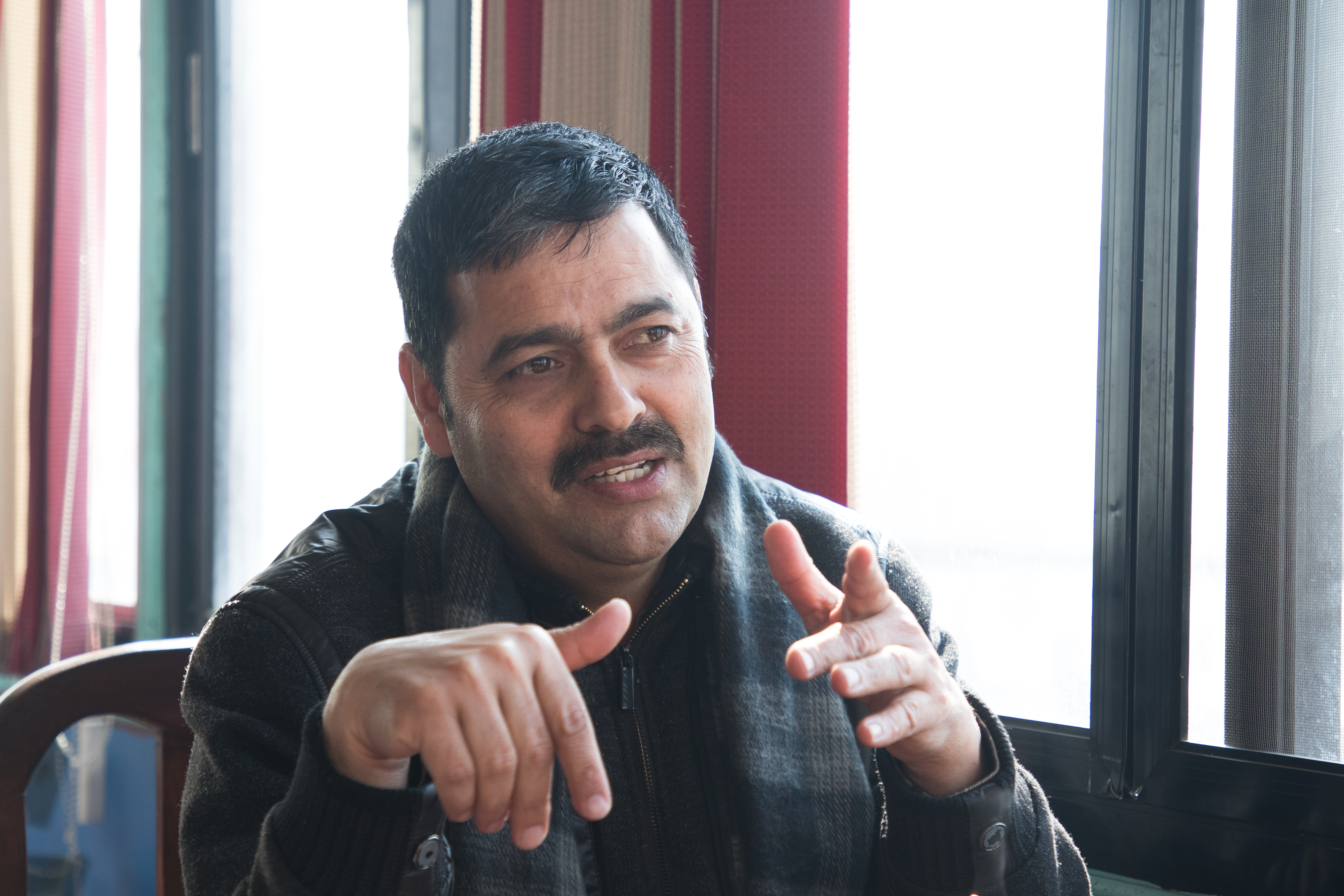
But despite these agreements something is still preventing the merger. Many party insiders say the only stumbling block now is Upendra Yadav's refusal to leave the government. “The unification will take place when Yadav quits,” says Keshav Jha, General Secretary of the RJP-N.
“Both the sides realize that without a united force of the Madhesi and other marginalized groups we cannot exert sufficient pressure on the government to amend the constitution,” he adds. But Yadav’s withdrawal from the government is one of the RJP-N’s preconditions to unification.
In a recent meeting of the Samajbadi Party, senior leader Baburam Bhattarai apprised party members of the progress so far in the unification process. “There have been discussions in the party. But we need not decide in haste,” says party general secretary Ram Sahaya Yadav, who is close to Upendra Yadav.
Although pressure seems to be building on Yadav to quit the government, he is not in a mood to do so immediately. “As another big Madhes movement is unlikely soon, Yadav has calculated that it would be beneficial to stay put,” says a Samajbadi Party leader requesting anonymity. Yadav has reportedly told party leaders that the party should exert pressure on amendment from the streets, the parliament, as well as the government.
Common cause
The two parties have also agreed to form a bigger alliance of identity-based political forces. According to leaders from the two parties, the next movement would be held under the banner of Rastriya Mukti Andolan. By accommodating Janajati and other forces that felt betrayed by the 2015 constitution, they plan to form a political force that provides an alternative to the ruling Nepal Communist Party as well as the main opposition Nepali Congress.
Amending the constitution remains a key political demand of the Madhes-based parties. The first amendment in January 2016 partially fulfilled their demands, but they have continued to push for another. But chances of another amendment in the near future appear bleak; the ruling NCP, which holds a two-third majority in the federal parliament, is not committed to it. That is why the Madhes-based parties wish to forge a united front and launch a street movement to exert pressure on the government.
There have been several rounds of talks between the government and the Madhes-based parties, but negotiations have broken down of late. Leaders of the Madhes-based parties say they supported the government with the belief that PM Oli would address their demands. “We haven’t had talks with the government on constitution amendment in recent months,” says Jha.
In public forums, Oli says the constitution can be amended ‘on the basis of necessity’ without further elaboration. NCP co-chair Pushpa Kamal Dahal is more receptive than Oli to the demand for an amendment. But a big section of the party, mostly comprised of the erstwhile CPN-UML leaders, is rigid. They seem confident that it is difficult to launch another Madhes movement as Madhesi leaders themselves govern Province 2.
The Madhes-based parties, meanwhile, are planning protests in the Tarai and in Kathmandu starting April 2020.

Oli’s iffy health reignites NCP leadership battle
A seemingly mysterious power-sharing agreement between KP Sharma Oli and Pushpa Kamal Dahal has been in the news since the unification of the erstwhile CPN-UML and CPN (Maoist Center) in 2018. The agreement is apparently about who leads the party and the government and for how long.
Former UML leaders, including Oli, want to either hide or downplay it, going so far as to publicly claim there is no such agreement. Whenever somebody makes a statement to that effect, a miffed Dahal immediately sees Oli and reminds him of the deal. An uneasy truce prevails after Oli assures Dahal he will honor the agreement. But another disagreement soon surfaces.
The implementation of such an agreement depends partly on what second-rung leaders of the party make of it. This week APEX explored the understanding and positions of some second-rung leaders of the ruling Nepal Communist Party (NCP) on the power-sharing deal. When it comes to the agreement, the second-rung leaders are clearly divided into two camps: those belonging to the former UML and those from the former Maoist Center.
Former Maoist leaders claim that Dahal has repeatedly briefed them on the ‘gentleman’s agreement’ with Oli. One such leader, requesting anonymity, said, “In the final days of the unification talks between the two leaders, Dahal had informed us of an agreement on leading the government on an equal basis—meaning Oli would hand over the reins of power to Dahal after two and half years.”
Room for compromise
As far as leading the party is concerned, former Maoist leaders say there had been a deal to chair party meetings on a rotational basis, but Oli has been presiding over such meetings himself, much to Dahal’s chagrin. The leaders suggest there is room for compromise if Oli hands over party chairmanship to Dahal.
“It is unnecessary to change the country’s premiership in the middle of the five-year term if Oli agrees to hand over party chairmanship to Dahal,” says a former Maoist leader close to Dahal. He adds that Dahal has time and again said there is no need for a rotational prime minister system if he gets full responsibility to run the party. Leaders close to Dahal have hence advised him to claim party chairmanship (rather than prime ministership) in order to penetrate deeper into party organizations.
Some UML leaders, however, say they do not know of any gentleman’s agreement between Oli and Dahal; others are of the view that agreements of such nature should be presented in official party platforms.
Deputy Prime Minister and Minister for Defense Ishwar Pokhrel has been fiercely opposing the gentleman’s agreement. He has repeatedly said in public forums that the party does not recognize the deal between Oli and Dahal, if there is such an agreement in the first place.
In light of the opposition by Pokhrel and some senior leaders, Dahal has started reaching out to former UML leaders to solicit their support in implementing the deal. Just after Dashain, for example, Dahal held a long conversation with Pokhrel. But Pokhrel maintains neither Oli nor Dahal has informed him of the agreement. Pokhrel and other leaders close to senior leader Madhav Kumar Nepal say the gentlemen’s agreement between the two chairmen should be an official party agenda.
Party capture
According to sources, some former UML leaders are also trying to bring PM Oli and senior leader Nepal closer in order to sideline Dahal. The likes of Ishwar Pokhrel, Shanker Pokhrel, Som Prasad Pandey and Rajendra Pandey, among others, want to see a reconciliation between PM Oli and Nepal. They fear Dahal and his team could capture party structures ahead of the NCP general convention, and are of the view that Oli should not bequeath the party’s legacy to a former Maoist leader. Still, whether Oli’s successor would be a former UML leader or a Maoist remains a matter of speculation.
NCP leader Devendra Poudel, who is close of party co-chairman Dahal, believes PM Oli is committed to the gentlemen’s agreement, and it is rather “some second-rung leaders who are provoking him into repudiating the deal.”
Senior leader Madhav Kumar Nepal has not publicly opposed the agreement. But at the same time, Nepal himself wants to lead the party and is likely to clash with Dahal over the matter. Nepal says both Oli and Dahal should inform party leaders and cadres about the gentleman’s agreement.
Other NCP senior leaders like Jhala Nath Khanal and Bam Dev Gautam have not publicly opposed the agreement. And even as many former UML leaders want them close, Nepal’s relationship with PM Oli has instead soured. PM Oli’s nomination of seven province heads without consulting the party rank and file has further irked Nepal.
With Oli’s heath condition worsening, he will face greater pressure to hand over party responsibilities to Dahal. But Oli seems undeterred by his frail health and is in no mood yet to resign from the posts of the PM and the party chair.
While he was in Singapore for medical treatment, PM Oli had entrusted Dahal with the responsibility of chairing party meetings for the first time since party unification. Dahal had used this opportunity to consult a wide range of NCP leaders. Oli had back then apparently almost agreed to hand over all party responsibilities to Dahal but had backtracked following intense pressure from party insiders.
Restless ramblings
This has left the former Maoist supremo chomping at the bit. Dissatisfied with the delay in handing him total control of the party, Dahal vented his ire at a recent program in Banke district. He assured local businessmen that all their demands would be fulfilled “as soon as I become the prime minister.”
Generally, Oli and Dahal jointly chair party meetings, although the former is dominant. As the party structures are dominated by former UML leaders and cadres, Dahal faces the challenge of making his leadership acceptable to them.
NCP leader Deepak Prakash Bhatta, who is close to senior leader Nepal, says there is no reason for dissatisfaction. “We still have 10 months to implement the deal. The pact was reached between two individuals, but its goal was to facilitate party unification. So I do not foresee any obstacle,” he says. Bhatta adds that the party unification process at the provincial and local levels has been smooth, and it would not be hard to reach a power-sharing agreement at the top.
Another leader close to Nepal, however, says there would be no objection to Dahal assuming temporary leadership until the general convention, but Dahal’s election as chairman from the convention floor is still uncertain. But the leaders close to Dahal claim the power-sharing deal would be applicable even after the general convention.

China-India Plus: Is it in Nepal’s interest?
“The two leaders also agreed to expand ‘China-India Plus’ cooperation, push forward facilitation of regional inter-connectivity, and work with other related parties to strike the Regional Comprehensive Economic Partnership (RCEP) agreement as early as possible.”
This is part of a statement provided by Chinese State Councilor and Foreign Minister Wang Yi in Beijing on October 13. The two leaders in the statement refer to Chinese President Xi Jinping and Indian Prime Minister Narendra Modi. But there has been no official response to Yi’s claim that the two leaders agreed to expand China-India Plus cooperation.
But what is the ‘China-India Plus’ concept anyway? No publicly available official document explains it in detail. It came to the fore after the first Xi-Modi informal summit in April 2018 in Wuhan, the capital of the Chinese province of Hubei. The summit had taken place against the backdrop of a 73-day-long standoff between India and China over Doklam, which, strictly speaking, was a bilateral issue between China and Bhutan. India had still deployed its army there on Bhutan’s behalf, stating that any changes in Doklam’s status would affect its security.
In the aftermath of the standoff, China proposed the China-India Plus cooperation in order to minimize the conflict between the two countries over smaller South Asian states. It was also an acknowledgement by the Chinese that India is the dominant power in South Asia, so they need to take the Indians into confidence while pursuing vital infrastructure projects and entering into military and other cooperation in the region. In other words, India is always an important consideration in China’s relations with South Asian countries.
Again, the Doklam issue seems to be the trigger for the China-India Plus concept, which envisions that India and China will be mindful of each other’s sensitivities and security interests in South Asia. During the Wuhan Summit, Xi and Modi agreed to implement joint economic projects in Afghanistan. Last year, they together launched a training program for Afghan diplomats in New Delhi.
China pushing
Nepal’s situation cannot be compared with that of Afghanistan, but India is obviously concerned about the growing Chinese influence here, particularly about big Chinese infrastructure projects. China thus wants to implement the Plus concept in Nepal in order to minimize the risk of confrontation with India over development projects here. Many reckon Xi’s decision to fly to Nepal from India—as opposed to coming here from China directly—indicates Beijing’s desire to execute this concept.
During Prime Minister KP Oli’s visit to China, Xi briefly shared with him the discussions he had had with Modi about the Plus concept. Xi and Modi also discussed it during their second informal summit in Mamallapuram, a coastal town in the south Indian state of Tamil Nadu, and Xi then shared it with Nepali leaders in Kathmandu. In return, Oli reportedly told Xi that Nepal is in favor of trilateral cooperation, but not the ‘two-plus one’ model. The Chinese side, however, is pushing for it.
PM Oli has rejected this proposition. In an interview with Kantipur, a Nepali daily, he argued that partnerships should be formed on the basis of equality. Experts also think Nepal should not accept this proposal, as it weakens the county's bargaining power with its two giant neighbors, and affects its sovereignty in that it undermines Nepal’s ability to deal independently with India and China on vital infrastructure and development projects. China is keen on the ‘two-plus one’ model as it wants to launch key projects in Nepal, such as the construction of a railway line, by taking India on board. China is also eager to invest in hydropower plants in Nepal and export energy to the Indian market.
Security over economy?
What about trilateral cooperation though? The idea of India and China collaborating on Nepal’s development is not new. Trilateral cooperation has been under discussion for about a decade; co-chairman of the ruling Nepal Communist Party Pushpa Kamal Dahal has been speaking about it since 2010. But how does it differ from the China-India Plus cooperation?
“China-India Plus cooperation entails the two countries taking each other into confidence while developing any projects in Nepal. The goal is to address each other’s concerns in Nepal,” says Pramod Jaiswal, Senior Fellow at the Institute of Peace and Conflict Studies, a Delhi-based think tank. “Although China-India Plus sounds similar to trilateral cooperation, the two are different. Trilateralism suggests equal share of all three countries and is more economic in nature, whereas the Plus concept is primarily security-driven,” says Jaiswal who has penned a book on trilateral cooperation.
“Genuine cooperation between China and India in Nepal is relatively easy to achieve, and there are multiple ways to do so, one example being a railway line connecting the three countries,” says Bhaskar Koirala, Director at the Nepal Institute of International and Strategic Studies. “The main argument here from a Nepali perspective is that sustained cooperation between its two neighbors in Nepal would almost certainly constitute the key ingredient for the country’s long-term stability and prosperity,” Koirala says. He adds that trilateral cooperation is not a concept proposed by the Chinese, but one that originated in Nepal, so the Nepali side should take its ownership. “I definitely agree that trilateral cooperation is much better for Nepal than the China-India Plus concept,” he says.
Hope and reality
Indian foreign policy experts and commentators, however, claim there is no possibility of India joining hands with China in Nepal. At a summit in Goa, India in 2016, then Prime Minister Pushpa Kamal Dahal had met with Modi and Xi together. Dahal had projected the meeting as a manifestation of trilateral cooperation.
The Indian Ministry of External Affairs quickly batted down any notion that it was a trilateral meeting, saying it was only a coincidence that the three leaders happened to share the same space. This clearly indicates India’s lack of interest in trilateral cooperation—and it will not materialize without India’s buy-in.
China, however, seems open to both the Plus concept and trilateral ideas. “China can invite India to join China-Nepal cooperation projects and develop China-Nepal-India trilateral cooperation. This will not only enhance trust, but also increase the economic value of the cooperation projects,” wrote Long Xingchun, Director of the Center for Indian Studies at China West Normal University, in an article published in the Global Times on October 13.
“For example, if the three countries can cooperate in hydropower generation, Nepal’s resources, China’s funds and technology and India’s huge market can be leveraged together.” As China-India strategic trust has increased, Nepal, he further argues, can use Chinese and Indian resources to promote its own development and act as a bridge linking the two nations.

Shared interests define Nepal-China friendship
“There is only friendship and cooperation between China and Nepal, and there are no problems,” Chinese President Xi Jinping said at a state dinner at the Soaltee Hotel on October 12. In today’s international relations, it is not often that two neighbors do not have any problem.
In my view, the fundamental driving force of state-to-state relations today are national interests. That is why China and the US were able to normalize their bilateral relations in the face of an aggressive Soviet Union in the 1970s. It also explains why the US, which always crows about democracy and freedom, views unelected monarchs as its strongest allies in the Middle East. From this point of view, it would be much easier to understand the friendship between China and Nepal.
Perhaps I am not entirely correct. But in my limited understanding, the most important thing for Nepali people is the continuous improvement in their living standards. Of course, other things are also important, but without economic well-being, everything else is a bubble.
Often I have sat alone on the stone steps of the Durbar Square, looking at the great medieval buildings shining at sunset and feeling the past glory of this great country. Looking at those countless wood and stone carvings, I cannot help but wonder about how much manpower and material resources they needed. It may take a skilled carpenter a week to make a beam full of reliefs. But how formidable were the logistical challenges? It perhaps took 1,000 craftsmen to build the entire square, over 100 or more years. The country that created such great buildings must have been powerful.
The world changed overnight when the westerners completed the Industrial Revolution. The unfortunate fact is that the once-mighty Nepal is now one of the least developed countries in the world. Countless scholars have reflected on possible reasons. According to my superficial understanding, a modern country’s fundamental power comes from its industrial production capacity. But due to Nepal’s geographical limitations, it has been unable to have large-scale industries.
Raw materials cannot be easily transported into Nepal, nor can its products be easily exported. Worse, traditional agricultural production has been unable to feed a growing population. As a result, more and more Nepali youths are going abroad for work, instead of building their homeland. Do they not love their country? I don’t think so. But there is nothing wrong with them seeking a better future either. This is a real tragedy.
There is a saying in China: “Build roads before you can get rich.” Without sorting out the challenges of Nepal’s external connections, Nepal’s development problems will not change fundamentally. I may sound a little extreme, but I believe that the so-called “democracy and freedom” cannot solve the fundamental problems of Nepal’s development. In Nepal, there seems to be enough time to quarrel in the parliament and protest on the streets, but not to build roads and other vital infrastructures.
Over the past 40 years, under the CPC leadership, the Chinese people have achieved remarkable success in socialist construction. Many countries are encountering problems in the course of their development. To solve these problems, the Chinese people have also made contributions, in the form of their labor and wisdom. President Xi Jinping has put forward the concept of “Building a community with a shared future for mankind”. China’s goal under the BRI framework of building a “three-dimensional connectivity network across the Himalayas” will help Nepal transform itself from a “land-locked” to a “land-linked” country.
Perhaps some readers will say: “All this talk is propaganda. Isn’t China also acting in its own national interest?” Of course, any country’s foreign policy serves its own interests, and China is no exception. But the point is that China’s interests are aligned with Nepal's.
First, Nepal is an important neighbor of China. So the Chinese want Nepalis to live in a high-quality society rather than only building luxury places in their homeland.
Second, stability and development go hand in hand. On the one hand, development is impossible without a stable social environment. On the other, if the society cannot develop sustainably, people’s living standards cannot be improved and social stability is undermined. For example, Nepal has had 10 governments in the past 10 years. As an important neighbor, Nepal’s prosperity is good for China. I cannot think of any counterexamples. China therefore hopes it can help Nepal realize the goal of “prosperous Nepal, happy Nepalis”.
Third, and more realistically, if Nepal falls into the trap of poverty and unrest, China’s national interests, especially its national security, will also be threatened. Poverty and unrest will weaken Nepal’s sovereignty and lead to more foreign involvement. Perhaps some countries will use Nepal’s territory against China. Of course, no country would publicly admit to doing any of these, but the possibility cannot be ruled out. If helping Nepal become stable and developed can reduce this possibility, why not?
China-Nepal relations are rich and multi-dimensional. What I want to emphasize here though is that it is not only the members of the CPC and the NCP who are comrades, but also the people of China and Nepal. This is the foundation of China-Nepal relations, rooted in protecting shared national interests. Nepal-China friendship, Jindabad!
The author is chief correspondent of the Kathmandu office of Shanghai Wen Hui Daily. He has a Master’s in International Relations


