


Ka-band’s faster, cheaper internet for rural Nepal

Following the recommendation of the Nepal Telecommunications Authority (NTA) to the government on opening the Ka-band frequency segment (19.7-21.2 Ghz Downlink, paired with 29.5-31 Ghz Uplink) for use in Nepal, all regions in the country are expected to benefit from faster internet at affordable rates. The recommendation means that businesses, communities and government agencies within Nepal will soon access services from one of Asia’s latest, state-of-the-art satellites: Kacific 1.
The Kacific 1 satellite, owned by Kacific Broadband Satellites Group, uses Ka-band technology designed specifically to provide reliable, high-speed broadband internet to rural and remote populations through concentrated spot beams and simple easy-to-install onsite 1.2m antennas. This technology, although new in Nepal, has been successfully used in other countries in Asia, including ones with similar mountainous geographies.
Nepal’s mountainous terrains make it difficult for ground-based technologies to provide widespread and reliable coverage, and a large swath of the country cannot be connected with cable-based technologies. This means that for the 22.8 million citizens living in rural areas, (around 80 percent of our 28.6 million population), satellite technology is the only way for individuals and organizations to access broadband. All they would need is a small, easy-to-transport and rapidly deployable satellite dish.

‘Stone village’ offering local jobs to those with foreign dreams
Khagendra Shreesh, 40, of Bhujung, Galkot Municipality-6, came back to Nepal after working in Saudi Arabia for eight years. Even after his return, his fascination with foreign employment remained intact. Two years ago, he applied for a visa to Japan. His application was rejected, and his dream of a Japanese job, much favored in Galkot, evaporated. Shreesh is now busy managing a stone quarry, and employs local youths.
“After being denied a visa to Japan, I thought a lot about what to do. I eventually decided to give continuity to my stone quarry business, a trade passed down generations from my grandfather,” he says. In 2000, Shreesh was in fact the first person to start a stone quarry with imported slate cutting equipment and expertise in Bhujung. He currently earns Rs 50,000-Rs 100,000 a month from his quarry, and employs 10 villagers.
Tul Bahadur Pariyar, who also returned home after working in Saudi Arabia for eight years, is now content with his work at the quarry. “I am happy to be able to work in my own country, in my own village,” Pariyar says. “I get to live with my family and to follow on my father’s footsteps.”
Workers get Rs 3 each for preparing a ‘cut piece’ slate tile. As a person can prepare up to 500 cut pieces in a day, the average monthly income comes to around Rs 35,000 to Rs 40,000, depending on the amount of stone mined from the quarry. These cut slate tiles are used for roofing, paving the ground and on house walls and are in great demand all over Nepal. However, Shreesh complains of his inability to export tiles due to bad roads and legal complications.
“We are now preparing to register the quarry and have requested the municipality to arrange easy road and electricity,” Shreesh says.
Shreesh has also employed women. Kumari Shrees, 36, says carrying slate in her spare time helps her meet family expenses. “We get Rs 2 for each cut piece we carry and we can carry up to 150 pieces in one consignment,” she says.
It has only been a few years since slate excavation in the area started on a commercial scale. Only now recognized as ‘Stone Village’, Bhujung has always been famous for its slates. In the past, villagers used to make a living by selling stones mined from quarries; the stones were only used on roofs. With new technology and recent use of slate as alternatives to tiles, there is a lot of potential for commercial manufacture of slate here.
Hemant Bhandari, spokesperson for Galkot Municipality, informs that an initiative is underway for proper management of all the quarries in the municipality. “We know there is a good potential for stone quarrying here, but we have been unable to bring it under the law’s purview. The municipality thus has been unable to collect tax from this industry,” Bhandari says.

Waste management in Kathmandu: Where does your garbage go?
Every day, 1,200 tons of waste collected from Kathmandu, Lalitpur, Bhaktapur, Kakani, and Banepa is dumped at the Sisdol landfill site in Kakani rural municipality, Nuwakot, according to the Solid Waste Management Association of Nepal (SWMAN). Sisdol landfill was supposed to be a temporary dumping site, meant to be used for three years. It’s been 13 years now.
In the past two years, the government has sped up landfill construction work at Banchare Danda, also in Nuwakot, and it’s expected to be complete by the (Nepali) year’s end. But without a scientific approach to waste management, experts say, Banchare Danda is fated to become the next Sisdol.
Dhurba Acharya, chairperson, SWMAN, says we need to learn from developed countries and their approaches to trash if we are to tackle our seemingly insurmountable waste management problem.
Currently, of the 1,200 tons of garbage collected daily, 65 percent is organic waste, and 15-20 percent is recyclable.
“This leaves you with very little that should actually be going to the landfill,” says Acharya. But without a proper system for waste segregation, much of the trash collected ends up in the landfill.
In recent times, a lot of emphasis has been given to recycling, upcycling, and reusing. Many people and corporate households seem to realize that the onus lies on each of us, and they are quite intent on doing their bit to reduce the amount of trash they generate. There are also many companies, organizations and social enterprises working to reduce the amount of trash that goes to the landfill.
For instance, there’s Doko Recyclers that helps you segregate your waste at its source. Khaalisisi is working towards building Nepal into one of the world’s Top 20 Recycling Nations by 2030. Upcycle Nepal Pvt. Ltd. tries to ensure all unused fabric are put to good use and don’t end up at Sisdol. Sukhawati Store Foundation promotes thrifting culture in Nepal, while Eco Saathi Nepal offers sustainable options for many daily use items that would otherwise ultimately end up in the landfill. Plus, there are many more such establishments doing similar work.
Sourced wrong
And yet, nothing has been enough to stop Sisdol from overflowing. Where are we going wrong? And what’s it going to take?
The only solution appears to lie in proper segregation of waste at its source: separating garbage into recyclable, non-recyclable, and organic bits, and disposing them off accordingly.
However, Kiran Shrestha at Action Waste Pvt. Ltd., a waste management company in Kathmandu, says segregation takes time and effort and thus most people don’t seem inclined to do it—much simpler to just dump everything in a single bin.
“In the areas we collect waste materials, less than two percent households segregate their trash,” he says.
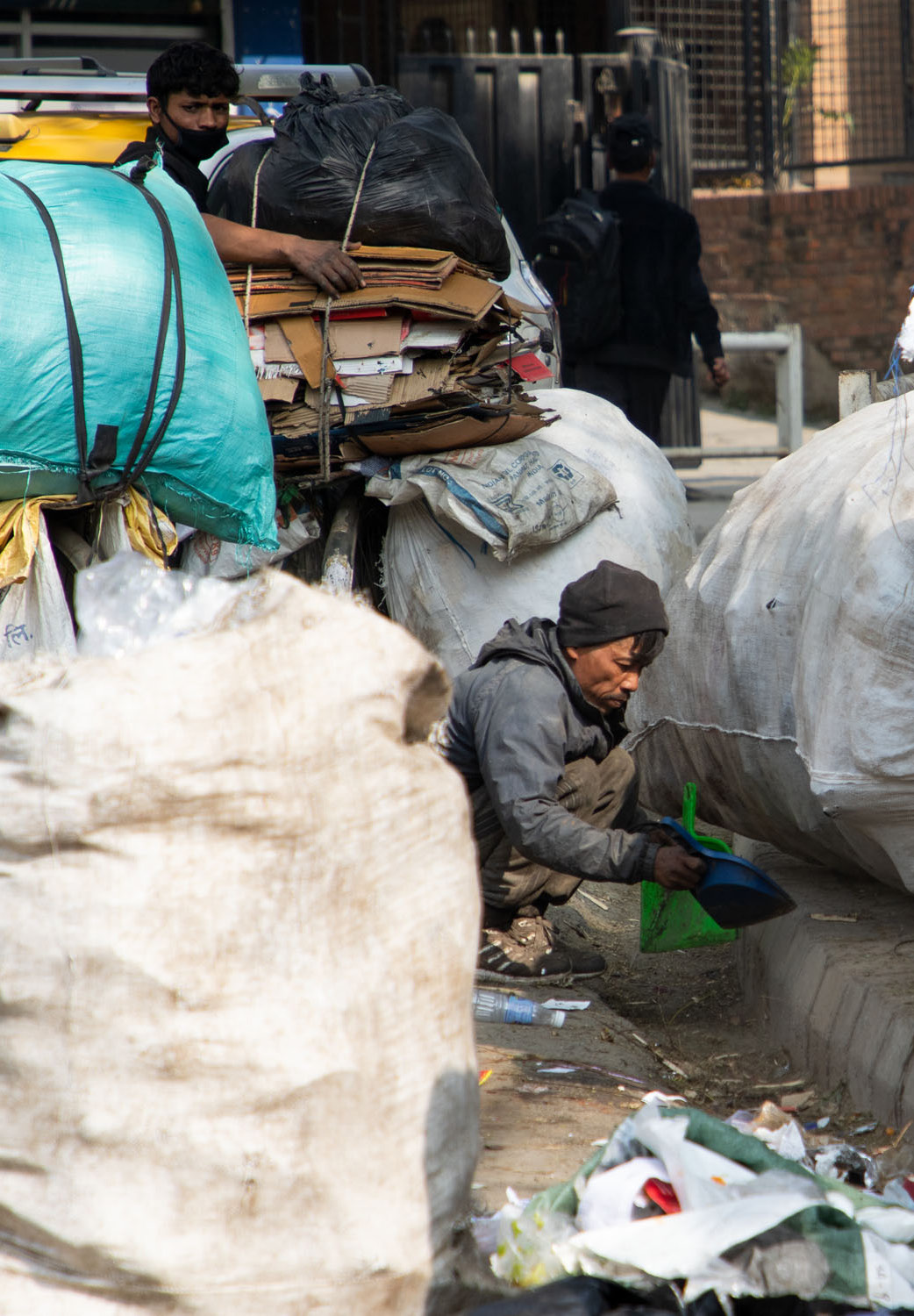
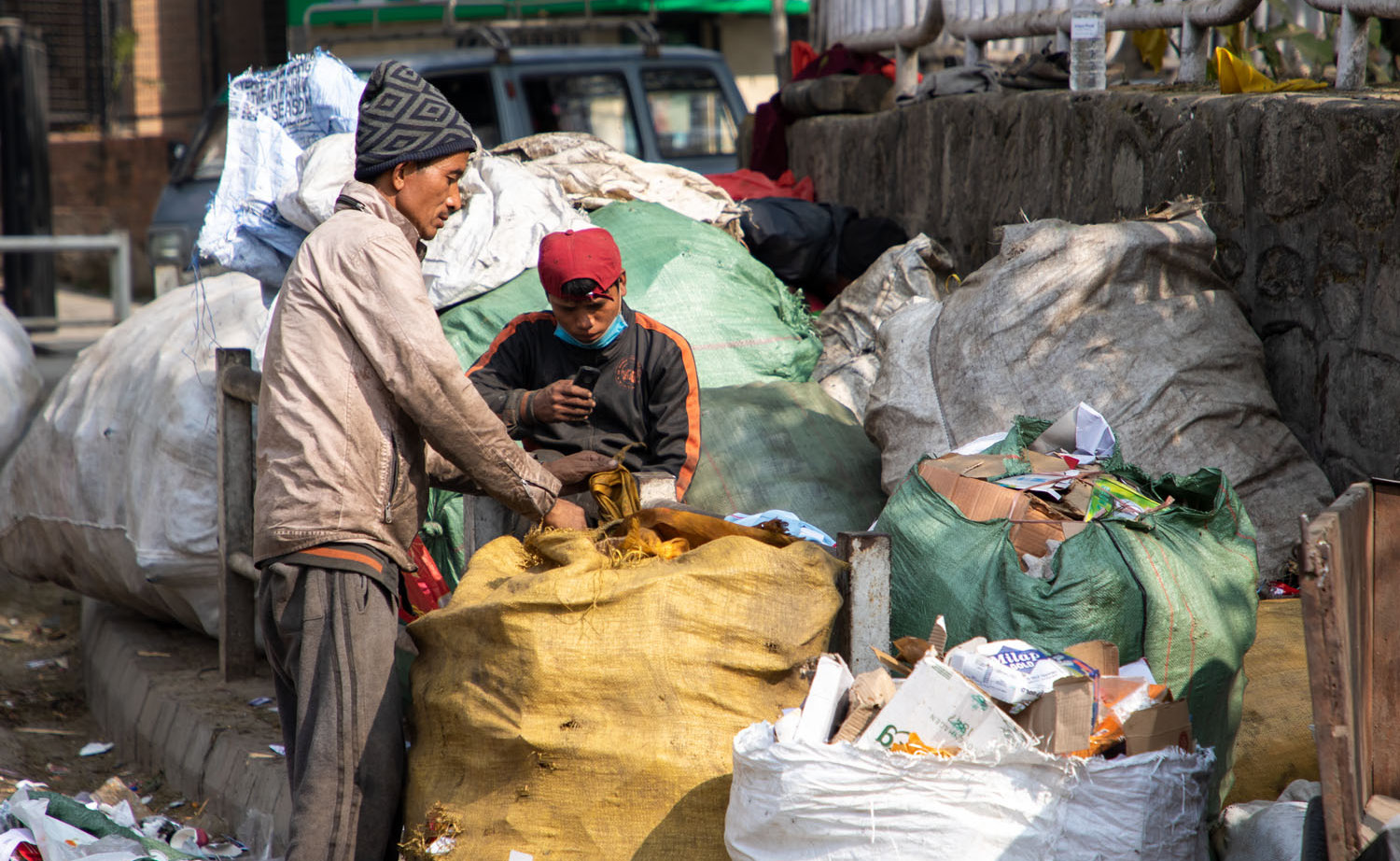
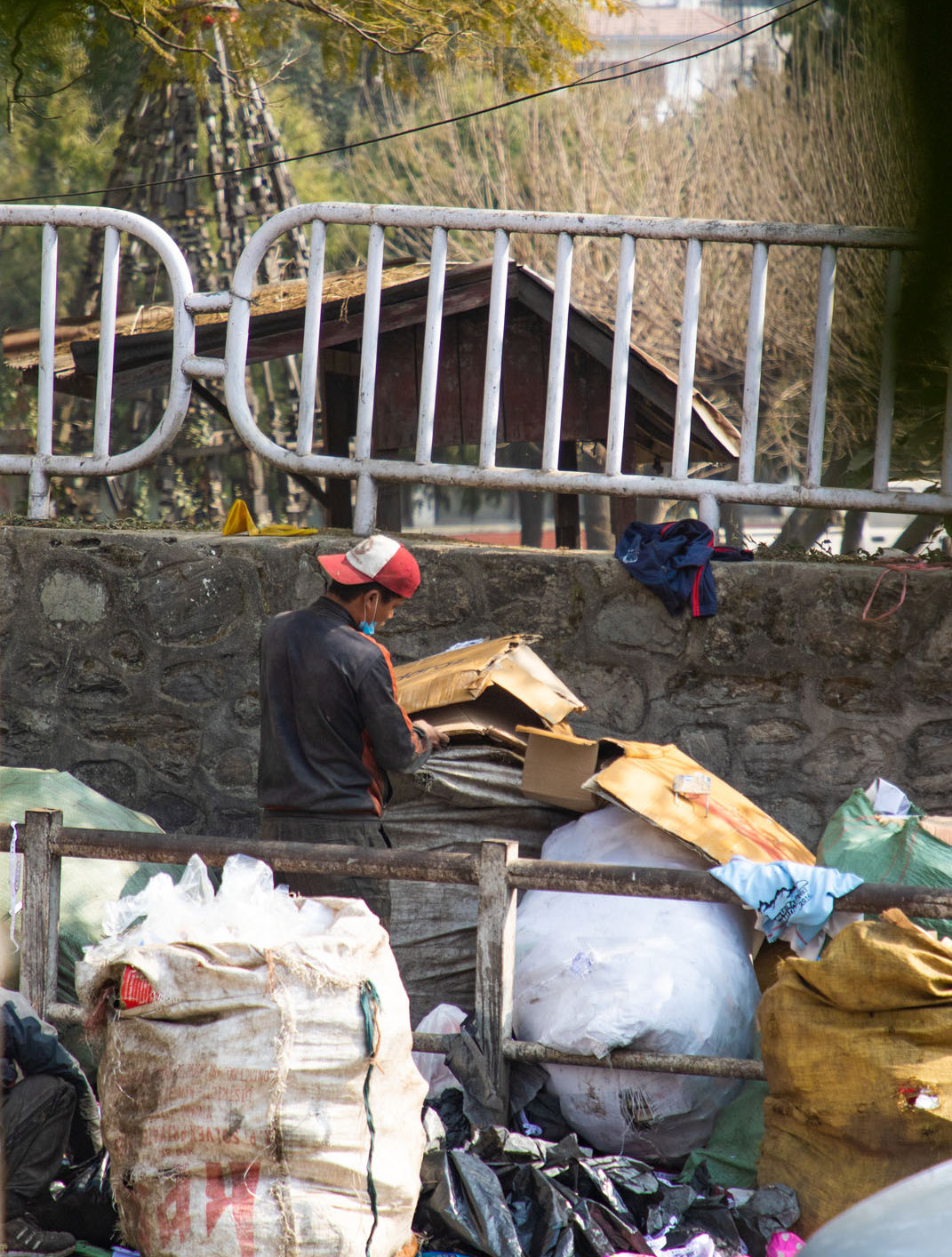
An obvious but often-forgotten fact is that someone has to manually sort through our waste when we don’t: handling our waste are around 4,000 laborers from 75 private companies and municipalities. Waste-sorters often accidentally cut their hands with broken glass pieces we throw in our trash. After years in the job many of them go on to develop long-term health complications.
Laxmi Prasad Ghimire, spokesperson, Nepsemyak, a company working in the field of community-based solid waste management, believes all of us could help by composting organic waste at home. This, he says, will considerably reduce the amount of trash we collectively generate.
“I understand that a lot of people live in apartments and single rooms, but composting is possible in small spaces too. If you learn how to compost, there’s really nothing to it. Then the second step which is separating your waste into recyclable and non-recyclable bits becomes easier,” he says.
The problem, Shrestha adds, is not that people don’t know about composting and recycling but that without clear states policies and laws and their strict implementation, they simply don’t bother.
Aayushi KC, founder of Khaalisisi, says a single person or household or even a community segregating its waste isn’t enough. It can’t create the desired impact and reverse the environmental damage we are causing, bit by bit, day by day.
“I know it sounds cynical but this is perhaps the only area where a little bit won’t go a long way,” she says. What we need instead, KC adds, is a complete package with lifestyle change on the part of people and society, and policies and investment from the government’s side.
KC says people need to be given incentives to segregate and recycle. This is one reason why at Khaalisisi they insist people take money for their recyclables and not just give them away for free. The fact that you can make an income, however meager, from things you are throwing away could act as a motivator of sorts.
Absent awareness
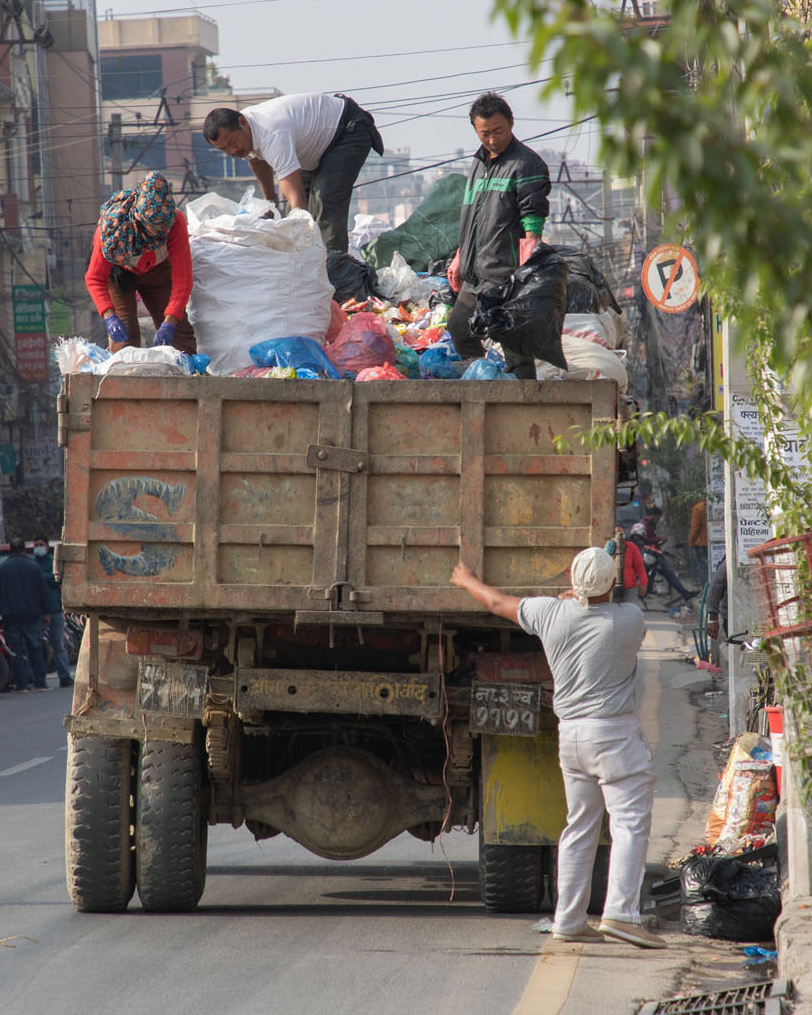
There is also a huge problem in the way collection is currently carried out, making segregation pretty pointless, say those working in the sector. Even if segregation happens at the source—meaning households, offices, and the like—waste materials are dumped together in the same vehicle when they are picked up.
“It can be extremely discouraging to those who take the trouble of separating their wastes,” says KC.
Shrestha, of Action Waste Pvt. Ltd., cites lack of public awareness as the reason for all sorts of waste being collected together. He recalls a time when Action Waste collected dry waste and wet waste on different days. But people would invariably throw mixed waste on both days.
Ghimire agrees that this method, if strictly practiced by each and every household, could bring us a step closer to creating a proper waste management system. Unfortunately, the behavioral changes needed for that will take time. Meanwhile, a comprehensive awareness of proper waste management has become essential.
The situation isn’t all bleak though. Many startups and companies have taken it upon themselves to help people follow the three Rs—Reduce, Reuse, and Recycle—to cut down the amount of waste that reaches the landfill.
Rajan Chakradhar, cofounder of Upcycle Nepal Pvt. Ltd., mentions that on average they get 300 to 400 kilos of clothes and scrap fabric every month. They repurpose these to make bags, scrunchies, and other accessories besides donating clothes that are in wearable condition to those in need.
“If people have clothes they are about to toss out, they can give them to us and we’ll keep them from ending up at Sisdol,” says Chakradhar.
Mani Karki, founder and CEO of Eco Saathi Nepal, thinks it’s imperative to shift the focus on sustainable living as it’s possible to greatly reduce waste by replacing single-use items with greener alternatives.
From compostable bamboo toothbrushes, hairbrushes and cutleries to metal straws, reusable cotton makeup removal pads and menstrual cups, Eco Saathi Nepal offers many things one would need to make the switch to a sustainable lifestyle.
Similarly, by promoting thrifting or secondhand shopping, Sukhawati Store Foundation has, in four years, prevented 30,530.73 kilos of goods from being discarded.
“Thrifting is important in reducing waste and though it’s a relatively new concept in Nepal, people seem to be more aware about it these days,” says Samita Rana Magar, coordinator at Sukhawati Store Foundation.
The foundation has various drop points—in Nakhipot, Banasthali, Bhaisepati, and Durbar Marg—where you can leave clothes, shoes, bags, accessories, electronics, and other items you would like to give away. Alternatively, you can also request them for a pick-up service.
Collective effort
Experts’ undivided opinion was that, given the breakneck speed of urbanization and our inadequate waste management infrastructure, companies like these working to minimize waste can slow the pace of waste reaching the landfill. But their efforts will be futile without adequate public support.
Stuti Sharma, communications and advocacy coordinator at Doko Recyclers, says people aren’t very enthused about proper waste management. There’s hope though as the idea of recycling and reducing are slowly entering people’s minds because of all the conversation surrounding sustainability and environmental preservation, especially on social media.
“There are so many private industries and organizations working together to manage waste properly that it’s bound to bring about change sooner or later. But people also need to understand that not everything can be recycled and try to create less waste,” she says. And it’s not that hard, she adds, if you are a little conscious about what you are using on a daily basis.

People in western Nepal heading back to India
Pancha Kumar DC, 27, holds his wife Rajanpura Rokaya’s hand as they queue at the Gauriphanta border point in Kailali district in far-western Nepal. The couple, who hail from Sani Triveni Rural Municipality-2 of Karnali province, is on its way to Bengaluru, India. They are in search of jobs.
“We are neighbors to our Province Chief Minister Mahendra Bahadur Shahi. But what difference does that make?” DC asks. “He seems to have forgotten all his electoral vows.”
DC had voted in the 2017 elections. “The leader I voted for won and his party is in the government,” he says. “But even the two-third majority federal government failed to meet our expectations. Now they have dissolved an elected House and are fighting among themselves. We are distraught.” The DC couple prefers living in their own village but with no jobs or stable income, they had no option but to leave to make their ends meet.
The brother duo of Padam Koli, 27, and Niraj Koli, 23, of Dasharathchanda Municipality-5, Baitadi, also voted in the last elections. “We had high hopes that this time the government would create local jobs and people would no longer have to go to India," Padam says. "But now, we are bitterly disappointed to see them fight among themselves.”
Federal elections have been announced for April-end after the dissolution of the House of Representatives. Niraj, who works as a security guard in India, says he has no intention of coming home to vote this time. “Our votes seemingly do no more than add to the prosperity of our leaders and their families.”
The Koli brothers live with their elderly parents back home. Padam is married. Both says they will earn enough money in India to finance the education of their little brother, the youngest of the three. “But we’re still not sure what he’ll here after his studies. As things stand, he too will ending up searching for a job in India,” Niraj says.
A faction of the ruling Nepal Communist Party has hit the streets after the dissolution of the federal House of Representatives. Opposition parties are also on the streets. They need people to support their respective movements. Many local leaders are already knocking on the doors, asking people to join their agitation.
“Some leaders came to our house and told us to join their protests,” says Bam Bahadur Bam of Gauriganga-9, Kailali, who was previously employed as a security guard in Pune, Maharashtra. “We refused to go but they kept coming. One reason I am going to India now is to avoid them.”
“Nepalis headed for India seem disgusted with the political situation in the country,” says Prakash Madai, program manager at Nepal Institute of Development Studies Nepal, an NGO working in the field of immigration. “People had been hoping for the creation of new employment and entrepreneurship opportunities after the formation of a strong government. That hope now appears dead.”


