



Curfew lifted in Tinkune-Baneshwor area

The Kathmandu District Administration Office has lifted a curfew in the Tinkune-Baneshwor area.
The order initially imposed from 4:25 pm to 10 pm was later extended to 7 am until Saturday following the clash and vandalism that ensued as a result of the protest and demonstration held by pro-monarchists.
The order was imposed as per Section (6) a of the Local Administration Act, 2028 BS, said Kathmandu Chief District Officer Rishiram Tiwari.
The curfew order was issued in the late afternoon to be effective from Old Baneshwor to Tinkune area, from Gaushala to the airport, Gairigaun, Tinkune to Koteshwor, from Koteshwor to Jadibuti Bridge, from Koteshwor to Balkumari Bridge, from Baneshwor Chowk to Shankhamul Bridge, from Gaushala Chowk to Old Baneshwor to Naya Baneshwor Chowk.
Two persons died and 45 others were injured in clashes between pro-monarchy protesters and security personnel on Friday.

Mob attacks Annapurna Media Network
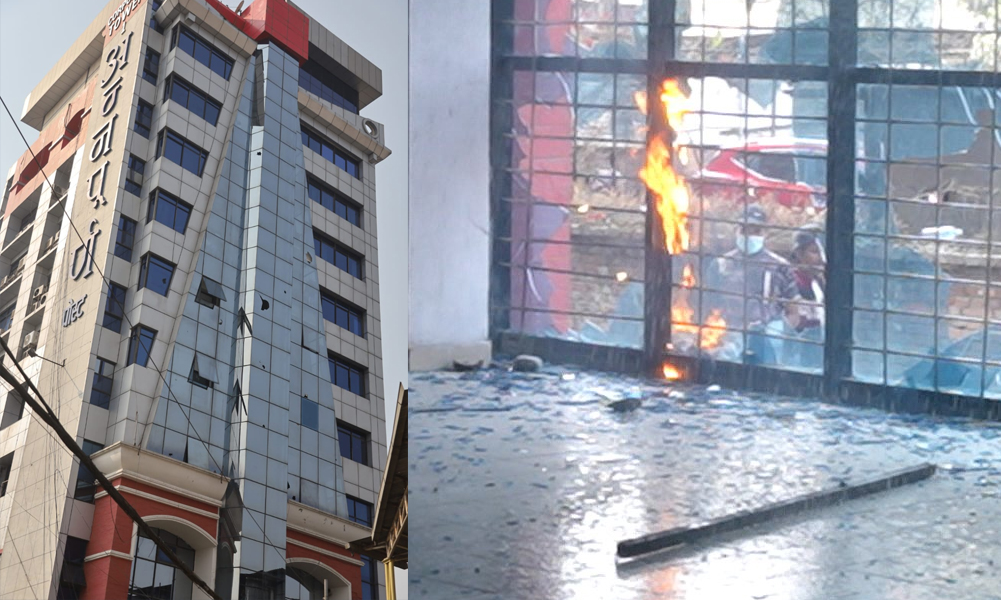
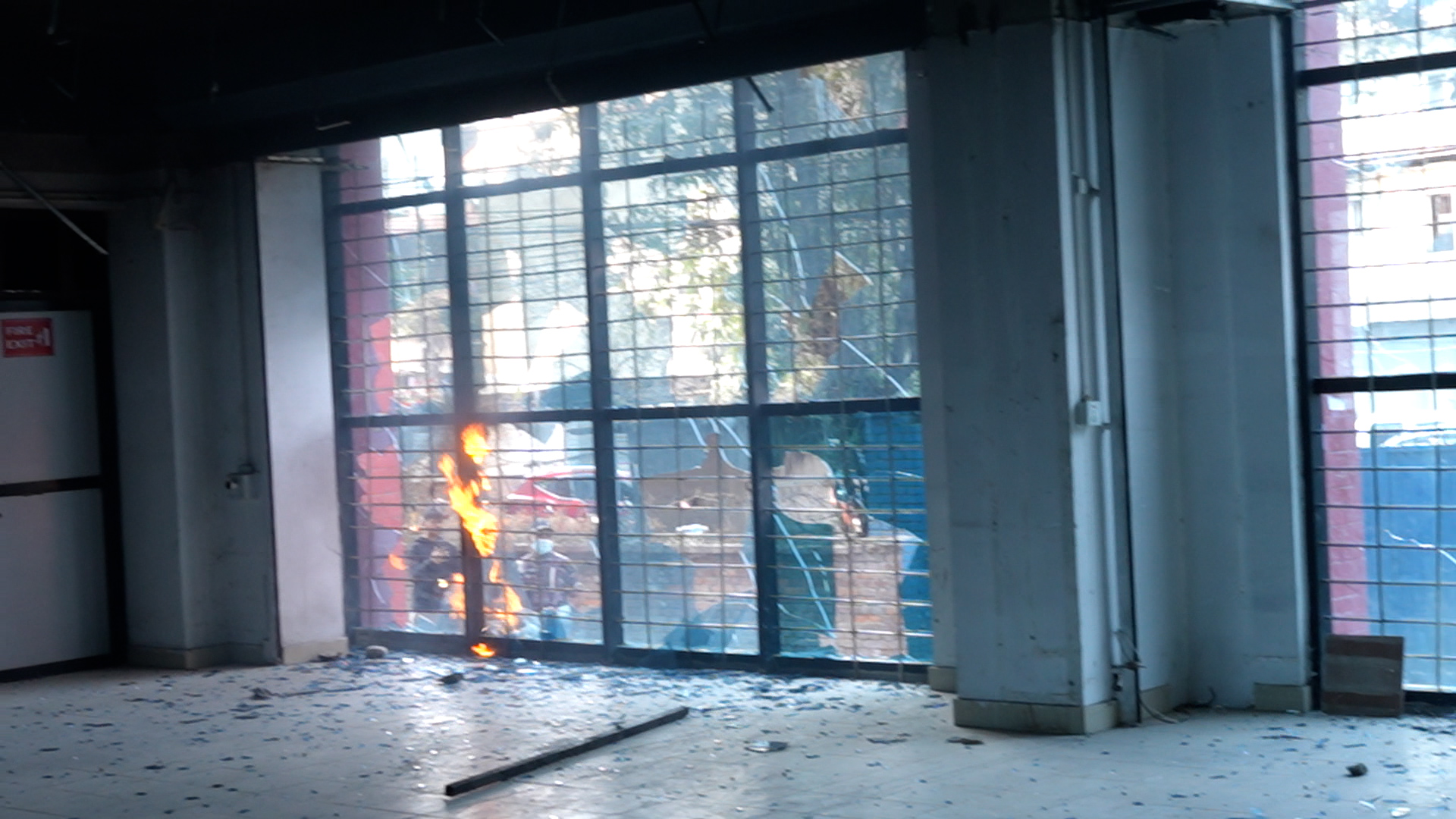
A protest organized by pro-monarchy supporters in Kathmandu turned violent and destructive. A mob systematically attacked the Annapurna Media Network (AMN) Tower at Tinkune, Kathmandu. The protest escalated quickly as individuals threw stones, breaking windows and attempting to ignite a fire inside the building. This vicious attack severely damaged the exterior of the AMN building and endangered the lives of the reporters as well as employees working inside. The incident has raised grave concerns about press freedom and the safety of journalists in Nepal, particularly as AMN has long been a respected and independent media outlet committed to providing unbiased and reliable news.
In addition to targeting AMN, the protestors also set fire to and caused significant damage to several commercial and residential properties in the Tinkune area.
Annapurna Media Network is calling for immediate action from both the national and international communities to ensure the protection of journalists and the safeguarding of media institutions. This assault is being viewed as an attack on democratic values and free press, requesting global media rights organizations to strongly condemning the violence. AMN remains committed to its mission of responsible journalism but stresses the urgent need for collective efforts to protect press freedom in Nepal and prevent future attacks on media houses and other corporate entities. The General Manager of Annapurna Media Network condemned the act, stating, “The attack on a reputed media house is an act of terrorism. We strongly condemn such violent and terrorist activities against independent media organizations. We call upon national and international organizations to stand with us in solidarity, and we urge the government to take strict action against those responsible for this horrific act of violence.” AMN seeks the support of all relevant national and international entities to ensure justice and security for media professionals in Nepal.
Pro-monarchy protesters attempt to torch the office of Annapurna Media Network
Protesters demanding the reinstatement of monarchy attempted to torch the office of the Annapurna Post on Friday.
The pro-monarchy protesters attempted to set fire to the office of the Annapurna Post at Corporate Tower in Tinkune. The security guards extinguished the flame.
The protest, which was expected to be peaceful, turned violent as the demonstrators’ hurled stones and attempted to torch the office of the Annapurna Post.
There were reports that the royalists have resorted to vandalism and arson in various parts of the Capital since this morning.

It seems that their intention was not to make the protest peaceful but violent.
Prior to attempting to set fire to the office of AMN, the pro-monarchy protesters had vandalized and torched a house in Tinkune.
Meanwhile, police have opened fire to take the situation under control. Two demonstrators were injured in the police action.
According to a police source, both were shot below the knee.
Police used force after the protesters turned violent.

Average base rate of Class ‘A’ banks down to 6.48 percent
Interest rates on bank loans have been steadily declining over the past few months with banks, flush with loanable funds, not getting sufficient demands for credit.
Despite a gradual improvement in credit disbursement, the base rate—the minimum interest rate used to determine loan pricing—has continued to drop. According to the Nepal Bankers’ Association, commercial banks disbursed Rs 4,850bn in loans over the first eight months of the current fiscal year (mid-July to mid-March), marking a 6.12 percent increase. As of mid-July last year, total outstanding loans stood at Rs 4,570bn. Nepal introduced the base rate system in the fiscal year 2012-13 to enhance transparency in interest rate determination. It includes clearly identifiable cost components, ensuring competitive and fair loan pricing.
The average base rate of commercial banks for the month of Chaitra (mid-March to mid-April) has dropped to 6.48 percent from 6.62 percent in the previous month (mid-February to mid-March). Four banks now have base rates below six percent, with Standard Chartered Bank offering the lowest at 5.03 percent. Rastriya Banijya Bank follows at 5.28 percent, while Everest Bank and Nepal Bank stand at 5.46 percent and 5.96 percent, respectively. NIC Asia has the highest base rate at 7.41 percent, while the base rates of 14 Class ‘A’ banks remain below seven percent. Prime Commercial Bank Ltd is the only other institution with a rate above seven percent.
All commercial banks reduced their base rates for Chaitra (March 14-April 13). Machhapuchhre Bank saw the sharpest cut (0.22 percent), lowering its rate from 6.9 percent to 6.68 percent, while Citizens Bank International made the smallest adjustment (0.06 percent), reducing its rate from 7.01 percent to 6.95 percent.
The decline in base rates is driven by surplus liquidity in the banking system, which has also led to a rapid reduction in deposit interest rates. Since loan interest rates are calculated by adding a premium to the base rate, the drop has made borrowing cheaper.
Despite lower interest rates, loan demand remains weak, leaving banks with over Rs 600bn in surplus investable funds. To attract borrowers, many are offering loans with minimal premium charges. Meanwhile, deposits grew by 4.9 percent to Rs 6,037bn in eight months—up from Rs 5,754bn in mid-July last year.


